On a YouTube livestream, Berkeley City College students carefully study the movements of stem cells to observe what they do as they become neurons: are they moving, growing, forming new connections with other neurons?
The cells are developing in a lab at the University of California, Santa Cruz that is miles away, but the students designed the experiment themselves and are deeply invested. This advanced biology lesson is possible because of an educational platform developed by the UC Santa Cruz Genomics Institute’s Braingeneers group to bring complex stem cell education to students remotely by livestreaming from cloud-connected microscopes.
The researchers are currently testing these technologies in lessons at four high schools— Alisal High School in Salinas, Galileo Academy in San Francisco, Harbor High School in Santa Cruz, and Stockdale High School in Bakersfield—as well as Berkeley City College and four schools in Peru. They aim to educate and empower students who may not otherwise have access to complex experiments with stem cells. The Braingeneers hope to scale this technology to broaden student access, and have published a new study in the journal Stem Cell Reports that shows a measurable positive impact on students’ scientific identity, particularly for Hispanic and first-generation college students.
“I think some of these students have never been exposed to these types of topics, and so they may have never imagined this is something they could do,” said Samira Vera-Choqqueccota, a Ph.D. student in the Braingeneers group and the study’s first author. “The impact of this intervention for them stands out, and it’s super good to see this.”
Cloud-connected classroom
Experiments with stem cells are prohibitively expensive and complex for many high schools and community colleges to provide for their students, but are the foundational work of researchers in the Braingeneers group. A team at the Live Cell Biotechnology Discovery lab, led by Genomics Institute researcher Mohammed Mostajo-Radji, developed the educational platform over several years as an adaptation of technology that was originally developed for research. Baskin Engineering Professor of Electrical and Computer Engineering Mircea Teodorescu and former Ph.D. student Drew Ehrlich adapted specialized microscopy instruments that allow real-time monitoring of cells inside an incubator, and set up a livestream compatible with YouTube, offering students a familiar user interface and enabling adaptive streaming for regions with limited internet bandwidth.
One of the biggest hurdles the team faced was creating an experiment that could be conducted within a time frame that was feasible for the classroom. Human stem cells usually take weeks or months to differentiate into neurons, but Vera-Choqqueccota created genetically engineered mouse stem cells that can differentiate in just five days. This tricky feat of engineering caught the attention of researchers at other institutions that had been looking for lines of cells that could differentiate more rapidly for research purposes.
“We realized that we could use this platform for both things—for research, but at the same time, if we combine the stem cells with technologies developed by the rest of the Braingeers team, we can have an impact on education,” Vera-Choqqueccota said. “We know that project-based learning is one of the best ways to expose students to these types of topics.”
After a lecture on stem cell biology from Vera-Choqqueccota, students work together to choose a compound that will be added to the stem cells as they differentiate into neurons, mimicking the effect of these substances on brain development. This is a major point of engagement and discussion for students, and they sometimes choose compounds that might be relevant to their lives, like pesticides for students in the agricultural region of Salinas. They also decide which variables related to cell changes they will track.
The experiment is prepared by Vera-Choqqueccota and then placed under the specialized microscope set up, available for students as a livestream over the course of the 48–72-hour experiment. Once the experiment is finished, the students analyze how the cells have changed and present their results.
“The students watch the livestream, but then it ends, and they’re like, ‘Can we get the videos? We want to see the videos,’” said Erika Yeh, a professor of biology at Berkeley City College whose students use the platform in her Intro to Biotechnology class. “They’re very eager to get the results and get their hands on it.”
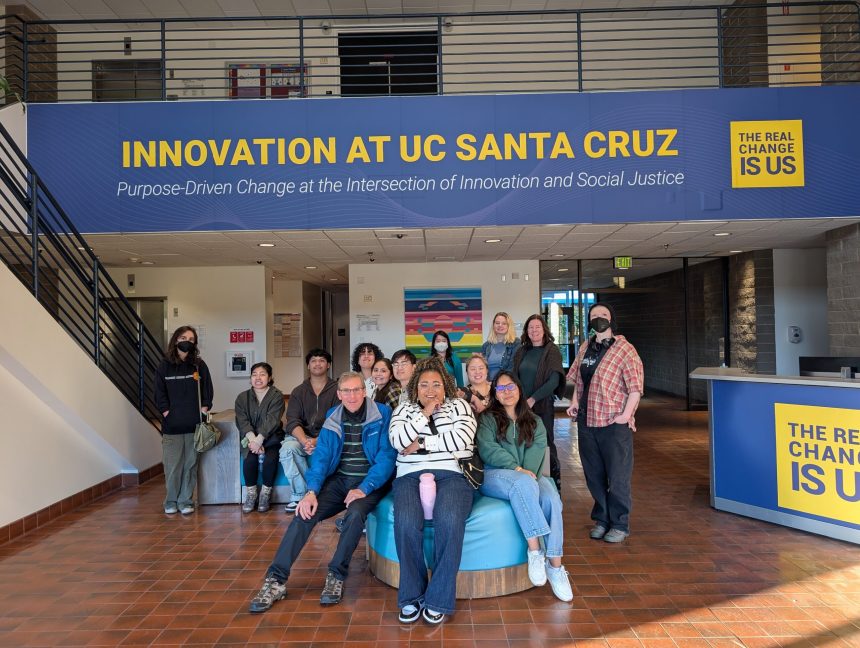
The Berkeley City College students also get the opportunity to visit the lab at UC Santa Cruz, which Yeh says is often a highlight of the course and a chance to reaffirm their interest in science.
Learning outcomes exceed expectations for Hispanic and first-gen students
To understand the impact of their learning platform on students, the Braingeneers team developed the Stem Cell Research Identity Scale, a survey designed to evaluate the extent to which students identify as scientists. The researchers created the survey in collaboration with UC Santa Cruz Associate Professor of Economics Kristian López Vargas to ensure they had a statistically rigorous way to understand how the lessons affect students, and break down effects on students of different ethnicities, genders, native languages, and parental education.
While they found their platform strengthens stem cell research identity overall, they found the most effect among Hispanic students and first-generation college students. They also found that having role models was particularly important for Hispanic students.
“That drives us to think about what we can do later on at the faculty level, because there are not a lot of Hispanics in the textbooks per se, so where can students get role models?” Mostajo-Radji said. “I think that’s something we should think about as a Hispanic-serving Institution: how can we diversify the faculty to affect the students’ learning.”
One such student that was positively impacted is Vladimir Luna-Gomez, who participated in the remote learning program when he was a student at Alisal High. He was inspired to apply to UC Santa Cruz and today is a third-year undergraduate student and published researcher with the Braingeneeners group.
Yeh also saw that role models at the UC Santa Cruz lab had a major impact on the range of community college students in her course.
“Students are very excited, because they see someone like themselves,” Yeh said. “The lab visit is toward the end of the class, and they go into a real lab and recognize a lot of things there, which builds up their confidence. And they all say that they have a lot of fun!”
Expanding education
After observing the positive impact their educational platform has on Hispanic students in California, the next step for the Braingeneers is to understand how it may affect Hispanic students in South America, who might have vastly different educational experiences.
“Now that we have a system that works and a way to evaluate different aspects of STEM identity in a way that can be rigorous, we can do the exact same intervention in different parts of the world, and look at how it affects populations differently,” Mostajo-Radji said. “Our final goal is to inform policy in a way that is relevant to the actual area—that’s important in Hispanic education especially, because the large majority of research on these populations is coming from the U.S., under the assumption that it’s applicable to all Hispanics.”
To do this, Vera-Choqqueccota is bringing the platform to schools in her home country of Peru. With the support of a UC Santa Cruz CITIRS grant, she has so far brought the lessons to two schools in Lima and two in the Peruvian highlands, two of which are all-girls schools.
“It was a super awesome experience. At the end of the class, they asked me how I managed to do my Ph.D. outside of the country, because for them, going to Lima is awesome but going outside of the country is something that some of them cannot imagine. It was touching for me to hear them say, ‘I really like what you’re doing, I would like to do the same thing when I am an adult.’”
The Braingeneers are also expanding to additional high schools in the state, with a continued analysis of how the educational program impacts these students. Teachers who are interested in this program can reach out to Mostajo-Radji (mmostajo@ucsc.edu) or Samira Vera-Choqqueccota (lveracho@ucsc.edu).