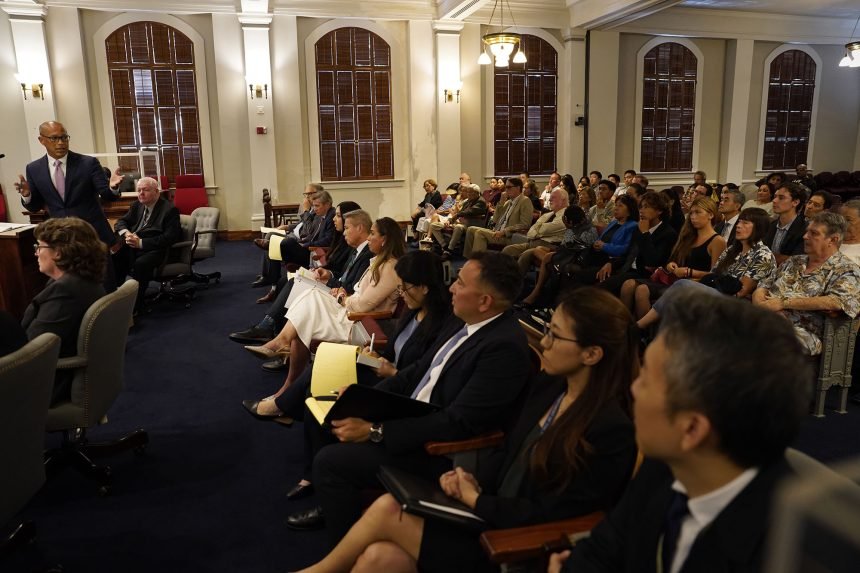
More than 8,000 East Honolulu residents voted for Honolulu City Council Chair Tommy Waters in the primary election only for their votes not to count. On Tuesday afternoon, the Hawaiʻi Supreme Court considered what to do now.
Waters was deemed ineligible to run after voting had already begun, throwing the race into a state of uncertainty. In oral arguments, the justices heard about whether Waters should be allowed to run for a third term after all and what to do about voters who have been disenfranchised.
“How can anybody think that’s OK?” attorney Tommy Otake, representing Waters’ supporters, asked the court. “This is a mess.”
In the August primary race to represent Waikīkī through Hawaiʻi Kai, Waters came in second to political foe Trevor Ozawa, but a state judge had declared Waters ineligible because he’d already served his maximum of two consecutive terms. Honolulu’s county clerk said he would follow the judge’s ruling and not allow Waters to advance. So the third-highest vote getter, first-time candidate Tara Malia Gregory, moved on to the general election.
Then, earlier this month, Waters asked the Supreme Court to put him back in the race.
The Supreme Court’s ruling, which is expected by Friday, will shape one of the hottest political contests of this election year and mark the third time the Supreme Court has had to weigh in on a battle between Waters and Ozawa for this particular council seat.
What exactly is the source of one of Hawaiʻi’s biggest political beefs, neither man will say.
“This was never personal,” Ozawa said after the hearing. “This was about making sure that the charter’s been upheld.”
Waters declined to comment.
The justices may choose from a few possible outcomes: Ozawa and Waters could face off in the general election. Or the current primary results could stand, with Ozawa facing Gregory. Or the primary could be conducted all over again — what Otake called a “do-over.”
That could be a headache for the city clerk’s team, Substitute Justice Peter Cahill joked in response.
In the courtroom, lawyers appearing before the justices repeatedly said the situation was unfortunate while also thanking the justices for their time and for expediting their decision on the case.
City lawyer Duane Pang, defending Acting City Clerk Chadd Kadota, said the city did the best it could to move forward based on the state court decision that deemed Waters ineligible.
“We really couldn’t wait – sorry – for this,” he said, referring to the Supreme Court proceedings.
In court, Gregory spoke up for her right to stay in the race, disputing the argument that Waters should advance with Ozawa to the general election.
“Votes cannot create legal eligibility where the charter does not provide it,” she said.
Debate Over What Constitutes A Term
The case hinges on the Honolulu city charter — essentially the local constitution — which national elections experts told Civil Beat earlier this year is ambiguous and therefore open to interpretation.
Waters joined the City Council after defeating Ozawa, then the incumbent, in an April 2019 special election. Waters said his first term should not count toward the City Charter’s limit of two consecutive four-year terms because he took office more than four months after the term officially started.
A judge didn’t buy that argument last month. Circuit Court Judge James Ashford ruled against Waters, saying the City Council only has two types of terms: regular terms and vacancy terms. Because Waters did not fill a vacancy term, Ashford said, his initial term counted as a regular term.

Ashford said a vacancy term is only triggered when a sitting council member vacates the seat.
“No one died, resigned or forfeited office in this particular case,” he said at last month’s hearing.
Ozawa’s lawyer, Deirdre Marie-Iha, said on Tuesday that Ashford made the right call. A four-year term commences on Jan. 2 whether or not someone is sworn in by then.
“Terms do not move,” she said during oral arguments. “What they’re talking about is Mr. Waters’ tenure in office – how long he served – not how long the term is.”
Justices Probe Attorneys
Waters’ lawyer Joseph Stewart pushed back on Ashford’s reasoning during Tuesday’s oral arguments. The City Charter doesn’t require a vacancy to arise because of any specific reason, he said, which means Waters’ first term could count as a vacancy term, leaving him eligible for a third term.
Associate Justice Lisa Ginoza was skeptical of Stewart’s argument.
Waters’ team cited three historical precedents they say are analogous to the council chair’s situation — each examples of council members serving partial terms after a prior member had left office or died and going on to serve additional full terms.
But Ginoza said Waters’ case is different from those. In each of the prior cases, somebody in office had vacated the seat and the successor was chosen by voters from a wide field of candidates.
In the case of the 2019 special election, the term was filled by essentially a re-do of the November 2018 election.
“It was only these two candidates again,” she said. “It wasn’t a full replay of an entire open seat.”
Acting Chief Justice Sabrina McKenna was more sympathetic to Waters. She said it appears the City Charter does not specify how vacancies need to occur, and that the charter’s language appeared to be ambiguous regarding how to handle this specific question of Waters’ eligibility. In such cases, the right thing to do may be to let voters decide.
“If there is an ambiguity as to a candidate’s eligibility,” McKenna said, “then that eligibility is to be construed in favor of allowing the person to run.”
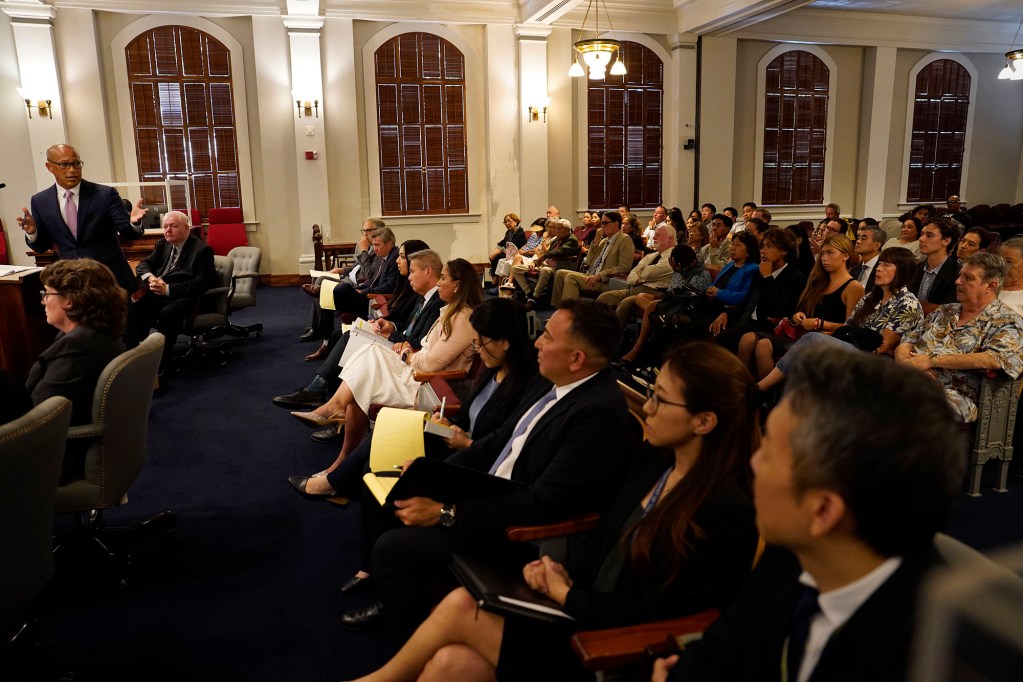
If Ozawa had won the April 2019 election, Substitute Justice Peter Kubota said, Waters’ logic would allow him to have served from 2015 through 2031 — a total of 16 consecutive years when the charter aims to limit members to eight.
“That is the result you wish us to reach?” Kubota asked Otake.
“Well, yes,” Otake said.
Otake said whatever implications stem from this, it’s up to the voters to decide whether to make the charter’s language more specific. He said terms of candidates elected before Jan. 2 should be considered four-year terms, and terms of candidates elected after Jan. 2 should be considered vacancy terms.
That, he said, is “the only way to do it without legislating from the bench and guessing what the specific intent was.”
Even before Tuesday’s hearing, the appeal kicked off a highly unusual scramble to assemble a panel that didn’t have a conflict of interest with either Waters or Ozawa, both of whom are lawyers themselves. Eight judges have recused themselves from the case, including new Supreme Court Chief Justice Vladimir Devens.
Devens served on the board of directors for a political action committee run by the carpenters union Pacific Resource Partnership, which has supported Waters via spending over $60,000 through a different super PAC this year.
In addition to Devens, Associate Justice Todd Eddins recused himself too, along with five out of seven Intermediate Court of Appeals judges. None gave a reason, and judiciary spokesman Brooks Baehr said on Wednesday judges are justices are not required to declare one. Three circuit court judges have been assigned to fill in for the case, replacing Devens and Eddins and covering for a vacancy on the Supreme Court.
The substitute justices are Cahill, Michael Soong and Kubota.
A group of 40 voters who favor Waters and live in his district filed their own case with the Supreme Court, which was also heard on Tuesday. Becky Gardner, one of the 40, said after Tuesday’s court proceedings that if Waters had been deemed ineligible earlier, more people might have run for the seat.
The fact that Ozawa challenged Waters’ eligibility after the candidate filing period closed meant Ozawa was the most prominent challenger and made it more likely for him to win his old seat back.
“The timing element, I think, just reflects bad faith,” Gardner said.
CORRECTION: An earlier version of this story misstated which justice brought up a hypothetical 16-year council tenure. It was Substitute Justice Peter Kubota.

Sign up for our FREE morning newsletter and face each day more informed.