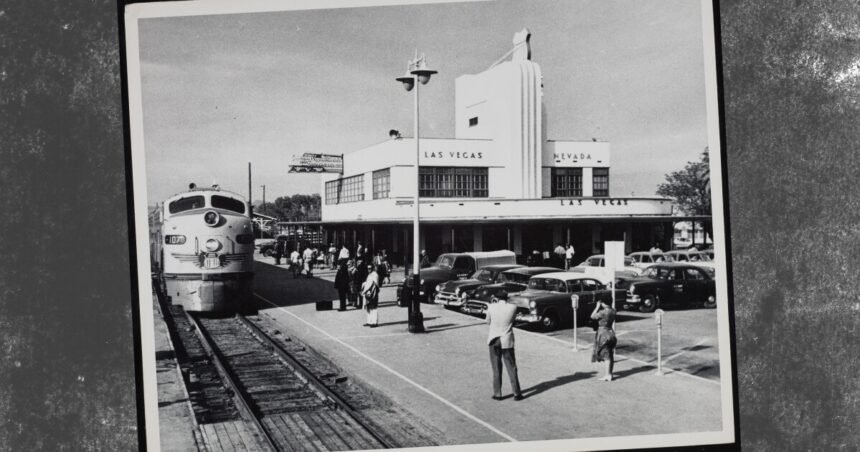
Real estate deals are a big part of every American city’s story, shaping their economies and character. In Las Vegas, they have done more than influence its history: The city we know simply would not exist without them. Here are seven that made a difference in a variety of ways.
FOUNDATION: Helen Stewart sells her ranch
In 1902, William Andrews Clark, a Montana copper mining mogul and U.S. senator, bought Helen Stewart’s ranch for $55,000. One of a handful of ranches in the area, it was the best situated for Clark’s purposes. He was building a railroad between Salt Lake City and Los Angeles and wanted Stewart’s 1,800-acre spread because of the plentiful artesian springs in the valley and timber in the nearby mountains. He planned to build a division point in what was already then called Las Vegas, with railroad shops and a town.
For Clark, one of America’s richest men, the purchase was important to his project but hardly momentous. Undoubtedly, neither he nor anyone else could have foreseen what this deal would set in motion.
BEGINNING: Railroad auctions townsite lots
After railroad service began in early 1905, Clark turned his attention to creating a town to support the railroad and its customers, who were flocking to Las Vegas from the bustling Goldfield, Tonopah, and Bullfrog mining camps to the north. The company platted a townsite of 1,200 lots on the east side of the tracks. The lots were advertised in Salt Lake and Los Angeles, and, after receiving considerable interest, the company held an auction for the most desirable parcels.
On May 15, 1905, hundreds of potential bidders descended on Las Vegas. On that first day, 176 lots were purchased for a total of $79,566. Many more were sold on the second day. The railroad netted $265,000 for the two days.
Tent structures went up immediately, soon followed by sturdier buildings. Las Vegas was born.
HOSPITALITY: Thomas Hull builds resort on Highway 91
The railroad remained the heart of the Las Vegas economy for more than 30 years. That changed in 1940, when local businessmen Robert Griffith and James Cashman persuaded California hotel developer Thomas Hull to build a resort in Las Vegas. At the time, Fremont Street featured several small casinos, but the community lacked a sprawling resort that could handle a higher volume and offer amenities that required space. Hull operated seven hotels in California, two of which offered luxury in an auto court setting — the perfect formula for Las Vegas.
Hull purchased 40-plus acres at the southwest corner of Highway 91 and San Francisco Avenue (now Sahara Avenue). The location irked some leaders because it was outside the city limits. But Hull wisely wanted to be on the highway leading into town, as well as beyond municipal regulations.
El Rancho Vegas opened on April 3, 1941, the first hotel-casino on what would become the Strip.
RESIDENTIAL: Howard Hughes acquires 25,000 acres west of Las Vegas
Howard Hughes, a frequent visitor to Las Vegas in the 1940s, moved here in 1953, leasing a small house just east of the Strip. During this period he engineered a massive land exchange, trading 73,000 acres he had accumulated in Northern Nevada for a 25,000-acre parcel west of Las Vegas. He wanted to move the Hughes Aircraft Company from Los Angeles to Las Vegas. Hughes Aircraft executives balked at relocating, but Hughes kept the land.
It lay dormant until the 1990s, when his heirs began to develop it into Summerlin. It was a shrewd move, yielding vast riches for Hughes’ heirs while providing Las Vegas with a middle-class wonderland of thoughtfully organized subdivisions, parks, schools, and shopping plazas. Today, Summerlin is home to more than 130,000 people and is still growing.
EDUCATION: Estelle Wilbourn donates land for university campus
In the 1950s, Las Vegans started thinking they would like to have a university of their own. For years, local kids seeking a college education had to travel to Reno or out of state. In 1955, plans for a campus in Las Vegas revolved around a generous offer from Estelle Wilbourn of Modesto, California.
Wilbourn had 80 acres along Maryland Parkway. She was willing to donate 60 of them for the campus if local officials came up with $35,000 for the rest. The Nevada Southern Campus Fund was created to raise money for the land as well as other necessities to start a campus. The fund raised $50,000, enough to buy the land, and to qualify for $200,000 in state funds.
In the 1960s, developers E. Parry Thomas and Jerry Mack created the Nevada Southern University Land Foundation, a land bank to buy properties to expand the campus; they acquired another 400 acres.
BUSINESS: Steve Wynn buys land in front of Caesars Palace
In the late 1960s, Howard Hughes purchased a narrow strip of land in front of Caesars Palace. The property was 100 feet wide and 1,500 feet deep. A few years later, a young entrepreneur named Steve Wynn approached Herb Nall, who handled real estate for Hughes, about buying it. Nall dismissed the idea, because, he said, Hughes “doesn’t sell, he buys.”
Undeterred, Wynn went to his mentor, Parry Thomas, who had a role in most of Hughes’ Las Vegas acquisitions. As Wynn tells it, after a couple of days he received a call from Nall telling him that Hughes would sell him the property for $1.1 million. Wynn had made his first big deal.
He announced plans to build a hotel-casino, The Godfather, on the tiny parcel. Caesars, naturally, did not want a competitor so close, so it bought the property from Wynn for $2.25 million. Wynn’s profit allowed him to take control of the Golden Nugget and eventually to build some of the Strip’s most iconic resorts.
FUTURE: City acquires Union Pacific rail yard
When Oscar Goodman became mayor in 1999, downtown redevelopment was his primary focus. Easily his biggest move occurred in 2000 when he executed a land exchange that turned over a large portion of the Union Pacific rail yard to the city.
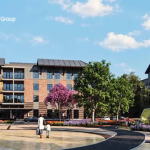
“Oscar’s 61 acres,” as the property was often described, has evolved into the city’s crown jewel, Symphony Park. Today, it’s home to The Smith Center for the Performing Arts, Discovery Children’s Museum, Cleveland Clinic Lou Ruvo Center for Brain Health, and more than 600 apartments. And the park’s not yet complete. A 400-room Marriott hotel is slated to open soon, and construction is underway on several high-rise condo towers. Eventually, the long-awaited Las Vegas Art Museum is expected to be built there.
It was only 120 years ago that Symphony Park was a patch of Mojave scrub selected by William Clark for a railroad depot between Los Angeles and Salt Lake.
Geoff Schumacher, vice president of exhibits and programs at The Mob Museum, is the author of Sun, Sin & Suburbia: The History of Modern Las Vegas.