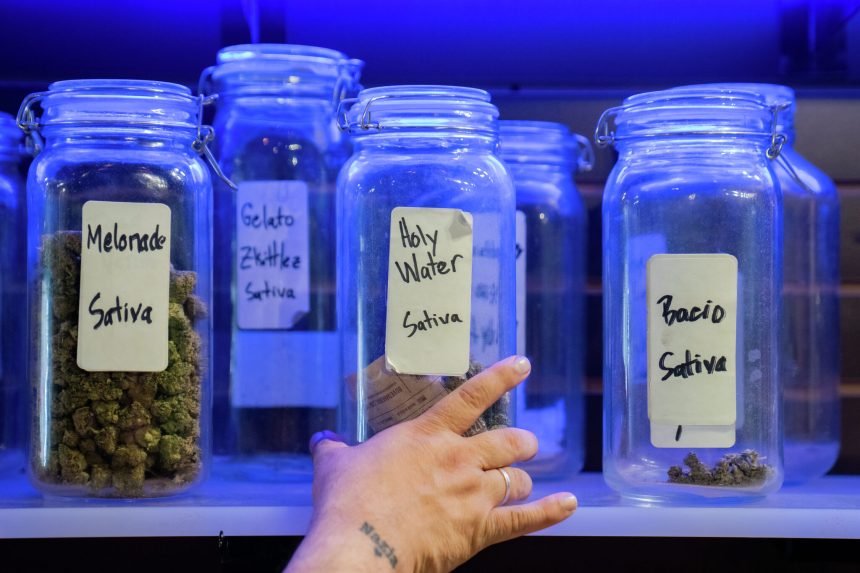
Kaab Malik, owner of iVape ATX, reaches for a strain of smokeable hemp at his shop on Guadalupe Street in Austin the day before new state rules went into effect on March 31. “This will destroy my business,” said Malik, who is not involved in the lawsuit seeking a restraining order on the law.
Mikala Compton/Austin American-Statesman
Saying a decision could exceed her authority, a judge has delayed ruling on a request by four Texas companies for a restraining order to keep the state from enforcing new rules on the sale of hemp-derived products.

State District Judge Maya Guerra Gamble said during an emergency hearing in Austin that she could not immediately decide whether the temporary restrictions would be appropriate given the technical nature of a consumable hemp market that already has been the subject of Texas Supreme Court rulings, state agency statements and law enforcement actions.
Article continues below this ad
“I don’t think a district court judge is allowed to do that,” she said Friday. “That sounds like I’m rulemaking. That’s my problem.”
The four companies that filed the suit — San Antonio, Dallas and Rio Grande Valley firms that produce, distribute and sell hemp products — said they are not trying to relitigate the law or earlier court decisions. Rather, they argue the state overstepped with rules that expanded the list of barred substances beyond what the Legislature intended.
Their suit comes after the state in late March began enforcing new rules that changed how delta-9 THC is measured in hemp products. The state separately classifies concentrated manufactured delta-8 THC as a Schedule I controlled substance.
The new schedule was challenged in court but eventually allowed by the Texas Supreme Court to go into effect July 31.
Article continues below this ad
The testing regimen and enforcement standard, the companies say, endanger their businesses.
“People are being raided on a regular basis, including in Dallas and San Antonio, based on the term ‘trace amounts’ and no one knows what trace amounts mean,” attorney David Sergi said during Friday’s hearing.
The confusion stems from the fact that while the state has barred delta-8 products, trace amounts of delta-8 occur naturally in other THC products that are still legal. The state says more than trace amounts of delta-8 THC can be considered illegal, and products and sellers can be referred to law enforcement.
Sergi’s clients argue the state should define “trace amounts” through the normal rulemaking process and that they should be allowed to sell their wares in the interim.
Article continues below this ad
The companies have said the new rules have caused layoffs, uncertainty about the legality of current stock and loss of sales. They also put at risk capital that was invested after state law legalized the products.
The state argued against any relief in the case and disputed that the request was an emergency.
“The timing of plaintiffs’ suit confirms the absence of urgency,” said James Rich, assistant attorney general.
The new schedule, or substance classification, was proposed in 2021 and went into effect July 31. The new rules went into effect in March. After months and years, he argued, there is no urgency, and seized items could be reclaimed through the courts after a ruling in the suit.
Article continues below this ad
An analysis by Whitney Economics estimated the new Texas rules could cost the industry $3.85 billion in lost revenue, 36,708 jobs and $1.44 billion in reduced wages.
Had the court issued the restraining order Friday, it could have spurred other companies to sue as state regulators seize products and refer individuals to law enforcement for criminal prosecution for stocking and selling items that were legal until a few months ago.
The plaintiffs in the Austin case are Dallas-based wholesaler SS Distro USA LLC; San Antonio-based Topps Distro, which operates 10 KingPin Kush stores across the state; Jason Moreno and his Webster-based store, My City Hemp; and Trevor Kocaoglan, a hemp cultivator and consultant in the Rio Grande Valley.
The plaintiffs filed suit in August alleging the state Department of State Health Services exceeded its authority by expanding the products considered illegal without legislative action or proper rulemaking.
Article continues below this ad
They also argued the new rules threaten to remove thousands of retail hemp registrants from the marketplace. That could create a monopoly in violation of the Texas Constitution for license holders in the Texas Compassionate Use Program, which sells edibles, gummies and other medical cannabis products. There are currently only three operational license holders for the program.
One Compassionate Use Program licensee sued multiple hemp businesses earlier this year over their products.
Other lawsuits challenge Texas hemp crackdown
The Austin lawsuit is one of at least four in state and federal courts against the crackdown.
Article continues below this ad
Boomtown Vapor, the Texas Hemp Business Council and Green Nation have filed separate Travis County suits challenging the health department’s new rules, including how it measures THC, fees and enforcement powers. In federal court, Monti Y. Garcia challenges the Schedule I classification of delta-8 and related products.
Guerra Gamble is expected to rule later.