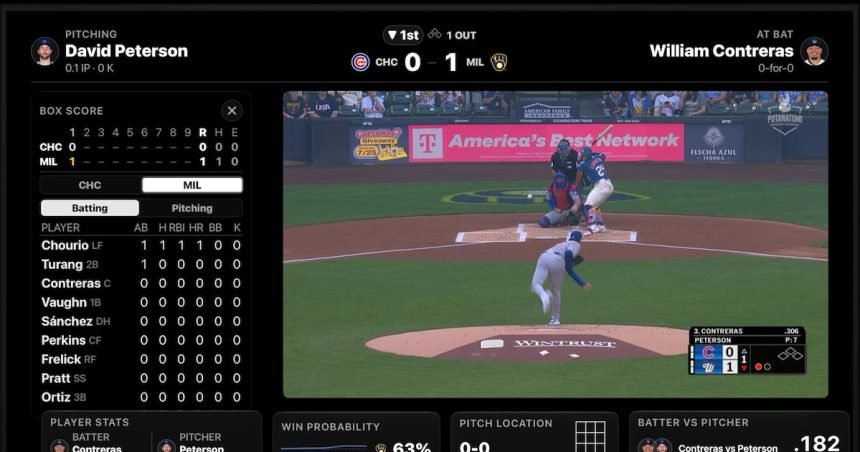
Just before Opening Day, baseball-loving technologist Jason Weingardt undertook an audacious side quest. He had long admired Major League Baseball’s flagship app but thought it had lost some of its innovative luster. Weingardt had been using AI in his day job and had ideas on how to infuse new features and maximize Apple iOS on multiple devices. He thought to himself, “Could I make the baseball app of my dreams?”
By drawing on public application programming interfaces (APIs) from the league and other sources, Weingradt built an app in TestFlight — Apple’s home for products still in beta — and shared his new creation, Mosaic, by posting on Threads and tagging #buildinpublic to solicit early adopter feedback. This was April 22, four weeks after the season started, with a closed pool of 100 test users gaining access.
The new app introduced mobile multiview (watching concurrent games isn’t available on smartphones via the MLB app) and enhanced lock-screen live activities, customizable interfaces and even an eye-tracking feature on iPad so audio plays for the split-screen game you’re actually watching. Integrations later followed to track your fantasy baseball roster and to stream highlights on an Apple Watch. Weingardt’s Threads post added the proviso, “I have no intention of widely distributing this.”
That very same day, MLB Executive Vice President Kenny Gersh received a Slack message from colleagues alerting him to Mosaic and asking if the league’s legal team should get involved. While of course not wanting just any developer to profit from baseball’s IP, Gersh appreciated that this was a controlled environment that required an MLB.tv subscription to access premium features, so he replied, “Not ideal, but it’s not a huge problem yet. Maybe we’ll hire.”
Earlier in August, less than four months later, Gersh’s Slack message proved prophetic: MLB hired Weingardt full time as principal product manager. He’ll keep developing Mosaic to nimbly test new ideas for possible implementation for the main app.
“He’s a unique talent that did something very, very cool that not only caught my attention, but caught my attention in a way that I wanted to make sure it was nurtured and had a chance to flourish,” Gersh said. “Without being too hyperbolic about it, it’s an exceptional app.”
Gersh cautioned that, as promising as some features of Mosaic are, it is more of a “rough draft of an app” than a ready-to-ship product. It hasn’t been pressure-tested by a wide audience, for example, but could influence next year’s app updates. One area it has already had an in-season influence is in how MLB enables fans to track games through live activities — previously limited to a user’s designated favorite team, now it can track any game.
Mosaic will remain in TestFlight, at least for the foreseeable future. Weingardt admitted that it was initially “terrifying” to hear from MLB — early on, he posted on Threads, “If you like it, tell your friends (just not if your friend is Rob Manfred)” — but the tenor of the league’s conversations was curiosity, not confrontation. Gersh showed the app to his boss, Deputy Commissioner Noah Garden, who in turn shared it with Manfred. Much to Weingardt’s relief, both were supportive.
“It’s a dream opportunity, point blank,” said Weingardt, whose prior work included stints at Postmates and real estate tech firm Qualia. “I was interested in learning about how they operate the MLB app at scale. That is a very hard thing to do, and we all take that for granted.”
As for the name Mosaic, it’s a nod to an old MLB product from 20 years ago, when fans could stream multiple games through a desktop app. The limit then was six games. The new Mosaic doubles that.

Outsiders become insiders
The promise of Mosaic is the latest chapter in MLB’s recent history of embracing external innovation. Cutting-edge analysis has long been done outside the league or team office — dozens of writers from sites such as Baseball Prospectus and FanGraphs have been hired by clubs.
A notable example from a decade ago was the league’s hiring of Daren Willman in 2016 after he built Baseball Savant. His easily searchable and delightfully visualized repository of advanced data was brought under the MLB digital umbrella. Willman stayed five years, left to take a job with the Texas Rangers in 2021 and then returned last December as MLB’s senior director of digital innovation.
“Our product team is excellent and develops products at scale that are best-in-class and battle-tested, but we also are always on the hunt for talented, smart people that we think can augment our team,” Gersh said, adding, “It was in our interest as a league, Jason’s interest as a person and most importantly, our fans’ interest, to see how we could bring this to a broader audience — or at least portions of it — in a controlled way.”
Gersh noted that part of the appeal of Weingardt’s work with Mosaic was the community he cultivated on Threads, which was responsive to his updates. Not every feature has been successful, and baseball fans, especially those sitting at a keyboard, are not a shy bunch by nature.
Weingardt said he’s trying to learn from the way Willman’s team created narratives around data, balancing content for casual and hardcore fans. “There’s this fine line that you have to traverse of being approachable but allowing people to be curious and learn about a game they think they know really well,” Weingardt said.
Joe Lemire can be reached at jlemire@sportsbusinessjournal.com.