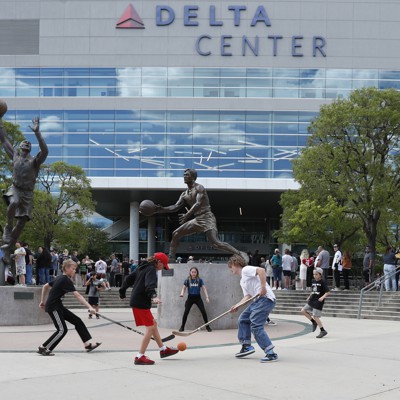
On June 11, the Salt Lake City Council held the latest in a series of public hearings about a proposed 0.5% sales tax increase within the boundaries of the city. The proceeds are intended to raise about $54 million a year to subsidize the financing of a major reconfiguring of the Delta Center. Currently home to the NBA’s Utah Jazz, the center needs substantive updates to accommodate a new hockey team next year. The NHL approved the sale of the Arizona Coyotes to the owner of the Jazz and tech billionaire Ryan Smith in early April. The money will also be used to help build housing, restaurants and other amenities in the area. A final vote will take place this summer.
Despite decades of research that show pro sports franchises often don’t boost local economies as much as promised, proponents of the deal still argue it will be a boon to downtown Salt Lake City, particularly in revitalizing several distressed neighborhoods.
But what makes this deal different from all the other stadium financing deals passed this year and in years past is that about 75% of the new revenues would go directly into the hands of a private sector entity, the Smith Entertainment Group.
Broad support for this economic development deal has emerged from elected officials at the state and local levels. In fact, it wouldn’t be possible without the support of the state legislature and Gov. Spencer Cox, who signed a bill in March that permits the city council to increase the sales tax.
The deal, though, has its opponents, who have cited several concerns. The main one is a lack of government oversight of taxpayer money and how it will be used by a private entity. At a city council meeting on May 21, one attendee commented, “Based on public comments by the mayor and members of the city council, it looks like adoption of the zone and the related sales tax increase is a done deal. We all know at this point who will benefit from this action. It certainly won’t be the residents of Salt Lake City, who will be required to invest in development concepts about which they know very little…”
Several opponents of the deal have complained that too few details have been made clear as the city council has considered its stance on the issue. Said one state government insider, “The lack of transparency has been appalling. There’s a website that has a flashy computer-generated image of the district, but no information about the cost or the timeline. It’s all fluff to generate excitement and emotion.”
Other observers simply believe the deal is not good tax policy. According to David Brunori, senior director at RSM US LLP, a tax consulting firm, “They’re imposing a tax to support a private enterprise, and you have to ask yourself whether this is what taxes are supposed to do. People think they’re paying taxes to support police, fire, sanitation and transportation—things that everyone can use. But while the fans will get a nice stadium, and it’s an enhancement for the economy near the stadium where hotels and restaurants will be built, if you’re on the other side of Salt Lake City, I don’t know how much you are going to benefit. The real beneficiaries are going to be the owners of the sports franchises.”
As some critics of the plan have pointed out, sales taxes are regressive and typically place a heavier burden on lower-income individuals as opposed to wealthier people.
That said, the sales tax increase is almost certain to pass. Leaders of both parties in the state—including Democrats who have leadership positions in the city and Republicans who control the state legislature and governorship—are in favor of the deal.
And taxpayers generally don’t seem overly concerned about it, according to Rusty Cannon, president of the Utah Taxpayers Association. “We’re always confused as to why taxpayers in Salt Lake City seem to be quite OK with nearly any tax increase proposal.”
Localities in Utah already have a number of small, designated sales taxes in addition to the ones levied by the state. Salt Lake City, for example, has a 0.5% sales tax for a correctional facility. Add in the 0.5% for the stadium, and Salt Lake City’s overall sales tax would go to 8.25%, which would be the highest of any large city in the state.
John Valentine, chairman of the Utah Tax Commission, has publicly expressed fears that ultimately this aggregation of taxes for specific projects is going to have a negative effect on Utah’s overall tax base, leaving the state and its localities in trouble when it comes to paying for basic services. “Some of the projects that we’ve passed in the state are eroding the tax base by sales tax diversions and tax increment financing,” he said in an interview with FOX 13 News.
Valentine indicated that if the state and its localities continue to go down this road, he “would be concerned that the government can’t do the functions that they’re required to do without raising the taxes because they’re diverting the taxes for other things.”
It’s difficult to ignore the fact that the city and county aren’t yielding their typical oversight of the use of tax revenues. As the Utah government insider told us, “There won’t be an open procurement process. There won’t be an open meeting on how the money is spent. There won’t be records access. And that’s a problem.”
What’s more, the Smith Entertainment Group has a fair amount of leverage. “They are under no obligation to keep the Utah Jazz in Salt Lake City and owner Ryan Smith has said publicly that he’s looking at other locations for his basketball team if things don’t work out in Salt Lake City” explains Phil Dean, chief economist at the Kem C. Gardner Policy Institute at the University of Utah.
This is classic Negotiating 101. While there’s no reason to doubt that Smith has a sincere dedication to the future of downtown Salt Lake City, there’s no question that having other places interested in the Utah Jazz and a new hockey team gives him a strong hand to play as he’s been working through the details of the plan.
There’s a great deal more complexity here. But it seems highly likely that the sales tax increase will be a reality before long, and the ramifications—good or bad—remain to be seen.