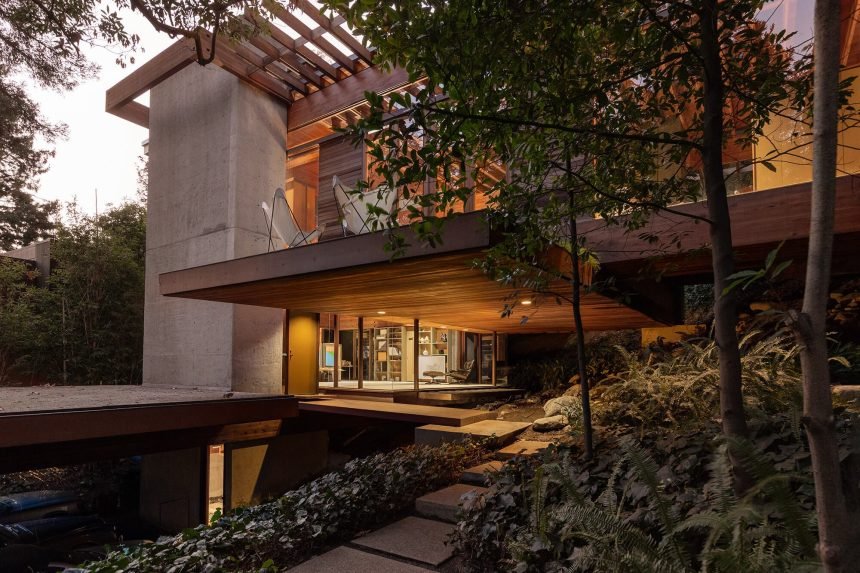
The house Ray Kappe designed for himself and his family is for sale $11.5 million. Kappe, a renowned midcentury architect in Los Angeles, was also a cofounder of the Southern California Institute of Architecture (SCI-Arc).
Kappe purchased the property where the 4,157-square-foot (5-bedroom, 5-bathroom) Pacific Palisades house is sited in 1962. The house was constructed over a span of two years, from 1965 to 1967. The residence was designated a Los Angeles Historic-Cultural Monument in 1996. Beyond a family residence, the house was an office and creative studio for Kappe, and even before it was built it was grounds for exploring spatial concepts and connection to site, informing much of Kappe’s extensive oeuvre for years to come. He has designed other homes in the neighborhood.
Ray Kappe died in 2019. Shelly Kappe, his wife, died in March 2025. Shelly was architectural historian with a trove of knowledge and insight on residential architecture in Los Angeles. Alongside her husband she was a founding member of SCI-Arc.

In 2011, for AN, Sam Lubell asked what Kappe what his house said about him:
I don’t know, you’d think I was an egomaniac! I can still sit here and look and be happy with it. It just evolved in a rather natural way. The heights weren’t pre-determined. I like the varying heights and shapes and sizes. As you draw the plan you’re walking through the whole process in your head of what’s going on. It’s a function of how I was taught to design. You start to think of space and dimensions, and what it looks like on the outside is from what those decisions are. I never designed from models. I made models for clients, but I didn’t design from them. Today people design from computer modeling. So the ones that design that way are still thinking about what it looks like externally, usually fitting the internal parts in some way or another.
Kappe sat for an oral history in 1995. The tapes, of which there are 17, chronicle his life, starting at the beginning, growing up in Minneapolis and visiting the Walker Art Center. They go on to detail other aspects of his career such as founding SCI-Arc, prominent projects, and discussion of his own residence.

The house was a place to live, but also a place for design exploration. Kappe credited a few concepts he had been ruminating with in past projects as guiding the spilt-level’s design such as: commandeering hillside sites, Louis Khan’s philosophy that “service elements” be one with the building, and the idea of control. From these Kappe executed a layout and massing that occupies a property with challenging topography and geology, as a stream runs down the slope.


Within the residence, Kappe’s ideas about modular design manifests as a collage of boxes and overlapping rectangular volumes. The house has a strong connection with its verdant landscape; elements like cantilevers, wood paneling, skylights, and spans of glazing contribute to that cause. Kappe’s ideas about space are revealed in the nooks, tiering, and shelving units layered throughout the interiors. The architect designed several of the furnishings too.
Kappe spoke about the relationship between architecture and photography: “In most of my cases people always make the statement that the house is so much better than the photograph, rather than the other way around. There is something about the way I work that seems to decompose the volume in a way that the photograph never truly tells the story of the feeling of the experience.”

His house was captured on screen in a short film by Matthew Donaldson as part of the In Residence series by Nowness.
Rustic Canyon sits on the edge of the Pacific Palisades neighborhood. Last year’s fires came close to entering the canyon, and a handful of houses in the neighborhood burned. The Eames House is nearby. The area sports a variety of architect-designed homes, including ones by Pierre Koenig, Marmol Radziner, Chu Gooding, and others. Richard Neutra’s 1938 Leon Barsha Residence, relocated to save it from freeway expansion in Hollywood, occupies the corner of Mesa Road and West Channel Road, while Johnston Marklee’s Hill House is set atop the western ridge.

Kappe’s home is listed by the Santa Monica–based Berkshire Hathaway Home Services agent Ian Brooks, who often sells high-profile architectural homes. He has been an “avid subscriber and fan of [AN] for years,” he wrote via email.
The home joins Koenig’s Stahl House as a piece of midcentury architecture history that is now on the market.