



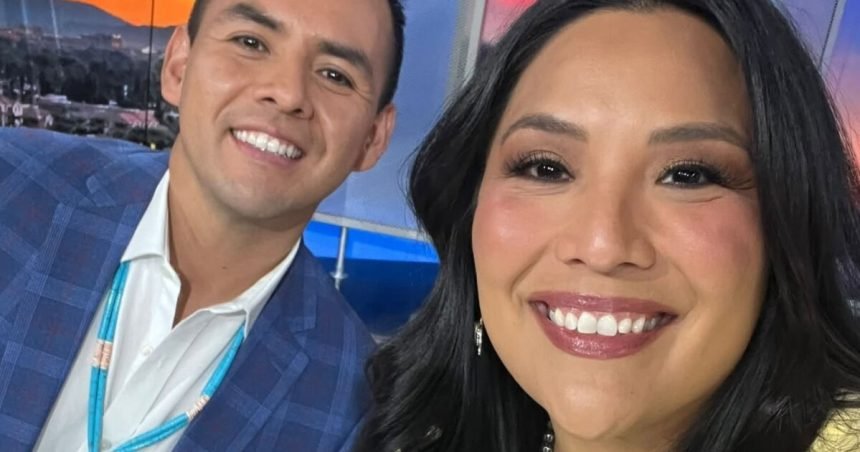
Native Americans make up just over 1% of the nation’s population. And when it comes to TV news broadcasts, their representation is even smaller. But for one early-morning weekday program in Arizona, it’s the dawn of a brand new day.
Early risers tuning into “Good Morning Arizona” simulcast on KTVK and KPHO might just catch a language that’s foreign to most ears: Diné. From hearing full-on sentences to simple phrases, the Navajo language is very much alive on Valley airwaves.
Words like yáʼátʼééh, which is a Diné greeting literally translating to “it is good,” and ahéhee’— or thank you in English — are being regularly uttered by Navajo co-anchors Charly Edsitty and Colton Shone.
Together, they have formed what Arizona’s Family is branding as the nation’s first all-Native American anchor team. The Navajo duo, reading off teleprompters from behind their Phoenix news desk, debuted last month on Oct. 19. Since then, they’ve also been busy out in the field — even recently taking the live show on the road in the aftermath of historic flooding across the sprawling Navajo Nation.
Born in Farmington, New Mexico, and raised in Glendale, Arizona, Edsitty has long considered the Valley metro her home. The Baylor University graduate began her reporting career in Phoenix but left for Houston.
She told KJZZ that returning to the Valley from Texas was tough. But the chance to team up with Shone, a lifelong Phoenician and Arizona State University graduate, and make history convinced Edsitty to make the move.
“I mean, this is home for me,” said Edsitty. “This is where all my family lives, this is where I grew up. So that part of it was easy, but the hard part was packing up my life over in Houston that I had made for myself for eight years, and that was difficult.”
“When I got the call from our news director saying that, ‘Hey, heads up, Charly’s going to be a new co-anchor,’ I was super excited,” added Shone. “I was thrilled. It’s hard work to climb up the ladder in television news. I mean, it’s really hard.”
Especially if you’re a Native American.
Trailblazing Hopi broadcaster Patty Talahongva began her journalism career behind the scenes at Flagstaff station KOAI-TV in 1979. Originally from the First Mesa village of Sichomovi in northern Arizona, she worked her way to the very Valley station that now employs Edsitty and Shone.
“Literally there were no role models, no Native Americans working on air, nobody that I knew who worked behind the scenes. There were no Native voices at the table,” said Talahongva. “And so to be that one Native voice trying to explain whatever the news story of the day was and how it impacts Indian Country, that was a huge responsibility, and I did the best I could.”

TV news has long struggled with diversity.
Between 1995 and 2020, Native Americans made up less than 1% of the total news staff among approximately 1,900 television stations surveyed by Syracuse University and the Radio Television Digital News Association.
“And still true to this day,” according to Keren Henderson, an associate professor of broadcast and digital journalism at Newhouse School of Public Communications who also serves as director of the survey.
“So if we don’t see, at best, a percent of the newsroom being Indigenous workers, the chances of somebody being an impactful decision maker in a newsroom is incredibly slim if the odds are stacked so heavily against you,” she continued.
Syracuse University has been compiling data for more than half a century. The latest industry figures reveal TV newsrooms across the country remain predominantly white — with more than three-fourths of employees still identifying as Caucasian.
But Talahongva, a past president of the Indigenous Journalists Association, argues the Shone-Edsitty team is an encouraging sign for young viewers — however they consume the news. “They’re going to be able to watch them anchor, and that’s the new normal. And I love that,” she said.
Other Natives who rose to prominence on screen in Arizona include the late Diné journalist Andy Harvey and San Carlos Apache Mary Kim Titla, who is credited as the Grand Canyon State’s first Native American TV reporter after breaking through to living rooms in 1987.
It’s a distinction celebrated by Titla’s alma mater, the Walter Cronkite School of Journalism and Mass Communication at ASU, when she was inducted into the school’s hall of fame two decades ago.

Edsitty remembers watching Talahongva, Harvey and Titla while growing up. “Seeing them on my TV screen showed me that there is a place for me in this industry, too, and it’s hard to believe that if you don’t see it,” she explained.
Now, she wants to inspire the next generation. “So I really hope that there are kids out there who are able to see Colton and I and will think to themselves, ‘Man, I want to do that someday,’” said Edsitty.
Shone believes it sends a simple message to viewers Valleywide and beyond.
“Two Indigenous faces every morning to know that, yes, we’re still here, and we’re not just relics of the past,” Shone elaborated. “We are modern Native American people, right? Living our lives, living our culture and being Indigenous.”
And maybe cracking a couple of unscripted Native jokes, added Edsitty. “You never know what you’re going to get on ‘Good Morning Arizona’, so you have to tune in to find out.”