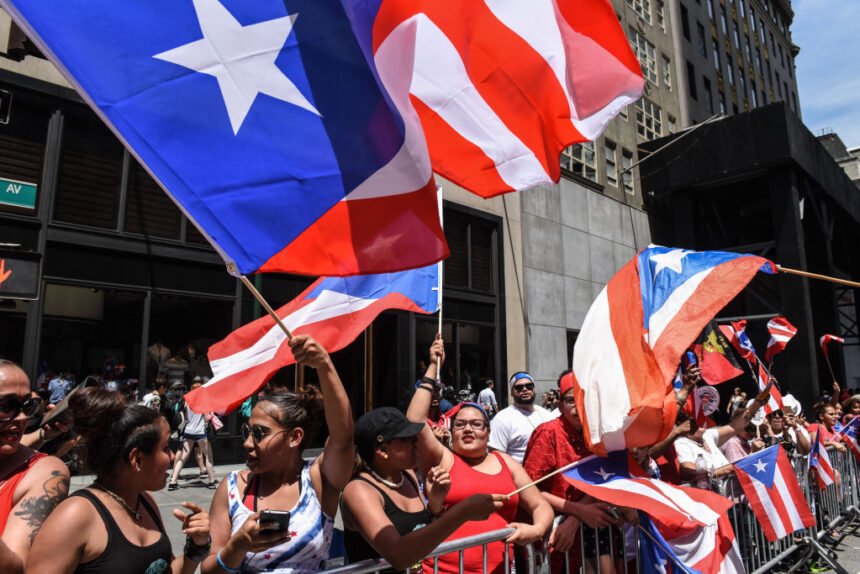
People participate in a Puerto Rican Day parade in New York City. Multiracial cultures such as Puerto Rican and Dominican may pose problems for new proposed Census Bureau survey formats that ask about race and Hispanic status separately. (Stephanie Keith/Getty Images)
The U.S. Census Bureau and a growing number of states are starting to gather more detailed information about Americans’ race and ethnicity, a change some advocates of the process say will allow people to choose identities that more closely reflect how they see themselves.
Crunching and sorting through those specific details — known as data disaggregation — will help illuminate disparities in areas such as housing and health outcomes that could be hidden within large racial and ethnic categories. But some experts say the details also might make it harder for Black people from multiracial countries to identify themselves.
Racial data gleaned from the census is important because local, state, tribal and federal governments use it to guide certain civil rights policies and “in planning and funding government programs that provide funds or services for specific groups,” according to the Census Bureau.
The form will have checkboxes for main categories — current census groupings include “Asian,” “Black,” “African American” and “White,” among others — followed by more specific checkboxes. Under Asian, for example, might be Chinese, Asian Indian, Filipino, Vietnamese, Korean or Japanese. And then there will be an empty box for people to write in more specific subgroups.
Collecting more detail by allowing free-form answers, for example, will make it possible for people to identify themselves as part of more racial and ethnic subgroups — such as “Sardinian” (an autonomous region within Italy) instead of simply “Italian” — and include alternative names for certain groups, such as writing “Schitsu’umsh,” the ancient language for “Coeur D’Alene Tribe.”
And the Census Bureau will for the first time include Middle Eastern/North African as a separate racial/ethnic category for respondents with that heritage. Until now, Middle Eastern people who did not choose a race were treated as a subcategory under “white,” based on a 1944 court ruling intended to protect Arab immigrants from racist laws banning U.S. citizenship for nonwhite immigrants.
Under new federal guidelines approved in March, the bureau also will give people the option to check no race at all if they identify as Hispanic or Middle Eastern/North African.
The Census Bureau already has decided to use more open-ended questions in both the 2027 American Community Survey and the nation’s 2030 census. But the agency is seeking public comment on the way write-in responses will be categorized.
The bureau wants to hear how people are likely to identify themselves, said Merarys Ríos-Vargas, chief of the bureau’s Ethnicity and Ancestry Branch, Population Division, in a recent webinar. The agency also is interested in whether there are missing or incorrect entries in its proposed list of possible responses.
‘It’s about people’s lives’
Nancy López, a University of New Mexico sociology professor, said she and other experts in Black Hispanic culture think the census should have a “visual race” or “street race” question, so people can communicate how others see them as well as how they identify themselves. The answer might be “Black” or a yet-unrecognized racial category such as “brown.”
“A separate question on race as a visual status helps illuminate the kind of things we are interested in — discrimination in housing, discrimination in employment, discrimination in education and accessing health care in public spaces,” said López, who is the daughter of Dominican immigrants and a co-founder of the university’s Institute for the Study of “Race” & Social Justice.
“It’s about people’s lives, it’s about the future, it’s about children, it’s about access to opportunities and it’s about fairness,” she added, noting that even if the federal government doesn’t add such questions to surveys and the decennial census, state and universities can still do it on their own as they collect data for health care, student enrollment and other topics.
The NALEO Educational Fund, an organization representing Latino elected and appointed officials, supports the decision to make a race choice optional for Hispanics.
“Many Latinos did not see themselves in any of the categories for their racial identity,” said Rosalind Gold, NALEO’s chief public policy officer. “There’s a large number of Latinos who feel that identifying as Latino is both their racial and ethnic identity.”
Gold said NALEO understands the concern some have that failing to require a race designation will obscure racial information on Black Hispanics. But her group argues that the census can get what it needs by educating the public on how to respond and by including prompts on the questionnaires to guide race choices.
Black Hispanic people often see themselves as having a single racial and ethnic identity, according to several experts in Hispanic identity who spoke at a Census Bureau National Advisory Committee meeting Nov. 7.
“They conceptualize themselves as belonging to one [group],” said Nicholas Vargas, an associate professor of ethnic studies at the University of California, Berkeley, speaking at the committee meeting.
“They check ‘Black’ and they check ‘Dominican’ — and don’t want to be counted as two or more,” he said.
In response, Rachel Marks, an adviser for the Census Bureau on race and ethnicity, said the bureau will consider that issue and other “feedback on how people want to be represented” before making a final decision on survey details.
It’s about people’s lives, it’s about the future, it’s about children, it’s about access to opportunities and it’s about fairness.
– Nancy López, University of New Mexico sociology professor
The bureau may recognize a term, Afro-Latino, that could be used to indicate both Black race and Hispanic ethnicity, according to a proposed code list from the agency, as well as “Blaxican” for Black Mexican and “Blasian“ for Black Asian.
The Leadership Conference on Civil and Human Rights, a coalition of civil rights groups, called the more detailed questions “a step forward” but also suggested more guidance on the forms to ensure people are categorized the way they want to be. In its comment on the changes, the group noted that in 2020, some people who wrote in “British” under the Black checkbox were categorized as partly white even if they didn’t mean that.
The group also said it is “concerned about a conflation of the concepts of race and ethnicity,” and it asked for more research to make sure people understand how to respond.
State actions
Some states are acting on their own to gather more detailed data about identity.
New Jersey is among the latest states to pass a law requiring more detailed race and ethnic data collection for state records such as health data and school enrollment.
A similar bill in Michigan would require state agencies that gather information to offer “multiracial” and “Middle Eastern or North African” as choices; the bill remains in committee.
And advocates in Oregon, which already has a law requiring detailed ethnic data collection, are asking the state for more details on Asian subgroups who face education challenges.
A December 2023 report by The Leadership Conference Education Fund identified 13 other states with laws requiring more detailed state data on ethnic and racial groups, including laws passed last year in Hawaii, Illinois, Massachusetts and Nevada.
The states of California, Connecticut, Minnesota, New Mexico, New York, Oklahoma, Oregon, Rhode Island and Washington already had such laws, the group found.
Stateline is part of States Newsroom, a nonprofit news network supported by grants and a coalition of donors as a 501c(3) public charity. Stateline maintains editorial independence. Contact Editor Scott S. Greenberger for questions: info@stateline.org. Follow Stateline on Facebook and X.