Voters across Florida might just say yes to a statewide ballot referendum that could save them thousands in property taxes.
And that’s why cities all over the Sunshine State, including Fort Lauderdale and Boca Raton, are prepping now for what could be coming.
If at least 60% of voters approve Amendment 3 on Nov. 3, municipalities across the state stand to lose millions in property tax revenue.
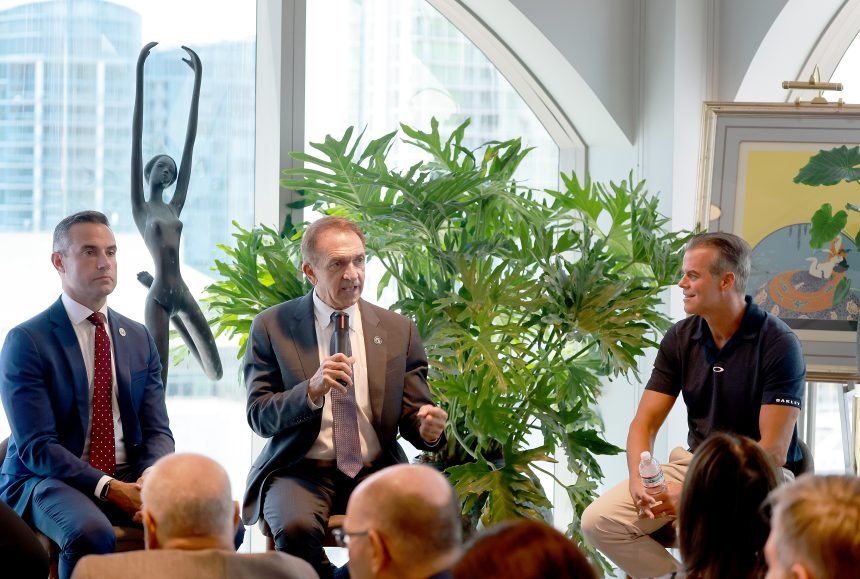
That topic was center stage Wednesday at the Tower Club in downtown Fort Lauderdale, where a group of business leaders gathered to hear a panel of experts discuss what the impact might be should the constitutional amendment pass.
The discussion, part of the Tower Club’s “From the Headlines to the High-rise” signature speaker series, was led by Fort Lauderdale Mayor Dean Trantalis, Boca Raton Mayor Andy Thomson and Broward County Property Appraiser Marty Kiar.
Amendment 3 would increase the current $50,000 homestead exemption to $150,000 in 2027 and $250,000 in 2028. In subsequent years, the homestead exemption would rise with inflation. The increased homestead exemption would not impact property taxes collected by school districts.
Gov. Ron DeSantis has pushed the proposal, arguing that local governments should rein in spending to provide relief to property owners forced to shoulder rising property tax bills.
Trantalis said he agrees the homestead exemption needs a reset, but argued that tripling it to $150,000 right off the bat could have a catastrophic impact on local governments across the state.
In Fort Lauderdale, property taxes fund 45% of the city’s day-to-day operations, Trantalis told the crowd of more than 40 business leaders, attorneys and real estate agents.
More than half of Fort Lauderdale’s budget — 62% — pays for police and fire service, Trantalis added.
“We’re going to have to make some tough choices (if this passes),” Trantalis said. “If you’re receiving less income, you can’t spend as much as you have in the past.”
Fort Lauderdale would lose $17 million in property taxes the first year and up to $27 million the second year, Trantalis said.
“That’s a lot of money and it’s going to affect a lot of things,” Trantalis said. “Does it mean we reduce the hours of our parks? Or reduce them altogether and close them down? Do we defund our police? Do we defund the fire department?”
In Florida, only about 25 cents of every property tax dollar goes to cities. The rest goes to other taxing authorities, including counties, school districts, public hospitals and other special districts.
Fort Lauderdale has one of the lowest tax rates in South Florida, Trantalis noted.
Property owners in Fort Lauderdale pay a base tax rate of $412 for every $100,000 in assessed property value.
If the city were to raise the tax rate — something it has not done in 20 years — non-homesteaded properties would take the hit and rents would likely increase, Trantalis said.
People with second homes would also end up paying more, he added.
“If you raise their taxes, what is going to happen to the real estate market?” he asked. “What’s going to happen when their taxes go up? These are the kinds of things we need to consider when trying to understand the consequences of an amendment like this.”

Kiar talked numbers, sharing the impact on both property owners and local governments in Broward County.
Kiar’s analysis applied the constitutional amendments as if they were in effect for the 2025 tax year.
In Broward, the average savings for homesteaded properties with an assessed value of more than $150,000 would come to $1,325 in the first year, Kiar told the crowd.
In the second year, the average savings for homesteaded properties with an assessed value of more than $250,000 would come to $2,661.
Broward County stands to lose $195 million in the first year, or 10.8% of its property revenues, Kiar said. In the second year, the losses would increase to $333.8 million, or 18.5%.
If Amendment 3 passes, Boca Raton would lose close to $8 million in property tax revenue in the first year, Thomson told the room.
“That’s significant, but it wouldn’t be cataclysmic,” he said.
In the second year, Boca Raton would take a bigger hit, losing nearly $17 million.
Boca Raton is already looking into how to address the potential drop in property tax revenues, Thomson said.
“We have looked at all of our departments with the expectation that if you give people the option of reducing their taxes, they’re going to vote for it,” he said. “It’s one of those things that kind of sells itself. Folks want to reduce their taxes. I get that.”

Boca Raton already has a low tax rate, Thomson said.
Property owners there pay $366 for every $100,000 in assessed property value.
“We will have to make tough decisions if it passes in order to make sure that we are living within our means,” Thomson said of Amendment 3.
Property taxes fund 55% of Boca Raton’s day-to-day operations, Thomson said.
To keep providing the same level of service to residents, the city will likely have to find other ways to bring in revenue, including increasing the municipal tax rate, Thomson said.
“That’s one option,” Thomson said. “And I’m really not inclined to do that. If we increase the tax rate, that will also fall on the non-homestead properties. Businesses would end up paying more. Renters would pay more.”
But cities like Boca Raton that have a significant number of commercial properties are better off than bedroom communities, Thomson noted.
“Cities like Boca can withstand this,” he said.
But some cities are considered primarily “bedroom communities,” meaning their residential properties far outnumber commercial properties, which generally have a higher market value and pay more in property taxes.
Those so-called bedroom communities are going to have difficult decisions to make, Thomson said.
“They’re going to have to decide, how many layoffs are we going to have to have?” he said. “What days are our libraries going to have to close? What hours are our parks going to be open?”
At the moment, Boca Raton does not recoup 100% of what it costs to keep parks open and other city services running.
That might need to change if Amendment 3 passes, Thomson said.
“Can we do it? Yes,” he said. “Do we want to do it? We will if we have to.”
Tax cuts may seem like a good thing, but they do come with consequences, Thomson said.
“You want to go ahead and vote for this recognizing what the consequences are, eyes wide open? That’s a perfectly valid thing,” he said. “But don’t do it simply because (you think) taxes are bad and local government is wasteful. Those kinds of assumptions may not even necessarily be true.”
Susannah Bryan can be reached at sbryan@sunsentinel.com. Follow me on X @Susannah_Bryan