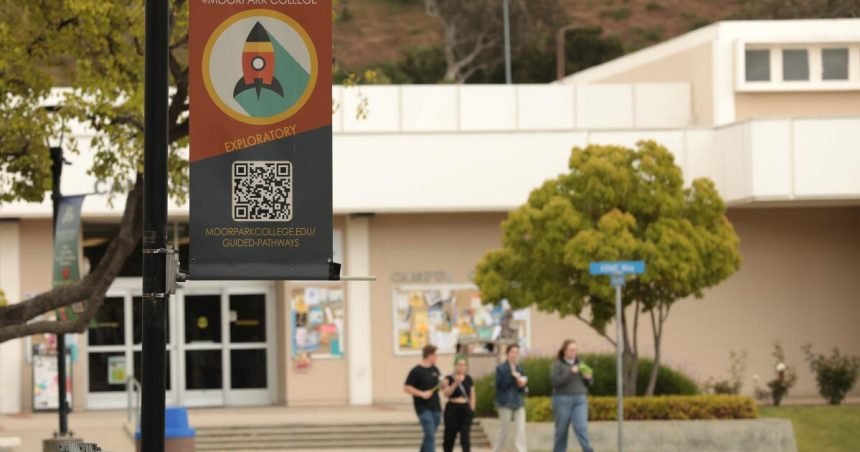
Moorpark College ended a program offering for Latino students pursuing a science degree.
Cal State Bakersfield, for the first time in years, won’t hold a multiday orientation ahead of the fall term for community college transfer students.
And the Central Valley’s West Hills Community College District this year terminated two initiatives to deliver education to adults without a high school diploma.
Across California, colleges and universities are cutting and closing down programs and services previously funded by federal grants for Hispanic-Serving Institutions, commonly called HSIs. Those were among the first higher-education grants to be axed since Trump took office last year after the administration declared those programs discriminatory and refused to fund them.
Earlier this year, some colleges were hopeful that new grant money would become available, after the federal budget maintained funding for the programs that support HSIs and other Minority Serving-Institutions, said Marybeth Gasman, executive director of the Rutgers Center for Minority Serving Institutions.
But optimism dissipated in recent months, and many colleges have been forced to eliminate or scale back programming as students return to campuses for the new academic year.
Even though funding was included in the budget deal, the grant program is discretionary. That means it’s up to the Trump administration to decide whether to allocate new grants, and the Department of Education has made no indication that it plans to do so.
Congress created the HSI designation in 1992 to expand access to higher education for Latino students, and the first grants were allocated in 1995. Supporters say the grants have benefited colleges with high numbers of low-income and Latino students, funding programs such as dual enrollment, counseling services and initiatives to expand access to STEM fields.
To be eligible for the HSI designation, a college must have an undergraduate enrollment of 25% Latino students. Once designated a Hispanic-Serving Institution, colleges historically have been able to apply for Title III and Title V federal grants.
California has 167 HSIs, by far the most of any state. The cuts in particular affect the state’s community colleges, where 107 of 116 campuses are HSIs, and California State University, where 21 of 22 campuses are HSIs. Within the last year, community colleges have lost at least $20 million and CSU campuses an estimated $43 million from the grant cuts.
Nationally, colleges and universities lost $507.9 million in HSI funding, according to Gasman’s center.
“I think people did have hope that possibly something would be done, and then the money would kind of come back, but we really haven’t seen that yet,” Gasman said.
Supporting low-income, Latino students
Carlos Pineda, 63, emigrated from El Salvador to California in 1990 and enrolled at Santa Monica College, where he found it difficult to navigate college. He ended up enrolling in classes he didn’t need, including a chemistry course, wasting his time and money.
“As an immigrant, you don’t quite understand how to navigate the college system. There are many terms, many protocols, procedures that a regular student from high school might find easy,” he said.
Pineda didn’t finish his degree at Santa Monica. He eventually moved to Simi Valley and gave college another try in fall 2023, when he enrolled as a part-time student at Moorpark College in Ventura County.
This time, Pineda’s experience was much different, which he credits to his participation in STEM Impacto. That program, funded by an HSI grant, assisted low-income or Latino students interested in a degree in biotechnology, biology or computer network systems engineering.
Through the program, he met with a peer mentor and had immediate access to counselors, who helped Pineda enroll in the right classes. He also received a $750 stipend each semester, which Pineda typically used to pay for gasoline to commute to campus.
Pineda is on track to finish his associate degree this semester, but he’ll have to do it without the support of the Impacto program, which ended in the spring because its grant expired.
About 60 students participated in the program in any given year, and they had higher retention and graduation rates than their peers, said Julius Sokenu, president of Moorpark College.
“We were hoping we could apply for another grant and continue all the wonderful things that we’ve been able to do, but it is no longer available to us,” Sokenu said.
‘The hammer came down’
For the past three years, students transferring to Cal State Bakersfield benefited from an extended orientation in August. Students participating in the three- to five-day program got an in-depth tour of the campus, met with student support staff and faculty, and took an accelerated writing course to meet a general education requirement. The program was open to all transfer students, not just Latinos.
The program was useful to Darci Ross-Smith, who transferred from Bakersfield College in 2024. Ross-Smith was home-schooled through high school and said the program was a “good bridge for me to understand” how to navigate a university.
Ross-Smith, an English major, also benefited from meeting with English department faculty during the orientation, developing a close relationship with the department chair. They eventually worked together on a research project that Ross-Smith presented at a CSU symposium.
“It felt like I started almost a semester ahead,” said Ross-Smith, who is now pursuing a master’s degree in library and information science at San José State.
The program was scheduled to host another incoming class of transfer students with an orientation this month, but the HSI grant supporting it was abruptly canceled, said Kris Grappendorf, faculty director of academic systems and director of the transfer program.
“We were getting really good feedback and figuring out the right programming, and then the hammer came down, and that was really disappointing,” she said.
Keeping some programs afloat
Not every program in the state funded by an HSI grant has been forced to shut down. Some colleges and districts have found other ways to fund their programs, at least in the short term.
The San Diego Community College District, for example, reallocated money from elsewhere in its budget to continue three initiatives, previously funded by HSI and MSI grants, supporting STEM students and students who are Asian American, Native American or Pacific Islander.
Whether those programs continue in the long term could depend on whether the state provides additional support, said Greg Smith, chancellor of the district.
Smith noted that this year’s state budget deal already included $147 million for a student support block grant, divided among the state’s community colleges. Those dollars can be used at each district’s discretion.
Chris Ferguson, executive vice chancellor of finance and strategic initiatives for California Community Colleges, said several colleges that lost HSI grants have been able to find funding to maintain their programs.
He acknowledged, however, that the state chancellor’s office hasn’t done a full accounting and said he has “no doubt that there are districts that have opted to make different decisions, just based upon their risk tolerance or their resource levels.”
Burke is a reporter for EdSource, a nonprofit, nonpartisan journalism organization covering education in California.