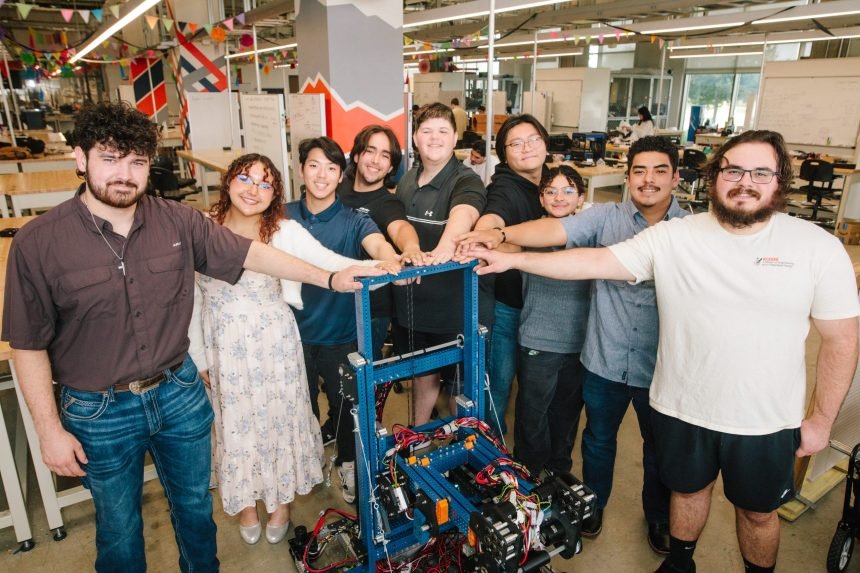
Team 210 Robotics, the all-freshmen team out of the University of Texas at San Antonio that became the sole U.S. finalist in a world-wide engineering competition, has been named the winner of the 2026 Siemens Immersive Design Competition.
“We are very grateful to the university. They had a watch party for us during the presentation and I thought that was amazing,” said team lead Israel Elizondo. “We had overwhelming support.”
The 210 Team, composed of eight multidisciplinary first-year students and a student ambassador, had been named one of three finalists in the immersive-engineering challenge sponsored by Siemens and Sony in April, alongside a team from México and one from the UK.
On Thursday, they presented their design before a panel of executive Siemens judges.
Their creation, RoboRowdy, is an autonomous robot designed for small and medium-sized 3D print farms to automate the process of part removal, build-plate cleaning and print restarts to increase efficiency and minimize errors.
Nine months of preparation, design and development, had to be boiled down into an 8-minute presentation to the judges who would select one winning team. So a few weeks before the final, the team locked in to practice and had the help of university leadership to do so.
University leadership including UT San Antonio President Taylor Eighmy, College of Engineering Dean Eric Brey, Director of Communications Katrina Kehoe, as well as Jeff Clarke, vice chairman and chief operating officer for Dell Technologies, were among those who answered the team’s call for help and jumped on multiple virtual meetings with them to hear their presentation and provide feedback.
“What this freshmen team has accomplished is incredible,” Brey said in a statement. “By offering them the environment, infrastructure and connections, we wanted to support a path for them to move forward independently and successfully. Seeing them grow with this project and inevitably win first place is an inspiration for us and future students.”
The team earned a Sony XR headset for their university, as well as licensing for Siemens’ Designcenter X, a computer-aided design software, for up to 200 students. But beyond these prizes, team members said they’ve earned the knowledge and confidence to amplify their college experience.
“I know it sounds corny, but it genuinely makes me believe the impossible is possible,” said Gray Samaniego, a first-year business major.
The San Antonio Report partners with Open Campus on higher education coverage.