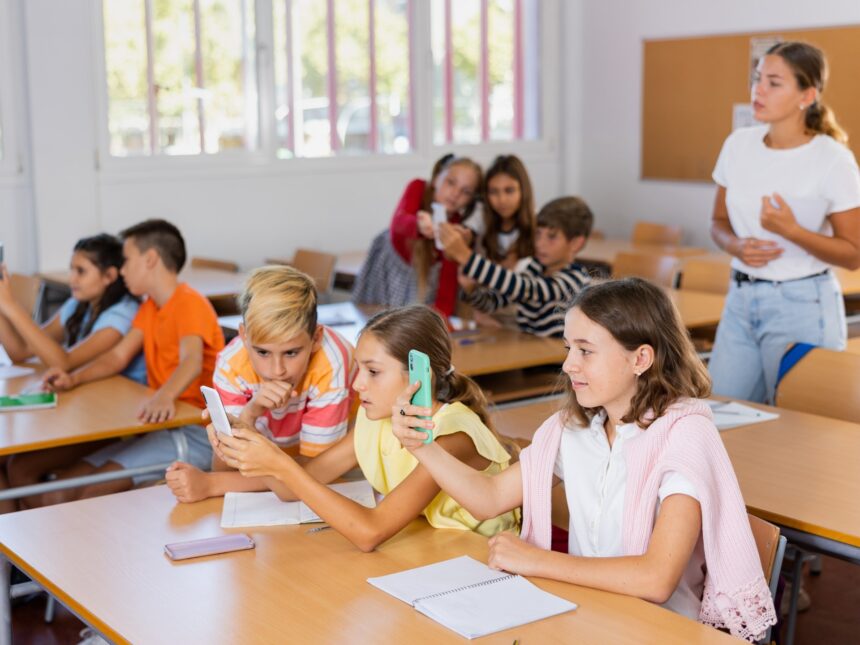
Los Angeles has joined a growing list of United States school districts, states and cities restricting the use of smartphones in public schools amid a debate over the effects of social media and technology on children and young people.
Last month, the Los Angeles Unified School District Board, which is responsible for about 1,000 schools, approved a resolution to develop a policy to ban student use of cellphones and social media platforms within 120 days. The policy itself would not be implemented until 2025, however. California passed legislation in 2019 that allows school districts to restrict smartphone usage during school hours with the exception of emergencies.
“When children and teens are in school, they should be focused on their studies, not their screens,” California Governor Gavin Newsom said on June 19.
Last week, US Surgeon General Dr Vivek Murthy called for warning labels to be added to social media platforms, similar to the health warnings that appear on tobacco and alcohol products.
“Social media is associated with significant mental health harms for adolescents. A surgeon general’s warning label, which requires congressional action, would regularly remind parents and adolescents that social media has not been proved safe,” Murthy wrote in The New York Times.
Where else have smartphones been banned in US schools?
The states of Ohio, Indiana, Oklahoma and Florida have already imposed statewide restrictions on the use of smartphones in public schools.
The Indiana Senate Bill 185, which bans students from using a device during school teaching hours, was signed into law by Governor Eric Holcomb in March and took effect on July 1.
Last month, Governor Mike DeWine of Ohio signed House Bill 250, requiring school districts to limit smartphone use in classrooms to reduce distractions. The bill leaves it up to local school administrators to create their own smartphone bans. Exceptions will be made for health or medical emergencies.
“By limiting these distractions, we will reestablish the opportunity for students across Ohio to immerse themselves in their classwork, learn from their teachers, and create lifelong memories with their closest friends,” DeWine said in a statement.
In February, the Oklahoma Senate Appropriations Committee also decided to impose a ban restricting the use of smartphones in schools. Under Senate Bill 1314, students are banned from using smartphones while on public school campuses.
“Being normal kids, like kids were prior to social media, is important. The social media (causes) more problems than it solves, and I think it causes more harm than good,” Florida Governor Ron DeSantis said in May last year after passing a law banning smartphones and other wireless devices in schools during teaching hours. Similar to the Ohio smartphone ban, local school districts can decide how they want to implement it.
“So, let’s have our education system be as much about traditional education as we can,” DeSantis stated at the time. The Florida law also blocks students’ access to Wi-Fi and requires that social media literacy be taught in schools.
Although there is no statewide ban in Michigan, some school districts have prohibited smartphone use in schools. In January, the Flint Board of Education implemented a phone ban in school buildings and on school buses.
Last month, New York State Governor Kathy Hochul said she intends to pursue a statewide ban on phones in schools from 2025 to protect young people’s mental health. New York City previously imposed a ban but dropped it in 2015, leaving it up to schools to decide for themselves.
In a recent interview with a local news station, David Banks, the chancellor of New York City Public Schools, stated: “They’re not just a distraction, kids are fully addicted now to phones … We’re going to ban the use of phones in schools.”
Why are smartphones in schools a problem?
Nearly three-quarters of US high school teachers say smartphones are a major distraction in the classroom, according to a Pew Research poll conducted last November.
“High school teachers are especially likely to see cellphones as problematic. About seven in 10 (72 percent) say that students being distracted by cellphones is a major problem in their classroom, compared with 33 percent of middle school teachers and six percent of elementary school teachers,” the Pew survey reported.
“If you talk to safety experts, they will tell you that it’s actually better for the kid if they are not all on their cellphones,” said Oklahoma State Representative Chad Caldwell, the sponsor of that state’s bill banning smartphones in school in February this year.
“One, they are quieter, but number two they can pay attention to the teacher or adult in the room to help give them directions.”
New York Governor Kathy Hochul said in an interview with The Guardian last month: “I have seen these addictive algorithms pull in young people, literally capture them and make them prisoners in a space where they are cut off from human connection, social interaction and normal classroom activity.”
What do experts on children’s mental health say?
Some experts have noted that the growth in popularity of smartphones in the early 2010s was the inflection point at which administrators and health experts started to see a difference in the mental health of young people.
“We’re trying to explain why in many countries between the years of 2010 and 2015, there was a sudden and sharp drop in a bunch of different measures of wellbeing and mental health among adolescents, and in particular adolescent girls,” Zach Rausch, associate research scientist at the NYU-Stern School of Business, told Al Jazeera.
“But what we’re trying to show is that the primary driver of the sudden change that happened during that period, we think, is tied to the rapid movement of social life among teenagers onto smartphones and social media.”
“To the teachers and administrators I spoke with, this wasn’t merely a coincidence. They saw clear links between rising phone addiction and declining mental health, to say nothing of declining academic performance,” Haidt, has written on his Substack, After Babel.
“A common theme in my conversations with them was: We all hate the phones. Keeping students off of them during class was a constant struggle. Getting students’ attention was harder because they seemed permanently distracted and congenitally distractible.”
Does banning smartphones in schools work?
Little research has been done on this and many experts argue that the data is inconclusive on the impact of these bans.
Marilyn Campbell, professor of early childhood and inclusive education in the Faculty of Education at Queensland University of Technology, and Elizabeth Edwards, associate professor in education at the University of Queensland, Australia, carried out a “scoping review” of published and unpublished global evidence for and against banning mobile phones in schools. The findings were published in March.
A scoping review is carried out on a topic for which there are not many studies. The review covered 1,317 articles and reports including dissertations from masters and PhD students, written between 2007 when the smartphone was first introduced, until May 2023.
In addition, they identified 22 studies that examined schools before and after phone bans. The studies covered schools in Bermuda, China, the Czech Republic, Ghana, Malawi, Norway, South Africa, Spain, Sweden, Thailand, the United Kingdom and the United States.
From their initial research, Campbell and Edwards said they found only weak evidence for the benefits of banning smartphones in school.
However, Policy Exchange, a British educational think tank, published a study in May – The Case for a Smartphone Ban in Schools – that it said “shows a clear correlation between an effective phone ban and better school performance”.
Rausch said: “Anecdotally, from the schools that we know that have gone phone-free – sometimes it’s hard initially, the first week or so, partly because it’s like cutting off your caffeine habit. You’re going to be pretty miserable for a little bit. But then as time goes on, kids start to focus more in class.
“We’ve never met a school that has gone phone-free and has regretted that decision.”
So, is it a good idea to ban phones in schools?
Opinions on how to address the impact of smartphones and social media vary considerably. Some oppose an outright ban on using smartphones in schools, saying removing critical communication devices from schools will not address the root of the problem.
“I don’t think bans solve the thing that we’re trying to solve, which is trying to get our kids to understand when it’s appropriate to use phones and when it’s not,” Keri Rodrigues, president of the US-based National Parents Union, told Al Jazeera.
However, Daisy Greenwell, co-founder of Smartphone Free Childhood in the United Kingdom, a parent-led organisation that focuses on the responsible use of smartphones with children, said she backs curbs on smartphone use.
“We feel like childhood is being colonised by Big Tech in a way that we’ve not, as a society, spoken about with each other enough,” Greenwell told Al Jazeera. “Teachers are telling us the biggest problems that they face in school come from the smartphones and the social side and social problems that it causes amongst the pupils.”
Some argue that banning smartphones in schools can mitigate distractions and enhance focus, but it may also deprive students of valuable learning resources and essential communication tools.
“School’s the same for 120 years, where kids go nine to three, have long holidays, sit at desks and have to regurgitate what the adults tell them to learn, basically all over the world. We’re blaming kids for falling academic standards, we’re blaming the rise in mental ill health, we’re blaming the rise of cyberbullying. Oh, well, it all must be the fault of the mobile phone,” Marilyn Campbell told Al Jazeera.
“I mean, what a simplistic view of how we are educating our children in a different world and taking away that main tool that we’re all using in society and saying, ‘No, the kids can’t have it now’.”
A balanced approach, involving regulated use and clear guidelines, may be the most effective way to harness the benefits of smartphones while minimising their drawbacks, experts say.
The general recommendation of Campbell and Edwards, who carried out the scoping review in Australia, was to leave it to individual schools to determine smartphone use and to focus on helping children to use smartphones positively.