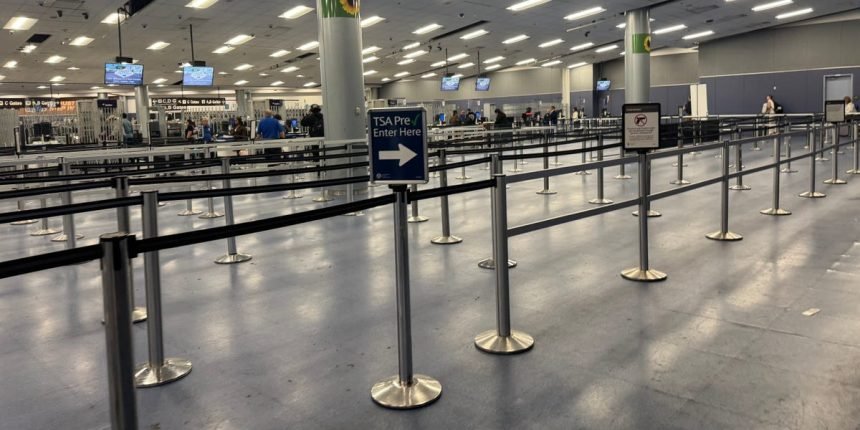
Atlanta TSA officer Aaron Barker knows that for travelers, the length of an airport security line can feel like a roll of the dice.
As the partial government shutdown drags on, however, a few key factors influence why the officer callout rate at Houston’s Hobby is 40%, for example, while operations at smaller airports remain business as usual.
“Daycare fees, the cost of gas, and things like that are different in different parts of the country,” Barker, an American Federation of Government Employees local president, said at the union’s press conference on Tuesday. The TSA officer callout rate at his airport is one of the highest in the country at 37%. “Most officers cannot afford to live in Atlanta,” he said, “so they’re living an hour, sometimes an hour-and-a-half away from work and need to commute. That’s probably why you may see a big difference in larger airports.”
The TSA told Business Insider that the average national callout rate reached nearly 12% on Monday, March 23.
“More than 450 TSA officers quit and thousands have called out sick from work because they are not able to afford gas, childcare, food, or rent,” according to Lauren Bis, the acting assistant secretary for public affairs at the Department of Homeland Security. The Trump administration has deployed Immigration and Customs Agents to “help bolster TSA efforts,” though the workers’ union says these ICE officers are “untrained” and should not replace TSA.
Business Insider dove into why staffing shortages and wait times vary widely between airports — and what travelers can expect going forward.
Burnout is big at major airports
Major US airports — like Chicago O’Hare, Phoenix, Pittsburgh, and New York-JFK — are seeing notably higher staff callouts than smaller airports. TSA officers (TSOs) received their first $0 paycheck in mid-March after DHS funding lapsed on February 14 and they started working without pay. This means bank accounts are stretched especially thin for staff living in higher cost-of-living cities. Workers are more likely to call out if they can’t afford childcare or transportation to and from work.
Speaking on behalf of the union, TSA officers at various locations said staff at smaller airports have received more donations — both monetary and food — to supplement their paychecks because the communities in rural areas tend to know local workers personally.
They said travel volume plays a role, too. Major airports service larger planes and significantly more people on a daily basis. Some of these airports may also serve as hubs for major airlines, meaning they handle many connecting flights in addition to direct traffic. For example, Delta in Atlanta, JetBlue at New York’s JFK, and United at Houston’s IAH. All of these airports are seeing officer callout rates over 30%.
“Larger hub airports are feeling the pressure more acutely because they have constant, steady streams of passengers, with rarely any lulls where the security line empties out the way you might see at a small regional airport,” Sally French, co-host of NerdWallet’s “Smart Travel” podcast, told Business Insider. “When you’re understaffed at a major hub, a long line only gets longer because there’s never that natural break in passenger flow that allows things to catch up. It’s a compounding problem.”
In addition, the partial shutdown is happening at a busy time of year for air travel. Many big-city airports are busy because of spring breakers; the US Travel Association estimated a record 171 million people will fly in the US in March and April. Travelers should expect longer lines on peak days, such as Sunday.
Airport policies are having an impact
Beyond travel volume, security wait times may also be shaped by individual airport policies.
Some airports, like San Francisco International and Orlando Sanford International, use private contractors instead of TSA screeners, which airports say helps ease wait times.
Other airports have a big share of workers living paycheck to paycheck who might lean on temporary, more predictable sources of income to make ends meet until their TSA paychecks resume.
“We’re seeing reports of food drives at airports for these employees, some of whom are supplementing their income by driving for rideshare services, picking up retail shifts or doing gig work,” French said.
Union leaders said that airport management varies in how they handle furloughs, PTO, and time-off policies. TSA workers are legally required to work without pay during a shutdown, and some employees feel their job security or chance at backpay is under greater threat if they call out because of their specific location.
“I know some airports in my region who are applying it in the most extreme measure, so that across the board, everybody has to follow the same strictest part of the policy in order to get time off during this, whereas some other airports follow the minimum portion of that policy,” said Duncan McGuire, another TSA worker in Portland and a union vice president for several western states.
He added that some TSOs are nearing retirement and that their benefits, earned over decades of service, are so good that there is no reason to quit during the shutdown to try to start over somewhere new.
Until TSA workers are back on payroll, French said travelers can continue to expect hourslong security lines. Next week, many employees will receive their April rent, childcare, and car invoices, which could prompt more workers to call off work. Union leaders said many workers have already quit.
It’s bad news for travelers and for airlines’ bottom line, French said, because “the travel industry thrives on consumer confidence, and right now, that confidence seems to be shaky.”
Carlos Rodriguez, a TSO and a union leader in the northeast, said he and his colleagues are doing their best to keep America moving.
“I love my city, I love my country, but most importantly, I love the great men and women of TSA who I serve with every day, fulfilling our oath to protect people and freedom of movement and commerce,” he said. “But it’s really difficult to do that when we don’t know who’s protecting us.”