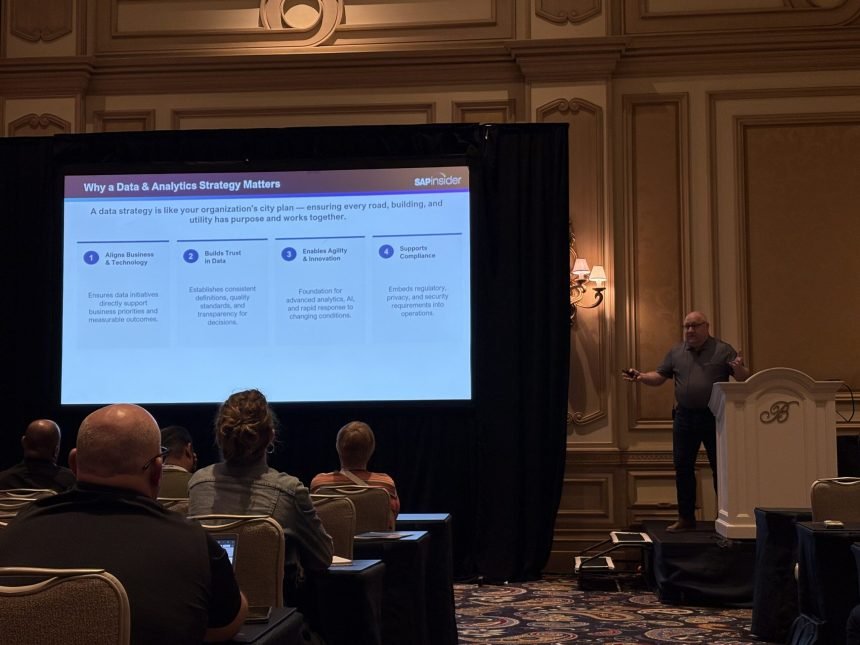
At SAPinsider Las Vegas 2026, Ingo Hilgefort, Senior Director for SAP Business Data Cloud at SimpleFi Solutions, made a direct case for why many data and analytics initiatives fail: organizations attempt to scale analytics and AI without first establishing trust in their data.
“If your data contains multiple definitions of what a customer is or what profit means, AI is not going to fix that,” Hilgefort said. “It’s going to make wrong decisions.”
That lack of trust continues to shape how users interact with analytics. Hilgefort described a common pattern in enterprises where business users recreate dashboards themselves, not out of preference, but skepticism.
“They want to double-check the numbers,” he said. “They don’t trust what’s already been built.”
The implication is clear: without a strong data foundation, analytics adoption stalls, and AI initiatives risk amplifying inconsistencies rather than resolving them.
Start With Business Outcomes, Not Technology
A central theme of Hilgefort’s session was that data strategy must begin with a clearly defined business purpose.
“This is not the point to talk architecture,” he said. “This is why we’re here. Are we trying to increase revenue? Reduce cost? What is the business reason?”
Hilgefort emphasized that organizations often fall into the trap of building strategies around tools rather than outcomes. References to platforms such as SAP Datasphere, SAP BTP, or AI agents should come later, he said.
“You cannot tie your data and analytics strategy to something that is not clearly articulated as part of your corporate goals,” he said.
Without that alignment, organizations struggle to secure executive sponsorship, funding, and long-term commitment.
Seven Core Elements of a Data and Analytics Strategy
Hilgefort outlined seven key areas organizations should address when building a data and analytics strategy, starting with executive alignment.
“Crucial is executive sponsorship,” he said. “If leadership is not aligned, this is not going to work.”
He pointed to real-world scenarios where misalignment between CIOs and CFOs stalled progress entirely.
Beyond sponsorship, the framework starts with a vision tied to business outcomes and clearly defined success metrics that are continuously measured, he added. It also includes governance, ownership, and data policies to ensure accountability. Organizations must assess their current-state architecture and plan for integration across multiple systems and vendors. In addition, they need to define data movement and performance expectations, while prioritizing analytics use cases based on cost versus benefit, Hilgefort explained.
He stressed that governance is not a compliance exercise, but a trust mechanism.
“Define who owns the data, who owns quality, who defines policies,” he said. “That’s where the trust comes into the picture.”
Trust, Semantics, and the Limits of AI
Hilgefort also highlighted the importance of consistent definitions and semantics.
Even basic inconsistencies, such as multiple labels for the same metric or entity, can undermine analytics and AI outcomes, he said.
“If you throw ten different names for the same item, it doesn’t understand that,” he explained.
This becomes especially critical as organizations move toward AI-driven decision-making. Without standardized definitions for key metrics like profit or customer, AI models operate on flawed inputs.
The result is not just inaccurate reporting, but potentially flawed business decisions at scale.
From Strategy to Execution: Prioritization and Quick Wins
Hilgefort emphasized that execution, not strategy design, is where many organizations fall short.
Rather than building long-term plans that take years to materialize, he advised organizations to focus on short-term, high-impact initiatives.
“What is your plan for the first 30, 60, 90 days?” he said.
He recommended identifying a small number of use cases that can deliver measurable value quickly, rather than attempting large-scale transformations all at once.
“If you cannot show progress, you might lose budget,” he said.
This approach not only builds momentum but also helps secure continued executive support.
A Practical Framework: The One-Slide Canvas
To operationalize strategy development, Hilgefort advocated for a simplified “canvas” approach.
“You get one slide,” he said. “It forces you to prioritize.”
The canvas includes:
- Vision
- Current state assessment
- Required capabilities
- Use case prioritization
- Execution roadmap
By constraining the strategy to a single page, organizations are forced to clarify priorities and align stakeholders.
“That becomes a powerful communication tool,” he said.
Measuring Success and Revisiting Strategy
Hilgefort also addressed how organizations should measure and refine their strategy over time.
He recommended revisiting progress at least once or twice per quarter, evaluating both execution and business outcomes.
“Are we still on track to deliver? Are we hitting our business goals?” he said.
Even when initiatives are delivered as planned, they may not produce the expected value, making continuous adjustment critical.
The Reality Check: Most Organizations Are Still in Reporting
Despite widespread discussion around AI, Hilgefort challenged the audience to assess their current maturity.
When asked how many organizations actively use predictive analytics, few hands were raised.
“In other words, you’re still doing reporting,” he said. “You’re reporting on history.”
This gap highlights a broader issue: many organizations are pursuing advanced analytics and AI without fully adopting foundational capabilities such as predictive modeling.
What This Means for ERP Insiders
ERP data must be governed before it can be trusted. ERP systems remain the primary source of financial, supply chain, and operational data, but inconsistent definitions and poor master data governance undermine confidence in reporting and analytics outputs.
ERP transformations must include a data strategy, not just system migration. Moving to S/4HANA, cloud ERP, or new analytics platforms will not deliver value unless organizations align data models, semantics, and governance with business outcomes from the start.
Incremental ERP analytics wins build long-term transformation momentum.
Prioritizing a small number of high-impact ERP use cases within 90 days helps demonstrate value, secure stakeholder buy-in, and sustain funding for broader data and analytics initiatives.