From the July/August 2025 issue of Apollo. Preview and subscribe here.
On 31 May, the Metropolitan Museum of Art in New York opened its newly refurbished Michael C. Rockefeller Wing, named after Nelson Rockefeller’s ethnographer son. It reflects both Rockefellers’ deep interest in non-Western and Indigenous art. Several galleries are dedicated to the arts of the ancient Americas, which are now embraced as high points of world culture. When Nelson Rockefeller first tried to donate his collection to the Met in the 1950s, however, he was rebuffed – such material was deemed of ethnographic interest only. By 1982, however, when the Rockefeller Wing opened, opinion had shifted; with its spectacular array of works from ancient Africa, Oceania and the ancient Americas, the new wing offered a radically enlarged view of world art.
This recent reopening takes place in a very different context. Institutions and auction houses have seen a rise in complaints from Latin American countries – including Mexico, Colombia, Guatemala, Honduras and Peru – about the trade in pre-Columbian cultural goods, and denunciation by the Mexican government of ‘the devastation of the history and identity of [Indigenous] peoples caused by the illicit trade in cultural goods’. Andrés Manuel López Obrador, president of Mexico from 2018 until last year, has been particularly vocal, making the return of cultural heritage a priority of foreign policy and launching a social media campaign under the hashtag #MiPatrimonioNoSeVende (‘My heritage is not for sale’). The Mexican government has contested several sales in Europe and the United States under a 1934 law prohibiting the export of Mexican objects of archaeological importance. Significant returns have been made from institutions and private collectors in Europe and some contested sales – including a November 2022 sale at the auctioneers Giquello in Paris – have had poor results. These conflicting trends – the heightened appreciation of the cultural value of these objects and controversy about the trade in them – shape the contemporary market.
Jean Christophe Argillet of Paris-based Galerie Furstenberg, a second-generation dealer with dual specialisms in Surrealism and pre-Columbian art, notes that this has always been a niche market. Although the early Spanish and Portuguese colonisers were bringing objects back to the Old World from the 15th century onwards, it was not until the mid 19th century that pre-Hispanic works gained attention from academics and collectors. Grave-plundering and scholarship grew in tandem, as major museum collections of pre-Columbian artefacts were established in Europe and North America as well as Latin America. The 1970 UNESCO Convention on the Means of Prohibiting and Preventing the Illicit Import, Export, and Transfer of Ownership of Cultural Property marked the end of unlicensed trade – reputable dealers today do not handle objects without full documentation outside the country of origin from before 1970. In addition, to guard against the trade in fakes, which shook confidence in the market for many years, Argillet uses thermoluminescence to date his objects – as he puts it, ‘An artefact without certification of provenance and scientific authentication has absolutely no value.’ While such safeguards may not address the moral argument about whether countries and individuals have a duty to return objects of spiritual significance, they help ensure that dealers and auction houses are legally unassailable.
Young court figure (500–900 AD), Veracruz culture, Mexico. Galerie Furstenberg, Paris. Courtesy Galerie Furstenberg
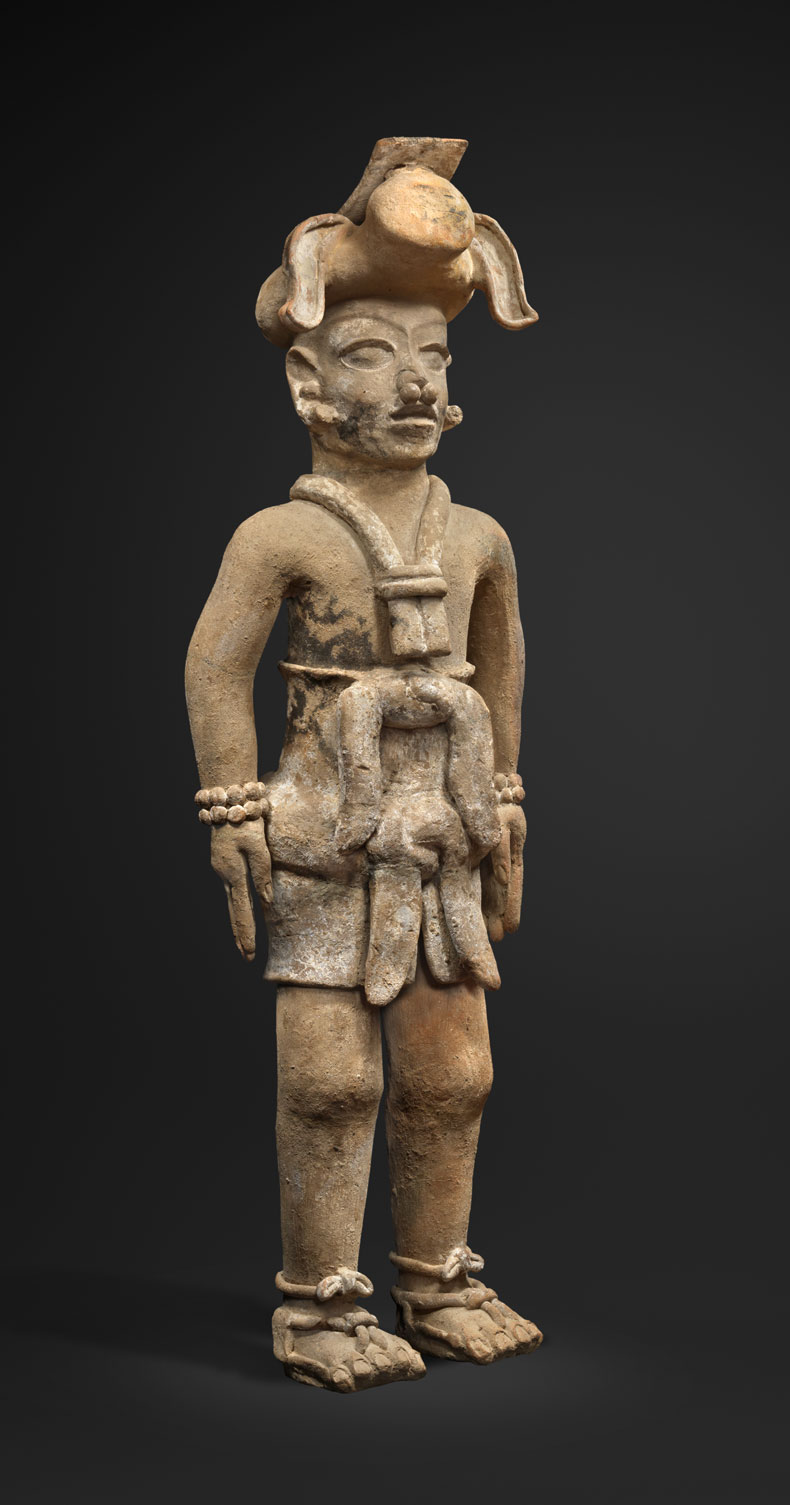
The pool of authorised, collectable objects is now much reduced, and there is fierce competition for the best. Argillet points to the sale at Sotheby’s Paris last winter of Meso-American objects from the Deletaille Collection, many of which went for well over top estimate, including artworks from the Olmec, Colima, Maya, Veracruz and Mezcala cultures, in stone, terracotta, jade, gold and marble. He says, ‘The market is much cleaner now and these fantastic artefacts will rise in value as they become rarer.’ He has available a large Veracruz (500–900 AD) terracotta figure documented in 1968 in Denver Art Museum, priced at €42,000, and a large ceremonial tripod jar from Nicaragua, Guanacaste culture (500–1000 AD), for many years on loan to the Musée de l’Homme in Paris, priced at €48,000. Most of his objects are in the range €5,000–€50,000 – appealing prices by comparison with classical African art.
Lin Deletaille, of the Brussels-based dealership Deletaille, confirms that the objects sold at Sotheby’s from her late husband Emile’s estate reflect long-term preferences in the market. Olmec, Mayan and Teotihuacan objects remain sought after, though she reports new interest in Costa Rican and Panamanian artworks, the latter boosted by Alan Grinnell’s recent book Painting the Cosmos: Art and Iconography of the Ceramics of Ancient Panama (2024). A Costa Rican jade macehead, Nicoya-Guanacaste (c. 1–500 AD), sold for €31,200, more than doubling its top estimate. She sells across the globe, including to collectors in Mexico, and in the autumn will mount an exhibition of Mayan figurative sculpture. Deletaille suggests that collectors should develop connoisseurship by handling objects, ‘and you have to know scholars and good dealers in your field’.
Santo Micali of Galerie Mermoz in Paris, specialists in pre-Columbian art, notes that where collectors used to have interests in specific materials or cultures, today people are drawn by aesthetic quality: ‘Jadeite attracts people, also colourful terracotta. Animals are always appealing. We try to find impressive things that have a timeless feel and will appeal to collectors of classical archaeology or contemporary art.’ A great proportion of their objects are from Meso-America, especially Mexico, but they report no issues with the Mexican government: ‘Collectors feel safe with us.’
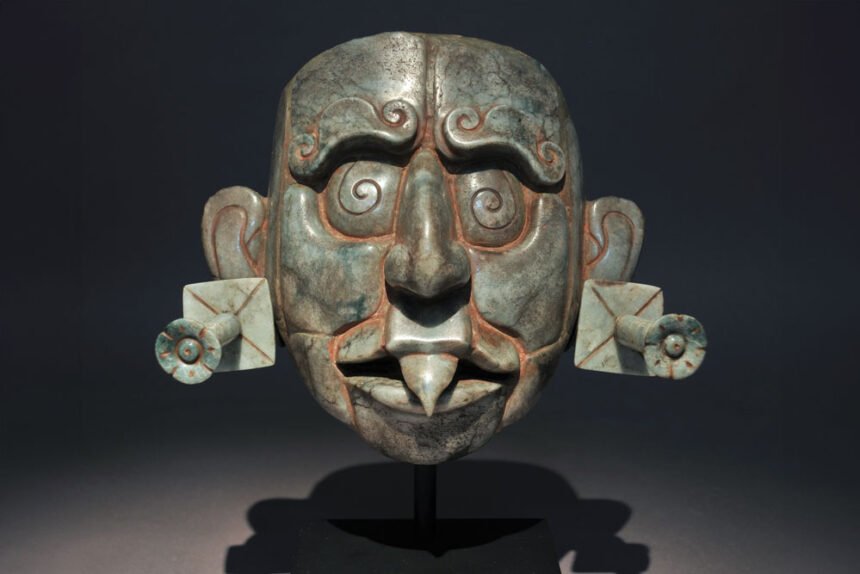
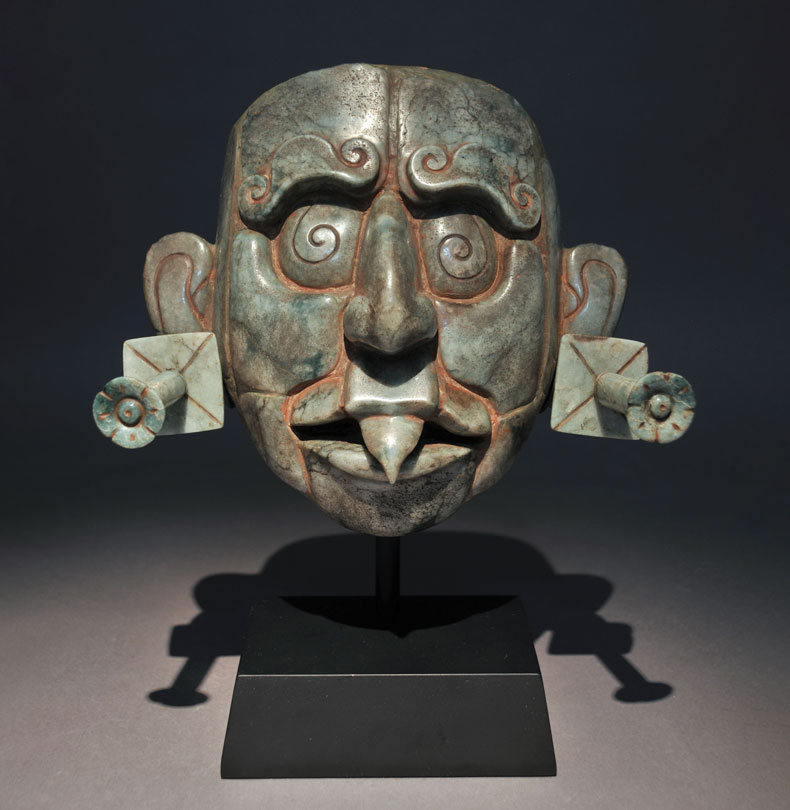
Mosaic mask, 250–900 AD, Maya culture, Mesoamerica. William Siegal. Courtesy William Siegal
Patrick Mestdagh of Galerie Mestdagh in Brussels agrees that the market is better for having ‘fewer fakes and fewer black sheep. We have fewer buyers but they are ready to spend more.’ Meso-American objects form a very small part of what he deals in: ‘I am a very cautious buyer. I buy the pieces which turn my stomach upside down. Collectors share this attitude. They want masterpieces.’ He has available a rare Aztec grey basalt grasshopper sculpture, 1325–1521 AD.
William Siegal, a gallerist in Santa Fe specialising in Andean weavings, thinks that ‘The low and middle ranges of the market have softened while demand for the best material remains strong.’ His clients incline towards ‘the formal, rather than the decorative and/or ornately figurative’. His inventory includes a Mayan mask, with carved jade and greenstone pieces fitted tightly to create a manifestation of the Mayan god Chaac, and an elegant, ‘unusually humanistic’ Olmec portrait mask with slightly asymmetrical features. Siegal reports that ‘the market is experiencing generational turnover. While there seems a lag in younger buyers, there is fabulous material being offered back into the market.’ He sells mostly in the United States, although the internet has enlarged his reach.
The internet has certainly ‘broadened the market greatly’ for auction houses, reports Stacy Goodman, a long-time consultant for Sotheby’s, New York. Where in the past Sotheby’s mounted specialist pre-Columbian sales, for more than ten years the artworks have been included in the larger category of Africa, Oceania and the Americas, ‘as we began to get cross-over buyers’; meanwhile, American museums continue to collect in this field, ‘to reflect their local populations’. Some collectors focus on gold or textiles or ceramics of a certain era, such as the protoclassical West Mexican Colima figures (100 BC–250 AD), but increasingly collectors want ‘great sculptural objects’. A powerful black stone Guennol Olmec figure of a deity (c. 900–600 BC), offered at Sotheby’s New York in January 2023, achieved $478,800 – almost twice its top estimate. Its success reflects both its splendour as art and its enduring spiritual power.
From the July/August 2025 issue of Apollo. Preview and subscribe here.