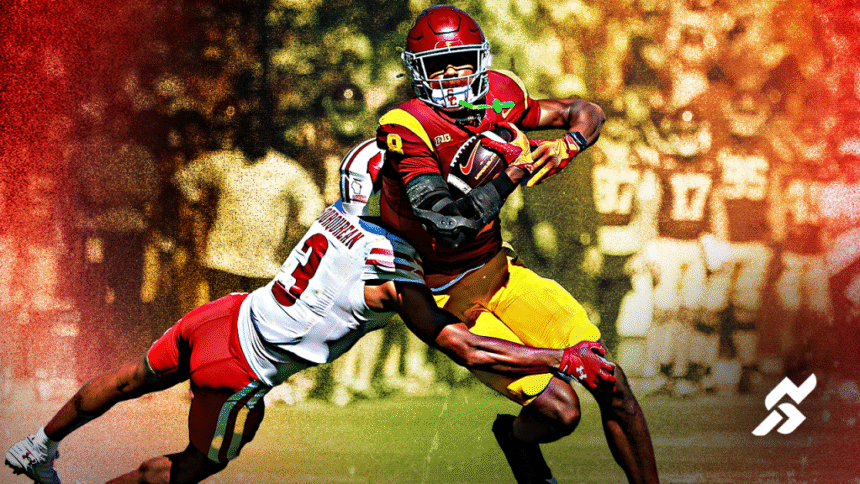
In a recent filing to the U.S. Court of Appeals for the Seventh Circuit, Wisconsin cornerback Nyzier Fourqurean contends the revenue-sharing features of the House settlement boost his case to play another season of college football. The NCAA responded with its own filing, arguing Fourqurean has it backwards and the House settlement undercuts his case.
In February, U.S. District Judge William M. Conley issued a preliminary injunction blocking the NCAA from enforcing eligibility rules that rendered Fourqurean ineligible to play in 2025-26. Those rules limit athletes to four seasons of intercollegiate competition within a five-year period, and Fourqurean played two seasons of D-II football in 2021 and 2022 and two seasons of D-I football in 2023 and 2024. Conley reasoned that the NCAA denying Fourqurean a chance to play another season is problematic under antitrust law because Fourqurean is a member of a labor market—football players at power conference schools—who can only sell their services to one buyer: colleges. When colleges, as competing businesses, join hands through NCAA rules to limit how they purchase the services of labor, it presents a potential antitrust problem.
There have been several rulings recently involving college athletes who want to play after their NCAA eligibility expires because they hope to earn more NIL money and refine their skills with the intent of eventually playing professionally. Judges have issued conflicting rulings; some find that players shouldn’t be excluded if there is market (i.e. college sports teams) interest in them. Other judges surmise that NCAA eligibility rules are better understood as reasonable restrictions on playing sports by college students, who are expected to eventually leave college, preferably with a degree, and allow incoming freshmen to take their roster spots.
The NCAA appealed Conley’s ruling to the U.S. Court of Appeals for the Seventh Circuit, which assigned a three-judge panel. The panel consists of Judges Kenneth F. Ripple, Amy J. St. Eve and Joshua P. Kolar.
In court filings, the NCAA contends the effect of eligibility rules is “simple” in that, “at some point, the student-athlete will have exhausted his eligibility and must move on from college sports and the compensation attendant on such participation.” Along those lines, the NCAA maintains that eligibility rules are “necessary for college football to exist” as a product different from pro football. In the NFL, players play for as long as there is a match between their continued interest and an NFL team interested in hiring them. In college, the player’s time comes to an end as their time in college ends.
In a June 19 letter to the Seventh Circuit, Fourqurean’s attorney, Michael P. Crooks, brought attention to U.S. District Judge Claudia Wilken granting final approval to the House settlement. Crooks stressed the revenue portion feature of the settlement, with schools being able to “pay athletes direct compensation” of about $20.5 million in 2025-26. He said the settlement is “direct evidence of the increasingly commercial nature of Division I college athletics.” Crooks added, in his view, the settlement “further illustrates the now direct correlation between eligibility and compensation, as only those eligible to play Division I college athletics at NCAA member institutions will be allowed to receive this compensation.”
The prospect of the House settlement being used as evidence to advance claims brought by college athletes who want to keep playing, either as college students or grad students, isn’t surprising. Last month, Sportico forecasted the prospect of more eligibility lawsuits as the House settlement means college athletes can draw from three pockets of compensation: a portion of the revenue share, individual player NIL deals and the value of full athletic scholarships to colleges—some of which cost in the ballpark of $90,000 a year to attend.
This compensation package—revenue share, NIL deals and full athletic scholarships—could be worth millions of dollars for some athletes. The amount might far exceed what this athlete could obtain if they play minor league sports, where NIL or endorsement opportunities without the brand power of playing for a major collegiate program could prove non-existent. The package would also far exceed what an ordinary job out of college would pay. It’s not surprising some college athletes would seek to play college sports for as long as possible.
In a June 24 response letter by NCAA attorney Rakesh N. Kilaru, the NCAA contends the House settlement helps, not hurts, the NCAA’s position against Fourqurean.
The settlement, Kilaru wrote, “expressly affirms the commitment of the NCAA and its member institutions to the Five-Year Rule.” He quoted language from the settlement stating that allows the NCAA and conferences to mandate that athletes can play four seasons in five years. Kilaru further noted that Wisconsin and the Big Ten are parties to the settlement and have endorsed it. In addition, Kilaru reiterated that the five-year rule “preserves the difference between college and professional sports, and thus preserves collegiate athletics as a distinct product.”
The parties now wait for a decision by the Seventh Circuit.