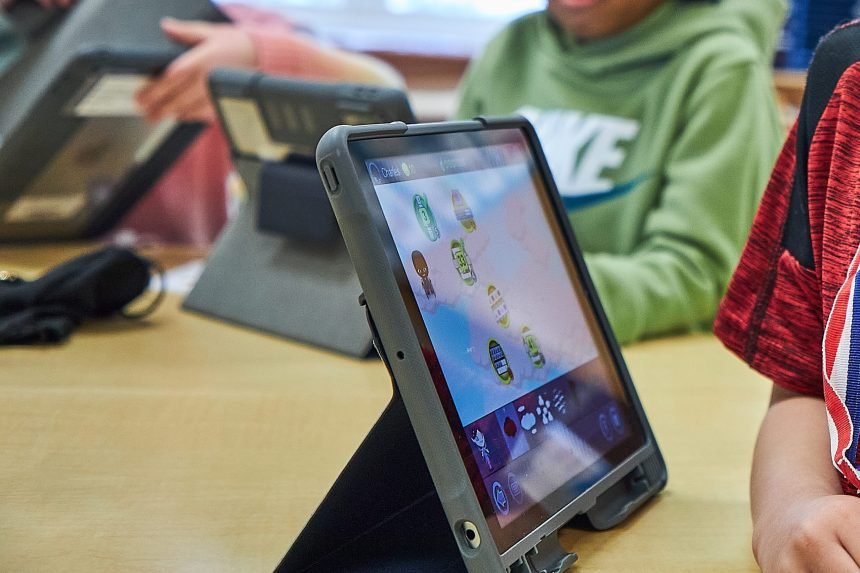
Some of Mrs. Rivera’s 4th-grade students come to school looking almost like little zombies, she says. Some tell her it is because they had been watching Youtube Shorts until 3 a.m.
Erin Rivera, an elementary school teacher in the Red Clay Consolidated School District, said today’s educators are teaching a generation of students who are experiencing the world through screens.
“They’re doom scrolling, melting their brain 12 seconds at a time, and now I have to compete with that in the classroom,” she said.
In response, Rivera said she tries to use technology intentionally in her class. She requires students to write and edit essays with a paper and pencil before they type final drafts. And she does not assign homework on Chromebooks, which students in the district have been allowed to bring home since last year.
Still, Rivera said parents complain to her about their children using their Chromebooks too much. She says many go home and open their device in their room, where it looks as though they are completing their homework.
“But they’re playing games,” Rivera said.
Along with the broader society, Delaware schools have shifted in recent years to embrace technology, with personal devices and digital boards in classrooms. But as those devices become common, many are now questioning how much technology is too much.
Spotlight Delaware spoke with nearly 50 people for this story — including school administrators, teachers, parents, students and academics — and found that large differences exist in the amount of technology that students use.
The reporting also showed that some district administrators have begun to pull back from technological adoptions, while parents say school-issued devices have become problematic when used at home for entertainment.
Meanwhile, teachers and students indicated that policies governing how the technology is deployed can depend on the individual school or teacher.
And not all follow Rivera’s approach.
One sixth grade student at HB du Pont Middle School, near Hockessin, said she used her Chromebook for four to five hours a day for schoolwork. Another from the Colonial School District said she used her Chromebook “all day.”
“It’s always been like this,” she told Spotlight Delaware.
Meanwhile, a second grader at Newark Charter said her learning is focused on paper handouts.
For at least one parent, the question is not just about screen time but also about who is pushing new technological adoptions.
Greg O’Neill, a middle school parent in the Red Clay school district, is skeptical about schools’ decisions to purchase certain software programs. He expressed concern that software companies are selling promises of a “new bright future” of digital learning, which he said could supplant the importance of teachers.
“I feel like it’s changing students’ vantage point from being the teacher to being the screen,” O’Neill said.
Pulling back?
While technology policies have varied across the state, some Delaware districts are responding to recent research and parental concern by scaling back device use.
Soon, fourth and fifth graders in the Brandywine School District will no longer be able to bring their assigned Chromebooks home. Instead, they will leave them in carts in their classes, said Michelle Kutch, the district’s director of curriculum and instruction.
Older students in the district will still have take-home devices.

Brandywine Superintendent Lisa Lawon noted that one-to-one technology has become less popular among educators and administrators in her district, since its rapid adoptions during the COVID pandemic.
And research raises questions about the effectiveness of educational technologies, she said.
Lawson described how today a 12th-grade teacher monitoring students taking tests on Chromebooks must watch “like a hawk” to make sure they aren’t going to other websites.
“It’s very different from the teacher of old, where there was just paper, pencil, and a student’s brain,” she said.
Appoquinimink School District is also scaling back its one-to-one technology program. This past school year, students in first through eighth grades brought their iPads home. Next year, the district will not allow first and second graders to bring them home.
When introducing the change during an April school board meeting, Appoquinimink’s Rebecca Feathers said research shows schools should be limiting technology and device use, and using tech in a “purposeful manner.”
In an interview with Spotlight Delaware, Appoquinimink board vice president Tim Higgins said the district is “learning that computers have a great role, but maybe not the role we gave them earlier, and certainly not the role we gave them during COVID.”
Outside of the public school sphere, one private school is allowing students to air out their insecurities about technology.
At the Independence School, which serves preschool through 8th grade students, administrators recently implemented a digital health discussion class. Margaret Ann Minihan, technology systems manager at the school, said the class helps students create boundaries with technology. According to her, students are eager to chat about what’s going on in their lives.
“We talk about, are grown-ups in your life always on their phone, but telling you to get off yours? And how does that feel?” she said.
Minihan also said students learn that Siri is not a “friend,” and have discussed how to limit time at home watching short-form content, which draws discussion about how that feels physically and how to find solutions for it.
“I just wasted a whole hour. I don’t like that feeling. So, what can you do to kind of address that for next time?” Minihan said.
The school will double the amount of time students spend in digital health class next year, Minihan said.
While some districts are pulling back on tech, others are not.
At the Christina School District, every student from Kindergarten to 12 grade brings their assigned Chromebooks home.
A pilot program of the one-to-one device program began in 2018. When the pandemic hit two years later, it was fully implemented, allowing students to take their devices when they leave school for the day.
Asked why the program is continuing, Christina Schools District’s manager of technology Robert Goff said it allows students to continue their education at home.
Sean Mulrine, the district’s supervisor of technology and assessment, also highlighted a data-driven program, called iReady, that runs diagnostic assessments two to three times a year to help remediate learning, which helps when a student has fallen behind or needs more support.
He said that it differs from state testing, which does not track growth throughout the year.
“But with technology, you can see data points when you start the year, through the midpoint, and then the end of the year,” Mulrine said.
What does the evidence say?
Sarah Kavanagh, an associate professor in the University of Pennsylvania’s Graduate School, notes that the ubiquity of devices means “there’s another party” in classrooms along with teachers and kids and books.
She said the structure of a modern school day is now “incredibly reliant” on educational technology platforms, such as the learning management system Schoology, mathematics learning platform Zern, book-reading platform Epic, and Google Classroom.
“And while ed tech companies are making the argument that this is going to be good for student learning, we don’t actually have a lot of evidence about that,” Kavanagh said.
Kavanagh, who has a background researching classroom discourse, said teachers have told her they can’t hold discussions because they’re mandated by their district to use platforms that require students to be on Chromebooks.
In turn, teachers are often evaluated by lessons completed on the platform, she said.
She noticed that instead of teachers sitting on the rugs with their students, book in hand, asking them questions along the way, they now are using platforms bought by their districts to project books that are read by a disembodied voice.
“I have real questions about what that’s going to do for student learning,” Kavanagh said.

Dana Suskind, professor of surgery and pediatrics at the University of Chicago Medical Center and founder of the TMW Center for Early Learning and Public Health, believes there should be a scientific understanding of how digital tools should be used for child learning and development.
Suskind said she believes schools and parents are used to “optimizing” learning. Instead, they should focus on teaching students to better navigate the human world, she said, by participating in “messy” human interaction, and experiencing boredom.
“To get your children ready for a high-tech world, a distinctly low-tech human-raised childhood-I call is what children need,” she said.
Punya Mishra, a professor at Arizona State University, thinks there should be more research conducted about the effects on student learning of technology use outside the classroom.
Mishra said he has a friend who works with children in a remote part of India where there are smartboards and other educational technologies in the classroom. Still, the biggest technological influence on at least one of the elementary-aged school girls there is radical content from YouTube, Mishra said.
“It makes her question the history that she’s being taught in her classroom,” said Mishra, who is the Director of Innovative Learning Futures at ASU’s Learning Engineering Institute.
Mishra said he believes children now live in a world that has been transformed socially, politically, culturally, and psychology by digital tools. But, he said, tech bans don’t work.
“What works is empowering teachers and empowering learners to be intentional and be in charge of their own learning,” he said.