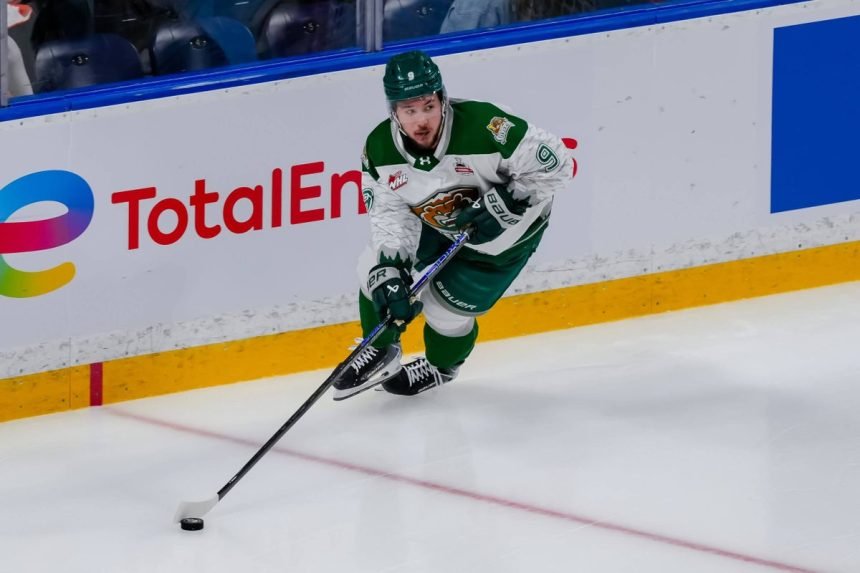
Landon DuPont is the WHL’s first exceptional status defenseman and second exceptional status player period. Derek Cain / Getty Images
Welcome to my preseason 2027 NHL Draft ranking.
The first major event on the prospects calendar — the Hlinka Gretzky Cup — is in the rearview mirror, and a new draft season is officially upon us.
The 2027 class, made up predominantly of 2009-born players, is headlined by Canadian star Landon DuPont (the WHL’s first exceptional-status defenseman), who will play his draft year at the University of Michigan. It also features what looks like the best Russian draft class in years.
This initial top 32 (plus 36 honorable mentions) follows my way-too-early top 25 list from the spring. It will be followed throughout the year by four top 64s (typically a month into the season in early November, after key January events, in mid-March, and then post-U18 Worlds in early May) and eventually my final top 100 next June.
Is Wyatt Cullen the future of USA hockey?
Corey Pronman, Scott Wheeler and more
As always, my ranking is broken down into tiers. I’ve got six to start the year: 1, 2-6, 7-11, 12-16, 17-28, 29-32+.
While I consult scouts, coaches, general managers, team staff and those around these players (their agents, skills coaches, strength and conditioning coaches, etc.) throughout the year, the evaluations and rankings are strictly my own.
Here are full reports on the top 32 (honorable mentions sorted alphabetically).

Loading
Try changing or resetting your filters to see more.
Tier 1
DuPont, the WHL’s first exceptional status defenseman and second exceptional status player after Connor Bedard, was immediately a top-end WHL D as a 15-year-old and set the WHL’s U16 scoring record (any position) with 60 points in 64 games, playing 22 minutes per game on a top team in Everett. Last year, at 16, he registered 102 points in 85 combined regular-season, playoff and Memorial Cup games, leading the Silvertips to a WHL championship and playing 25-plus minutes a night. He finished his year with a dominant showing on a high ankle sprain at the Mem Cup. He’ll play at Michigan as a true 17-year-old in his draft year this year and should be an important part of the Canadian World Junior team as an underager. After easing into the Hlinka a little bit, I thought he really separated himself as the tournament went on and demonstrated the clear cut above he was.
More than just the production, DuPont is also a play driver in every area, with pristine underlying numbers and microstats. Zone exit, zone entries, denials, shot creation, pass creation: you name it. He has a lethal curl-and-drag release into his feet and a one-timer, excellent hands and both the IQ and the competitiveness to be consistently impactful in all three zones. He wants to get inside the dots every time he has the chance. He snaps the puck around as a passer on the breakout and inside the offensive zone, playing decisively. He has excellent four-way mobility and very active feet. He defends at a very, very high level, is extremely strong for his size and reads the play as well off the puck as on it. His maturity and work ethic are both well beyond his years, and he plays hard and into bodies/hands, acting as decisively defensively as offensively. He’s closer to maxed out physically than Quinn Hughes or Cale Makar were at the same age, but he’s a stud in his own right. His game just has a firmness to it. DuPont looks like a future star defenseman in the NHL and I think there’s seperation between him and the pack at the top at the moment.
Read more in our feature here.


Tier 2
Privalov had one of the better U17 seasons in MHL history last year, leading CSKA in goals and points and playing to a point per game. Only Matvei Michkov has scored more goals at the same age, and only Michkov, Nikita Kucherov and Ivan Ryabkin have scored more points. He scored two hat tricks in his first eight games in the MHL, becoming the fastest player to do so and breaking a Kucherov record that had stood for 15 years. He’s also something his statistical contemporaries weren’t: a physically advanced, already 6-4, 200-plus pound forward. (He actually played half a dozen games at center last year but is viewed as a winger). He also impressed last November at Russia’s Future Cup, which sees its U18 team play its U20 team.
Privalov is a big, strong, powerful forward who can push through contact and, for his size, make plays off the rush with an already-patented drive move he uses to cut from his forehand to his backhand into a quick release. He has an NHL shot, a strong and balanced stride, quick and soft hands for his size (he accepts passes really well, an underrated skill) and a presence and joy about his game reminiscent of Juraj Slafkovský, though I think he’s further ahead at the same age and has a higher upside based on my preliminary read. He’s still very much learning the finer details of the game, but his raw talent and size make him a lot to handle out there. I’ll be fascinated to see how he fares against men and would expect him to get an early look this year. His contract, which runs until May 31, 2030, is going to be a major talking point will take him out of the first overall conversation even if his play warrants it.

Skvortsov led Nizhny Novgorod in scoring last year as a 16-year-old and did it while making some flashy plays with the puck, wearing a letter and elevating in the playoffs, where his 18 points were seven more than his nearest teammate and he had a four-goal game. He’s a highly, highly talented left-shot winger whose offensive package features hesitations, a lightning-quick release in motion and real speed, with an ability to make plays in space and beat defenders and goalies. He’s also got great instincts on and off the puck and frequently gets loose for breakaways and rush chances. And while he’s still a little lean and can get pushed off of pucks, he looks like an athlete, and once he adds weight, he feels like a future top-six playmaker with quick-strike ability — and maybe a star. I might be a little high on him but he’s one of the most talented players I’ve watched in the ’09 age group. There are a lot of players in this class with really solid NHL projections but he’s one of the only ones whose skill level can truly excite you.
Sundström is a driven and talented pro-sized center who impressed as the top player on Sweden’s U17 team last year and has now done the same with its U18s at Hlinka (though I thought he was more good not great at Hlinka). He has had several standout showings internationally already and clicked at a goal per game as a 16-year-old at the J20 level. He has a big-time shot that comes off his blade hard. He’s noticeably strong on his feet, plays through contact, wins battles and gets up and under sticks. He’s good in the faceoff circle. He can drive, will hold onto pucks, and wants to round corners and take them off the wall to the interior. He’s viewed as a two-way center but he can also score off the flank on the power play, shows one-on-one attributes and has poise on the puck. He’ll need to develop his skating, which is just average, but otherwise he looks like the real deal to me.
Neuenschwander made headlines when he made his pro and World Juniors debuts at 15, and has now played in two World Juniors and scored multiple goals in the NL, one of the better pro leagues in Europe. He was also a standout at his second Hlinka Gretzky Cup last week, leading the Swiss to a fifth-place finish with several strong performances down the middle. He’s a 6-4 forward (he’s a natural center and played center at Hlinka but has played a lot of wing at the pro level) who skates very well and can transport pucks in transition. He pursues pucks, forechecks, finishes checks and plays 200 feet. He makes decisions quickly. He sees the ice well on PP and even started killing penalties late last season. He’ll go to the front of the net against older competition. He can protect and shade pucks well, cutting back along the wall to free himself. He’s got a hard release. He definitely has some pro tools. I find that he creates more/is around the puck more than he actually finishes plays at times, so he’ll have to do more of that, which can be hard when you’re playing for a mid-tier country internationally or at the pro level as a teenager. But he showed more of that final execution quality at the Hlinka, too. He’s a very good prospect and looks like he’s going to have a long pro career as a top-six forward. I do wonder if there’s the first-line upside needed to position himself as a challenge for DuPont, but he’s a top prospect regardless.
Photo:
Steven Ellis / Daily Faceoff

Joseph, the No. 1 pick in the 2025 QMJHL draft, is a big center with skill. He was dominant at the World Under-17 Hockey Challenge last November, leading Canada Red to gold and the tournament in goals with six in five games, and was a top player on a rebuilding under-.500 team in Saint John last year, playing to above a point per game.
Joseph played in all situations as a 16-year-old as a go-to player at five-on-five and on the PP, and a contributor on the PK. He can challenge opposing D with his combination of size, strength and quick hands/touch around the net. He’s also comfortable trying things and taking guys one-on-one, and has scored some pretty goals, beating opponents off the rush and driving the net. While he’s in great shape at an early age, I would assess his skating as just average and that, combined with a tendency to stop moving his feet and coming to a standstill too frequently, has caught my eye recently: both at U18 Worlds, where he was dropped to 13th forward and scratched after starting in the top six, and then at the Hlinka, where he was lowered from the top-six to the fourth line. Big kids always have to show they can continue to take steps in order to shut down questions about being maxed out an early age, and he’s going to have to have a big year to maintain the status he held last season, especially after some recent softening from folks. Competitiveness and pace both aren’t strengths of his game, and at that size teams will want them to be. He can play through contact and can be good both ways, but he needs to keep his feet moving in the D-zone and pursue pucks harder at times. He is a summer birthday, so with continued development he could profile as the kind of center teams covet as a cornerstone piece. But you have to show it on the ice again and again, and he has left me wanting more a little too frequently. I thought about dropping him into Tier 3 here and will if he doesn’t pick it up.
Photo:
Michael Hawkins / QMJHL

Tier 3
Zhilkin, the younger brother of Jets prospect Danny, is a late-birthday ’08 who was named captain of the Spirit last season and wore a letter for Canada at U18 Worlds, where he was also one of the team’s best players and their first-line right wing. He was also a standout at the World Junior Summer Showcase as Canada’s lone draft-eligible. He’s a skilled “rat” who uses skating, cuts, handles and a dirty-areas drive to make plays and stay around the puck between whistles, and then likes to get under the opposition’s skin after them. He’s the heartbeat of his lines and a play-driver who rises in big moments, wants to be in the fight, and can play on the perimeter or in the guts of the ice with his skill out wide and determination inside and around the net. He’s got some Zach Benson in him in all of those ways. He also gets shots off quickly in a crowd, has great hands in tight and plays with a sneaky-strong physicality and excellent contact skills. He’s always around the puck and the action and can ramp things up in possession or slow them down. He lacks ideal size but makes up for it in spirit (no pun intended) and is going to be a future fan favorite somewhere — and a favorite of his future linemates.
He was voted the Western Conference’s second hardest worker and second-best hands in the OHL Coaches Poll, a sign of respect from the opposition. He finished last year’s regular season with 36 goals, 75 points and 100 penalty minutes in 59 games. He’s also, by all accounts, a leader off the ice. He was really good at last summer’s Hlinka Gretzky Cup (where his role expanded as the tournament progressed), on top of his 7-in-5 showing at U18s. I expect him to be on Canada’s World Junior team this year. He might be my favorite player in this class and I thought about ranking him in Tier 2.
Read more in our feature here.
Photo:
Eric Young / Saginaw Spirit

The best skater I’ve seen in this class, and one of the best I’ve watched at 16/17, England’s game is defined by his elite breakaway speed and acceleration. He can pull away in straight lines or wind up through his crossovers and make guys miss. He has moments where he looks electric on the ice and pulls you out of your seat with his ability to create. And then on top of the speed, he has the quick-twitch hands to go with it and a nasty release with some real pop off of his blade as a shooter. He also played to positive two-way results and was challenged in Seattle last year to take on a lot of responsibility and played in all situations for Canada at Hlinka, including a beautiful end-to-end short-handed goal. He’s still got work to do on how best to use and deploy his speed, and he’s a sub-6-foot center who needs to improve in the faceoff circle and may end up as a winger: they’ve already bounced him around position-wise with the Thunderbirds and he played wing with Canada. But the talent, shot and skating should take him a long way. He’s not afraid to play the body either and will deliver an open-ice hit. He’s also an August birthday, so there’s runway for him to really put it all together and continue to take steps.
England finished last season with 51 points in 64 games and a team-best plus-12 rating, and I think he’s got a chance to challenge for 40 goals and 90 points this year in the WHL. He’s one of the only forwards in this class that can really pull you out of your seat.

Nelson, a late-birthday ’08 who was just days away from 2026 eligibility, was a driver for that age group as one of its youngest players for two seasons prior to making the jump to the NCAA in his draft year. He’s a big, strong center who will follow in the footsteps of his brother Danny (an Islanders prospect) footsteps at Notre Dame.
Nelson has shown more offense at the same age than Danny did and is a better skater (he has a very strong stride) while also having his brother’s size, unselfishness and all-zone commitment. He plays a driven game, will go to the net, has a pro shot and good release, uses and plays off his linemates well and can play on the wall and to the net. He has some jump off the puck and keeps his feet moving to get open, too, which young players don’t always do. He’s also strong in the faceoff circle and has a good defensive stick. He finished last season as one of USA’s top three players at U18 Worlds, impressed at the World Junior Summer Showcase at the end of July, and I expect him to make Team USA for Edmonton this Christmas. Nelson just looks like he’s going to have a long pro career as a top-nine forward and potentially more than that.
Photo:
Rena Laverty / USA Hockey’s NTDP

Cripps, the No. 2 pick in the 2024 WHL draft, was a prolific and accomplished minor hockey defenseman who won the CSSHL’s top D award at its U15 and U18 levels in back-to-back seasons, won its U15 MVP award, and played nearly 26 minutes per game to lead Canada Red to gold at the World Under-17 Hockey Challenge last fall. As a rookie in the WHL last season, he has averaged 18 minutes per game, was very productive for a summer birthday 16-year-old in those minutes, and stepped up big in Prince Albert’s run to the WHL final. I thought he was impressive at the Hlinka and got better as the tournament went on as well.
He’s a highly talented player with the puck, blending agile and impressive skating with excellent lateral hands to carry pucks up ice, evade sticks and make plays. He has deception inside the offensive zone and always has his head and eyes up to find lanes and puts pucks into space for teammates. He has an active disposition on both sides of the puck, too, with a want to activate and the feet to gap up, surf and angle the other way. He’s a sub-6-foot D in a class that looks like it has a lot of them, but he’s a heck of a player and has dynamic traits offensively. He’s the second-best D prospect I’ve watched play in this class.
Photo:
Mark Peterson / WHL

Meyer, a BU commit who is making the move from the NTDP to the QMJHL for his draft year, was the best ’09 at the program last year and looked like a potential top-10 pick when I watched him with the U17 or U18 team. After he was called up, he also became a regular contributor on into U18 Worlds, registering five points in five games from its fourth line. The son of former NHL defenseman Freddy Meyer, Carter is a competitive, well-rounded and talented center who has driven offense and kills penalties with the national team. He plays with his head up, can play at different paces, protects and holds onto pucks well, and has skill in possession and a quick release. He’ll also go to the front of the net, play through contact, finish his checks, battle and occasionally take an emotional penalty. He’s got nice vision. He’s also a strong skater who likes to attack one-on-one off the rush and go at defenders. He looks like a future competitive second-line center and should be one of the top young players in the Q this year.
Photo:
Rena Laverty / USA Hockey’s NTDP

Tier 4
Meijer is a December ’08 who’s on the older side of the class, but still smaller. To go in this kind of range, he’s going to have to keep proving himself as a result. But to date? He has already been a top player at the J20 level (including in the playoffs) and impressed at multiple major international events, including most recently at U18 Worlds, where he was a top-six center, wore a letter, and wore the “C” when the team’s captain fell sick. He has also already made his SHL debut. He made some pretty, pretty plays last year, both internationally (including also at the February U18 Five Nations, where he scored a couple of the nicer goals of the event) and domestically with the puck in his hands as well. He’s good around the net and can play multiple roles on the power play, both the flank or the net-front/back post. He competes. He carves up coverage. He’s skilled laterally but will also play direct. He’s a team player who will make the right play and chip pucks in when he needs to. He supports play well defensive and can penalty kill. Add in legit skating, speed and smarts to the skill and craft he has, and there’s reason to believe in him. Those smarts extend to his play off the puck as a center as well.
Jacobson has been one of the most productive young players in the WHL over the last two seasons and change at age 15-17 (and as a center, no less). Last season, he wore an “A” as a draft-minus-one and led the Wheat Kings in points (85 in 63 games) and assists (60) despite dealing with a lower-body injury he suffered in November and later played through. After starting as a scratch for Canada at U18 Worlds, he also came in as their 3C for Game 3 and gave them some secondary juice offensively. He’s a pass-first pivot who should be one of the WHL’s top forwards in his draft year.
Jacobson is a heady, crafty, highly intelligent offensive player who drives a lot of offense on his lines with his playmaking and IQ. He has quick hands, a soft touch on his forehand and backhand, an excellent small-area game under triangles and in traffic, and a natural release. He puts pucks into great spots and with perfect timing and weight for his teammates and runs the half-wall on the power play. He’s a decent skater, though not an explosive one for his size and carries some weight/could use a quicker first-step acceleration. There have been times in my viewings when I’ve wanted him to get to the dirty areas offensively and play through contact a little more, but he’s competitive enough to potentially project as a center; he’s also strong in the faceoff circle and won 55 percent of his draws last year. His playmaking will have to carry him in order to get picked in this kind of range, but it’s where I’m starting him because of just how noticeable his craft on the puck is relative to most of his peers.
His dad, Jared, owns the Wheat Kings.
Photo:
Jillybean Photography / WHL

Gordon-Carroll is a well-rounded center who got off to a tremendous start to last season in Medicine Hat before getting banged up and slowing down a little, though I thought he had a good playoffs. He’s one of the better skaters I’ve seen in the draft, with a strong lower third that has both obvious power and some quickness. He plays hard and wants to be a driver, with a willingness to work off the puck, play in the guts of the ice and be a responsible player. When he’s at his best, he has a presence to his game and is involved in the action, making things happen on and off the puck. He has quick hands and can attack directly and on angles to challenge D with a push into a slight change of direction. He has good stick placement when he’s pursuing an opposing carrier and a knack for forcing turnovers. He’s willing to play the body and win positioning, and is strong on his feet. He’ll occasionally make a rushed decision with the puck and needs to settle down at times (the IQ looks average to me) but he’s a very good player who should have a long career in the league as a middle-six C. He’s also strong in the faceoff circle.
Photo:
Erica Perreaux / WHL

Davidson, a Boston College commit who made the move from Shattuck St. Mary’s to Medicine Hat last year, impressed scouts at the Hlinka Gretzky with Team USA ahead of his jump to the WHL last season, registering six points in five games and looking like a legit pro prospect. He’s a big, strong, athletic winger with a legit NHL shot and good hands around the net. He’s also a powerful skater who gets around pucks, and handles and shields well, with an ability to attack through the middle or drive wide. It took him some time to get going in Medicine Hat as he adjusted to the new level in the WHL, but he got better and better as the season went on, was a dominant player in the league in the second half, and had a strong playoffs. While he’s listed as a winger most places, he also played a ton of center and won well over 50 percent of the more than 600 draws he took. He played stretches of that second half with the Ruck twins on the Tigers’ top line and had stretches of successful play-driving and scoring away from them as well. He projects as a modern scoring power forward and scored 30 goals as a first-year WHLer. He’s still learning some of the little details, too (especially keeping his feet moving off puck) and has plenty of untapped potential despite his physically advanced build.
Photo:
Erica Perreaux / WHL

Kazda was one of the top young forwards in the USHL last year and then led U18 Worlds in scoring with 12 points in seven games, winning tournament MVP and leading the Slovaks on a run to the gold medal game as their first-line right wing and an alternate captain. He makes quick decisions, can drive offence on his lines at five-on-five, manages the half wall on the power play well, has a good first touch, is a good skater, gets in and out of his stops and starts quickly, and protects puck really well along the wall. After finishing fourth in under-18 scoring in the USHL last year with 22 goals and 41 points in 59 games (leading the low-scoring Steel in goals), he’s making the move to the OHL this year with the Memorial Cup hosts in Guelph. I haven’t seen top-10 attributes per se, but he’s solidly a first-rounder and looks like a potential future second-line player. He can play center and the wing and played a lot of both in Chicago, so I’ll be interested to see where he slots in with the Storm.
Photo:
Chicago Steel / USHL

Tier 5
Fitzhenry is a talented forward who played both center (his primary position growing up) and the wing at the program last year and made some of the U17 team’s nicer plays both inside the offensive zone and one-on-one off the rush. He has a shooter’s release and can cleanly beat goalies from mid-range with it. He has good dexterity, with quick hands and a soft first touch when he takes passes. Inside the offensive zone, he also quickly identifies the next play, often making it out of one of those first touches to play small-area games with teammates. He’s also built pretty strong and is willing to work. He looks like a mid-to-late first-round type.
Photo:
Rena Laverty / USA Hockey’s NTDP

Pustovoy, a December birthday, was the most productive U18 forward in the MHL last season despite only playing 16 and a half minutes per game with a deep Yaroslavl team — and bouncing between center and the wing. He also wore a letter for the U18 team at the Future Cup. He has good size and wants the puck in shooting areas so that he can get low and use his strong one-touch and catch-and-release shooting motions, often going to the slot or the flank to call for it. He has a dangerous snap shot off the rush, too. He pitchforks a little in his skating stride, and I would say has just average skating. I also don’t know if his skill level is dynamic despite the production. But he can score, he goes to good spots and he’s strong and will battle and finish his checks.
Wycisk, the No. 2 pick in the 2025 OHL draft, is a pro-bodied center and athlete. He’s a good skater for how heavy he already is and plays a striaght-line, energetic two-way game. Offensively, though he doesn’t have dynamic skill or offensive IQ, he’s talented enough, he’s got a quick release, he’s got good instincts and he’ll take pucks to the net. He’s also strong in puck protection, good on the cycle, possesses excellent overall contact skills, wins pucks with a heavy stick, and can make plays below the goal line. He got better as his rookie season went on and his line was Guelph’s best on many nights in the second half. He got better as the Hlinka went on as well and was Canada’s best player in their semifinal win over Finland, dominanting in hard areas. The Storm are hosting the Memorial Cup this season and he should be an important part of that team. He’s got all of the tools needed to become a very good middle-six/up-and-down-the-lineup player who can play on the wall and in the guts of the ice.
Photo:
Natalie Shaver / OHL Images

L’Italien is a big, sturdily-built, pro-look defenseman with athletic traits and strong skating and balance over his feet. He’s got a good shot and plays with confidence, with a willingness to carry and handle pucks, an ability to attack off of the line and a comfort in puck protection out wide to his body. I’ve wondered about his IQ on and off the puck at times as he’s a bit of a mixed bag in terms of decision-making and is prone to the odd hiccup, but his toolsy makeup allows him to recover and defend hard and drives his value from an NHL standpoint. In a draft class short on big, athletic D, he stands out. He profiles as a two-way top-four D at the next level and there are some who view him as a top-10 talent.
Photo:
Trevor MacMillan / Halifax Mooseheads

Tomek is a well-rounded, high-effort, highly skilled but small forward who has already scored double-digit pro goals in Czechia’s top flight, including a couple of highlight-reel ones. He was considered for their World Junior team in his draft-minus-one season, which included a goal against Finland and primary assist against Switzerland in their November U20 Five Nations (albeit as an October birthday). He was the captain and a first-line player, at times at center and at times on the wing, for the Czech U18 team last year but has played the wing professionally. He’s a good skater with quick feet who keeps his feet moving off the puck, can turn and round corners in a hurry, and does a nice job being opportunistic to jump to get open, which is complemented by a good one-touch shot. Though he can look tiny, he’ll go to dirty areas and the interior with the puck and he’s very shifty when he does. He really works off of the puck to break up plays and be disruptive with his stick, too. His size is already a talking point and will land him in a wide range on draft boards I expect, but he has got skill, skating, scoring, instincts and two-way commitment, and I felt he warranted a placement here based on what he has shown to date.
Glance, a BU commit, is the oldest player on my list but he was a top player on last year’s U18 team at the program with the ’08s, was invited to the World Junior Summer Showcase as a draft eligible (he won’t make the team, but he looked like he belonged), and I expect him to be a top player in the QMJHL quickly this fall. He works, he’s smart, he’s skilled, and he does it all while playing quickly and decisively with and without the puck. He’s a sub-6-foot winger but he’s just a very good player who can both make plays in open ice and crowds, and be a creator or a driver for his lines. He’s likeable and consistently impactful.
Photo:
Rena Laverty / USA Hockey’s NTDP

Edgar, a Michigan commit, was a captain in minor hockey and is a talented center — though he started last year on the wing, he moved back to the middle in January and stayed there. He was one of Niagara’s best players as last season progressed, often playing 20-25 minutes per game down the stretch. I again liked him at Hlinka as well, where his speed was consistently noticeable.
He has quick hands and can make guys miss jumping past them laterally. He’s a very good skater who can play off the rush and release from coverage to win foot races to pucks and keep plays alive with his active feet. He’s a smart player in all three zones, is reliable off the puck and sticks with plays. He uses active feet to stay around the play and is a good overall skater. He’ll drive but also shows vision on the perimeter. He’s also a quiet competitor who is willing to play in contact and take pucks to the net. He has grown and is now up to 5-11. I thought he was arguably the most consistently noticeable 16-year-old in the OHL last year and have liked his game in all of my viewings. I’m a fan.
Photo:
Natalie Shaver / OHL Images

Selic is a pro-sized winger who has impressed internationally as one of Slovakia’s top ’09s, first as an underager at U18 Worlds in the spring and now with his age group in a dominant performance at Hlinka that included a six-point game. Offensively, he’s a strong skater, controls and protects pucks well, has a comfortable curl-and-drag release, and has good instincts on where to go and timing. Defensively, he plays in all situations (including on the penalty kill), works and tracks off of the puck, and has a good stick to break up and lift pucks. I’m not sure the offence is top-line but he just looks like a legit pro prospect who has a clear path to a middle-six career in the league.
Yakunin is a good-sized center who wore a letter as a rookie in the MHL last season and had one of its more productive U17 seasons ever (and the most assists ever), albeit on a team with some firepower. He’s already big and strong, and plays a pro-style game, contributing on both special teams in the MHL last season. Without the puck, he goes and gets it, plays a committed game and gets up and under sticks to track and take back possession. With it, he can build a head of steam and drive or slow the game down and find the trailer consistently; he likes to wait for options to open up in possession. His hands aren’t going to wow you like some of the other Russians in this class, but he has a lot of pro attributes and plays an appreciated style of game.
Santala has been a top player in Finland’s 2009 age group internationally and has stood out with the ’08s in multiple U18 competitions. He’s a well-rounded center. He’s got a good one-touch shot in release that he can strike with, taking passes into small pockets of the O-zone. He’s a decent skater (it’s not a selling point but he moves well enough) who can score off the rush by getting open, but has also shown an ability to drive one-on-one out wide and has room to fill out his 6-2 frame. He keeps his head up. He’ll slow play down and makes the right decision with the puck more often than not. I’ve often found him more good than great in my viewings, though, and wonder if he’s more of a high-floor late-first type. His production in Finland’s top junior league last year didn’t rise nearly to the point-per-game level that the country’s true draft stars have produced at in their U17 season either, though he’s a late-July birthday as well. While most of his goals and plays are scored/made around the slot, he’s consistently around it, he has some tools and he plays a premium position. I just want to see him take over more often and do it with a little more pace at times.
Naudinš, a former Harvard commit now committed to Michigan, is a big winger who can play and has already appeared in two World Juniors for Latvia. After developping at Shattuck St. Mary’s, he’s making the move to the WHL with Penticton this year. He can handle and hold onto pucks. He keeps his head up and sees the ice well. And most importantly, he’s a good athlete who moves well for his size, with control of his feet, crossovers that don’t look clunky, and clean push and glide to his stride. He’s an early source of intrigue in this class for NHL scouts and will be watched closely with the Vees from Day 1.
Photo:
Steven Ellis / Daily Faceoff

Shtyrkhunov had the second-most productive season in MHL history by a U17 D last year, playing 20 minutes per game (including on the PK even though his game tilts offense) for CSKA. He can skate and carry pucks in transition, and is eager to jump and activate off the puck when opportunities present themselves. He has good hands and some flow and swagger to his game. He sees the ice well and often stretches it or feathers passes into space for his teammates. I wouldn’t call him a game-breaker, but he’s a talented right-shot with skill. He also has a comfortable one-timer, though his wrister lacks some pop and he needs to get stronger. Defensively, his game is about timing, patience and a good stick as he’s not particularly physical. It’ll be important that he fills out if his game is to translate up levels.
Tier 6
Johnsson is a highly talented, undersized, puck-moving defenseman who has been Sweden’s No. 1 D with its ’09s internationally as a summer birthday (including as a go-to penalty killer). He’s got natural edges and mobility, with the ability to wind up and breeze down ice carrying pucks but also adjust laterally from a standstill and make guys miss one-on-one. Because of his effortless footwork, he’s also able to defend with his feet and quickly set gaps. Add in legit hockey IQ and vision and there’s reason to believe at this stage that he can be a legit pick and prospect as a small D.
Gutierrez, the top D prospect with the program’s ’09s and one of the first players to be called up to play with the ’08s last season, is a two-way defenseman who is a good athlete and skater, though I find he can lack that extra gear in straight lines. In a class where filled with talented D in the 5-10 to 6-foot range, he’s also got a little more size. I’ve had a hard time getting on board with him though and find that his decision-making and reads can let him down: almost like he’s unsure at times, particularly defending but also with the puck a little, though he does pick his spots to jump off of the pucker better. He walks the line well and has some tools. And while he may not have the offensive elements and isn’t super physical, he moves pucks cleanly, can transport, can play in all situations, gaps up well and has a good stick. I want to see him develop a clearer identity and be more consistent this year.
Photo:
Rena Laverty / USA Hockey’s NTDP

Tait is a pro-sized, physical and competitive left-shot defenseman who was counted upon to play tough minutes with both Wenatchee in the WHL, where he has averaged about 21 minutes per game as a go-to PK guy, and Canada Red at the World Under-17 Hockey Challenge, where he played the same role effectively and showed some offense. He was also a top-four D for Canada at Hlinka.
Tait’s mobile, plays hard every shift, can lean on guys and even fought last year. He also has some secondary offense, with a comfortable curl-and-drag wrister taking space off the point, a hard-and-on-target point shot from long distance and a good first pass. It’s easy to imagine him at 200-plus pounds as a hard-minutes, two-way NHL D with continued development.
Photo:
Keith Dwiggins / WHL

Eshkawkogan was named to the OHL’s first All-Rookie team at 16 and emerged last season as a top D on a top team in Ottawa, playing 20-plus minutes per game. The 67’s were a by-committee team last year, and he was their game-breaker at times. He was also named the Eastern Conference’s third-best skater and third-best offensive defenseman in the 2025-26 OHL Coaches Poll and was a third-pairing D for Canada at U18 Worlds in the spring. He’s a late birthday and lacks ideal size, but he’s strong on his feet, is extremely mobile and can break down coverage laterally on the attack. He’s also a zone-exit and entry machine who transports a lot of pucks down ice, stretches the ice with crisp tape-to-tape outlets, and makes a lot happen in give-and-gos off entries or downhill moments swinging across the offensive zone and into the slot (great soft-area movement). I’ve liked his stick-on-puck D and gap-setting defensively as well, and he’ll block shots. He’s picking his spots better and better but does come with some risk. He’s fun to watch, and I think ahead of fellow late-birthday 5-11 offensive right-shot OHL D Levi Harper in Saginaw by a hair (though I’ve got time for both). He first caught my eye at U17s for his ability to walk the line, and I’ve been impressed since (including in last year’s OHL playoffs).
Whether he’s dynamic enough at his size will be a talking point but his sturdiness and the lack of D in this class should help him.
Photo:
Brandon Taylor / OHL Images

Tier Honorable Mention
LHD
🇸🇰
Tier Honorable Mention
Slovakia
C
🇺🇸
Tier Honorable Mention
WHL
C
🇩🇪
Tier Honorable Mention
DEL
C
🇺🇸
Tier Honorable Mention
USHL
LW
🇺🇸
Tier Honorable Mention
OHL
C
🇸🇪
Tier Honorable Mention
J20
C
🇸🇪
Tier Honorable Mention
J20
RHD
🇺🇸
Tier Honorable Mention
OHL
C
🇨🇿
Tier Honorable Mention
Czechia
C
🇨🇿
Tier Honorable Mention
WHL
RHD
🇨🇿
Tier Honorable Mention
Czechia
LW
🇸🇪
Tier Honorable Mention
J20
RHD
🇫🇮
Tier Honorable Mention
Liiga U20
LHD
🇸🇰
Tier Honorable Mention
QMJHL
RHD
🇫🇮
Tier Honorable Mention
Liiga U20
LHD
🇱🇻
Tier Honorable Mention
Liiga U20
LW
🇨🇿
Tier Honorable Mention
QMJHL
RHD
🇨🇦
Tier Honorable Mention
OHL
C
🇨🇦
Tier Honorable Mention
OHL
RW
🇨🇦
Tier Honorable Mention
OHL
LW
🇨🇿
Tier Honorable Mention
OHL
LW
🇸🇪
Tier Honorable Mention
J20
C
🇺🇸
Tier Honorable Mention
NTDP
RHD
🇺🇸
Tier Honorable Mention
NTDP
C
🇷🇺
Tier Honorable Mention
MHL
C
🇷🇺
Tier Honorable Mention
OHL
C
🇨🇦
Tier Honorable Mention
QMJHL
C
🇩🇪
Tier Honorable Mention
Liiga U20
LW
🇺🇸
Tier Honorable Mention
NTDP
C
🇸🇰
Tier Honorable Mention
USHL
C
🇦🇹
Tier Honorable Mention
ICEHL
LW
🇨🇦
Tier Honorable Mention
WHL
RW
🇸🇪
Tier Honorable Mention
J20
C
🇺🇸
Tier Honorable Mention
OHL
RW
🇨🇦
Tier Honorable Mention
OHL
LW
🇷🇺
Tier Honorable Mention
MHL


Connections: Sports Edition
Spot the pattern. Connect the terms
Find the hidden link between sports terms
Play today’s puzzle