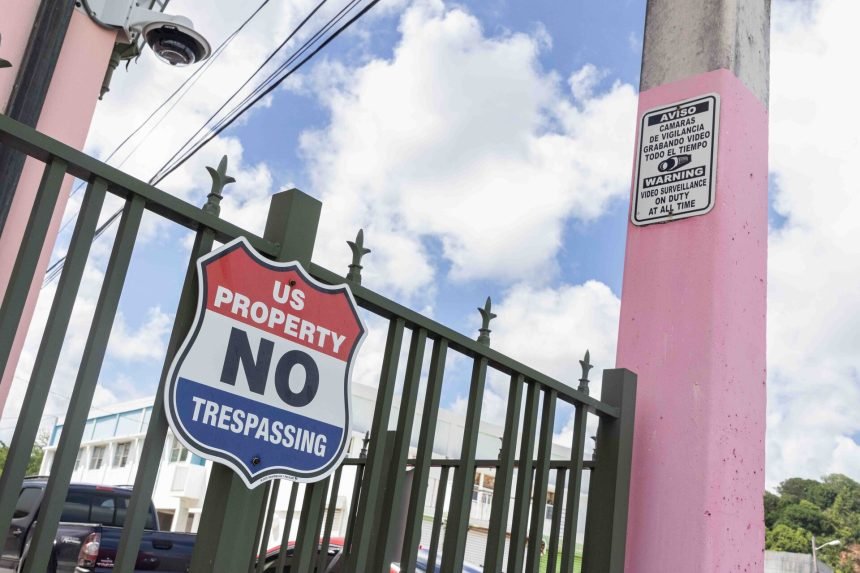
A no trespassing sign, an under surveillance sign, and a security camera at the U.S. Customs House in Fajardo, Puerto Rico (Photo by Carlos Berríos Polanco/The Latino Newsletter)
SAN JUAN — United States Customs and Border Protection (CBP) has built a surveillance network along the coast of Fajardo that watches private marinas, according to procurement records reviewed by The Latino Newsletter.
Closed-Circuit Television (CCTV) cameras were listed at the SunBay Marina, Villa Marina, Marina Puerto Chico, Isleta Marina, Las Croabas, Dos Marinas Rental, and the U.S Customs House in Fajardo, according to the document. Cameras were also listed at San Juan’s Isla Grande Airport and Pier 10, which handles most export business in the archipelago.
The number of cameras installed and their exact locations are unknown. However, The Latino Newsletter visited public docks and boat ramps in the areas listed in the documents and observed several solar-powered surveillance cameras that — although a different brand than listed in the documents — seemed to match the description.
Meant to be integrated into CBP’s existing security network, the cameras can be remotely operated from their central security offices and were designed to “minimize the installation footprint in and around these privately owned marinas,” according to the justification and approval document, which is created prior to a federal agency entering into a contract. The installation started in September 2024 and ended in July, according to the second procurement document.
A publicly available justification and approval document and a heavily redacted statement of work document obtained through a Freedom of Information Act (FOIA) request provide competing reasons for why the surveillance network was installed in Fajardo and San Juan. One document claims that “not having CCTV coverage of private marina’s [sic] encourages both drug and human smuggling.” Meanwhile, the other document claims that it is “needed to safeguard all CBP property and employees.”
“Private marinas are critical points of entry and departure for vessels, making them high-risk areas for smuggling operations. Surveillance in these locations complements other enforcement efforts, including beach patrols and aerial monitoring, to create a layered security approach,” Jeffrey Quiñones, a CBP public affairs officer, wrote in an emailed statement.

Surveillance cameras overlooking a boat ramp near Villa Marina and Dos Marinas in Fajardo, Puerto Rico (Photo by Carlos Berríos Polanco/The Latino Newsletter).
Isander Agosto, the dockmaster for the SunBay Marina, said that his marina has not seen any cases of drug or human trafficking. He also commented that they do not have access to the system installed by CBP, which has an on-site building for customs inspections.
Data about drug trafficking and undocumented migration in Fajardo is not readily accessible. CBP has previously arrested drug traffickers on two separate occasions at the boat ramp in Las Croabas, where The Latino Newsletter observed a solar-powered camera, according to 2018 press releases. Fajardo, a popular boating town of about 31,000 people, had 79 drug-related crimes in 2024, Puerto Rico Police data notes. Luquillo, a municipality next to it with a little over half the population, had 52.
The Latino Newsletter reached out to the other marinas, but they did not respond to a request for comment. The Puerto Rico Port Authority, which oversees airports and ports, did not respond to a request for comment. The Municipality of Fajardo did not immediately respond to a request for comment.
EAS Systems, the company that installed the surveillance system for CBP, declined to comment and referred all questions to CBP.
Privacy Concerns
Surveillance cameras in public docks and private marinas raise serious privacy concerns, according to Jeramie Scott, Senior Counsel for the Electronic Privacy Information Center (EPIC) and Director of its Surveillance Oversight Program. He points out that it is not clear how the videos recorded by the cameras will be used to identify associations with people in the marina, or to create misassociations between people who were simply at the marina when an illicit activity was recorded.
Scott explained that he was unaware of a CBP privacy impact assessment that specifically addressed surveillance in private marinas. He explained that while CBP might try to argue private marina cameras would fall under a previous privacy impact assessment, he believes that it would require an update, if not a new one altogether.
It’s currently unclear what’s being done with the information gathered by the newly installed surveillance cameras. A 2025 privacy impact assessment for closed-circuit television (CCTV) cameras around federal properties says that they keep that surveillance footage for six months.
“There’s a lot of unknowns here, and I think the government, particularly during this current administration, has forfeited any benefit of doubt and trust that citizens might have beforehand because of their willingness not to abide by regulations, by court orders, by the norms established previously by other administrations. It’s important we turn a critical eye to any type of activities by this government, particularly ones that have implications for people’s privacy,” Scott told The Latino Newsletter over the phone.
When The Latino Newsletter reached out for a second round of questions, including whether a previous privacy impact assessment covers the new cameras, CBP did not immediately respond.
Diego Alcalá Laboy, an assistant law professor at Albany Law School who researches surveillance technology, explained that CBP’s camera network is part of the spread of surveillance across the archipelago. The Puerto Rican government has deployed at least 10,179 surveillance cameras across the archipelago, according to his research, he explained.
One of his biggest concerns is how this type of public-facing surveillance has become normalized in many places, without it being clear that people are under surveillance.
The Latino Newsletter did not see any signs posted around the cameras telling people they’re being recorded that match the description in the justification and approval document. In contrast, the Fajardo Customs House has a large sign saying that passersby are under surveillance.
Quiñones, the CBP spokesperson, wrote that surveillance systems “are installed in public or semi-public areas where there is no reasonable expectation of privacy” and that CBP “works closely with marina operators and stakeholders to ensure compliance with legal requirements and notifications may be provided as appropriate.” He wrote that the surveillance is “focused on enhancing security and preventing illegal activities, not monitoring lawful activities of marina clients” and that they aid in the enforcement of small vessel reporting requirements.
Agosto, the dockmaster, said that SunBay Marina has various signs telling people they’re under constant surveillance.
“There’s a difference between surveillance by a private sector entity versus a public sector entity, where the government can bring the state to bear on an individual. There’s more at stake with government surveillance,” Scott said.
The documents referenced in this story can be accessed here.
About the Author
Carlos Berríos Polanco is a journalist from Puerto Rico who covers climate, conflict, and their intersection. He is also the Deputy Editor of The Latino Newsletter’s San Juan bureau.
We want to keep The Latino Newsletter accessible without paywalls. To help, you can donate here. Any amount (one-time or monthly) will keep us going.
What We’re Reading
Operación Mesa Llena: With all that is going on with SNAP benefits from the current government shutdown, we received the following update from our friends at the Latino Equity Fund (LEF) at the Boston Foundation. We felt compelled to share this update from Javier Juárez of LEF with our community:
In the days leading up to the suspension of SNAP benefits on November 1, the Latino Equity Fund acted swiftly to support vulnerable families in our area. In partnership with The Boston Foundation’s Food, Fuel, and Shelter Fund and with a generous 1:1 match from Latino-owned Stop and Compare Markets, we successfully crowd-funded $100,000 in a matter of days prior to November 1.
Utilizing a trusted network of more than 40 community partners and churches in Chelsea, East Boston, and Lynn, we are happy to report that we have finished the distribution for support to 667 households most affected by the pause and reduction in benefits this past weekend.
We named this effort Operación Mesa Llena (Full Table) because every family deserves a seat at a table filled with nourishment and dignity. This campaign shows what is possible when data, philanthropy, community, and local business come together with urgency and purpose.
While the past 72 hours have been hectic, this is the type of collaboration that is so urgently needed in our communities.
Julio Ricardo Varela edited and published this edition of The Latino Newsletter.
Consider donating to The Latino Newsletter. Any contribution, no matter how small, helps keep this newsletter free and accessible to all. ¡Gracias mil!