
The appropriations bill that concluded the longest-ever government shutdown included new limitations on hemp products, a fast-growing Iowa sector that is now facing its second existential battle after a conflict with state regulators last year.
The new federal regulations would remove a legal loophole from the 2018 Farm Act that opened the way to the manufacture of drinks and edibles infused with hemp-derived THC, the psychoactive ingredient in marijuana.
Here’s what to know about the new national hemp restrictions and what they mean for Iowa.
What are the new hemp restrictions?
The new hemp restrictions would lower the total concentration of tetrahydrocannabinol, or THC, permitted in products like low-dose cannabis drinks or edibles. Products containing more than 0.4 milligrams of total THC per container will be outlawed.
Previously, the Farm Bill provision, aimed at encouraging production of hemp, a close marijuana relative which has many uses, placed a 0.3% limit on the THC content of the plants, but not on products made from them.
Currently, more than 90% of nonintoxicating, hemp-derived products contain levels of THC that are greater than the new cap, according to the U.S. Hemp Roundtable.
Banning all products with more than 0.4 milligrams of THC per container could wipe out 95% of the $29 billion industry, according to the U.S. Hemp Roundtable. It also could cost around $1.5 billion in lost tax revenue.
When does the THC law go into effect?
The law will go into effect on Nov. 13, 2026, exactly one year after President Donald Trump signed the 2026 fiscal appropriations law. But Kentucky’s two Republican U.S. senators are girding for a fight that could reshape the provision.
Sen. Mitch McConnell introduced the hemp restriction in the appropriations law to close the legal loophole in the 2018 Farm Act. He said his goal in drastically lowering the allowed level of THC is to keep products that could lead to drug addiction out of the hands of children.
Backing the move were 39 attorneys general from states and territories across the country, including Iowa Attorney General Brenna Bird, who signed a letter urging Congress to close the loophole and clarify the federal definition of hemp. The letter said consumable hemp products were being sold without “consistent age restrictions, labeling standards, or safety requirements.”
McConnell’s fellow Kentucky Republican, Sen. Rand Paul, was one of the authors of the law promoting hemp cultivation. Paul says the industry is in danger of being wiped out by the measure, and “that it takes away consumer choice and destroys the livelihoods of hemp farmers.”
He failed to get the provision removed from the appropriations bill in a Senate vote, but has vowed to continue fighting for its repeal.
What are some Iowa leaders in the THC beverages industry saying?
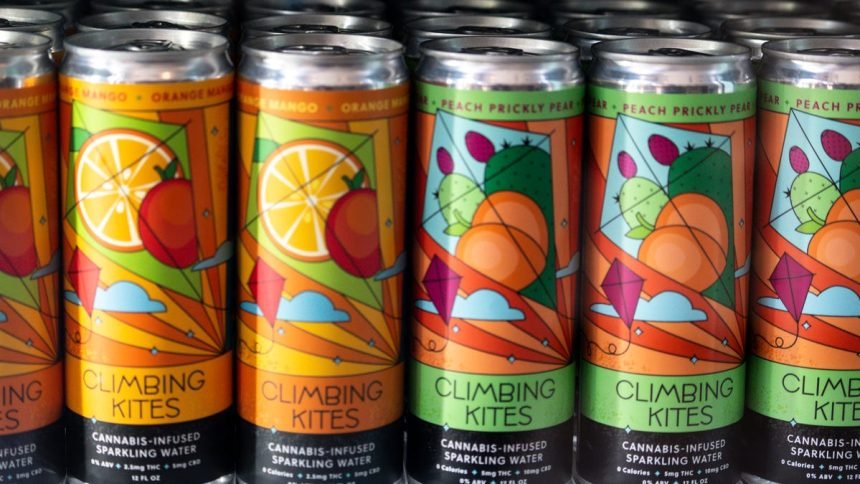
Iowa’s biggest maker of cannabis-infused products is Big Grove Brewery. Its Climbing Kites brand of flavored sparkling waters represent a sizable share of its business.
Lua Brewing, based in Des Moines, introduced the brand in May 2023 and the following February sold a controlling interest to the larger Big Grove, based in Solon. The drinks originally were available with 2.5-, 5- and 10-mg concentrations of THC. Since July 2024, when the state imposed new restrictions, the drink has been available only in 2.5- and 4-mg cans. It’s made under contract in other states, and Big Grove has said plans to move production to Iowa are on indefinite hold.
In a statement responding to the new federal law, Big Grove Marketing Director Bryan Farrell said that “despite those changes, we remain able to continue to sell Climbing Kites at all our Big Grove locations for the time being. We have no plan to do otherwise, but will always follow local, state, and federal guidelines as those continue to evolve.”
“Our hope is that sensible legislation can be agreed upon and enacted to protect this type of product for all our customers,” Farrell said.
Alec Travis of Field Day Brewing in North Liberty, which produces the Daydreamer brand of cannabis-containing drinks in Iowa, said he also intends to carry on.“We feel confident that we’re going to continue on for the next year as well, and then obviously follow all federal and state regulations that do come up as like a final thing,” he said. “But with it being a $29 billion industry, I’m not that concerned about a full ban, 100%, forever.”
He noted that switching production to a state like Illinois, where marijuana is legal, could allow the use of another source of cannabis, but it wouldn’t help with sales in Iowa.
Quinton McClain of Lion Bridge Brewing in Cedar Rapids said he is concerned about the prospect of losing his Moondream beverage brand and a new line of THC-containing gummies at a time when beer sales are flat and young people are buying less alcohol.
“So like, Moondream is a pretty bright spot, and losing it would be substantial, really solid,” McClain said. “Yeah. I mean… it would really be detrimental to our business to lose.”
What are other Iowa THC-product retailers saying?
Ashely Powell, owner of American Shaman shops in West Des Moines and Altoons, said affected products at her business would include even non-intoxicating creams.
“There’s no way we could survive it,” Powell said of the new law.
Are hemp and marijuana the same?
Hemp and marijuana are the same species, according to Healthline. They’re just two different names for cannabis. The main difference between the terms is how much THC each contains.
The term “hemp” is used to mean cannabis that contains 0.3% or less THC content by dry weight, according to Healthline.
Marijuana is generally associated with getting high. The term legally refers to cannabis that has more than 0.3% THC by dry weight.
Marijuana is not legal in Iowa, but hemp products can be sold if they comply with state rules about their content.
Philip Joens covers retail and real estate for the Des Moines Register. He can be reached at 515-284-8184 or pjoens@registermedia.com.
Jessica Risch is a reporter for the Iowa City Press-Citizen.
USA Today, the Knoxville News-Sentinel and Reuters contributed to this article.