The Chicago Bears announced last week that their board of directors voted to proceed with stadium plans in Hammond.
The announcement came less than a week after the Illinois legislature adjourned its spring session without taking up a last-ditch Senate bill that could’ve given the Bears a path to a new stadium in Arlington Heights or Chicago.
But a move to northwest Indiana is far from a done deal. In their statement, the Bears noted they had yet to select an exact location for a stadium in Hammond.
Still, the “pride and joy of Illinois” appears one step closer to a move across state lines. So how did things get to this point?
Here’s a look back at the timeline of events.
Feb. 23, 2021: Churchill Downs Inc. announces it is selling Arlington Park
Louisville, Ky.-based Churchill Downs Inc. originally bought the Arlington Heights racetrack in 2000 for $71 million.
“It’s a sad day when you lose a business that’s been our primary attraction for more than 100 years,” then-Arlington Heights Mayor Tom Hayes said.
The location had been the site of a racetrack since 1927. The original track was destroyed by a fire in 1985, and the rebuilt track reopened in 1989 as Arlington International Racecourse.
June 17, 2021: Bears submit bid to purchase Arlington Park
The Bears, under former President and CEO Ted Phillips, announced they submitted a bid to buy the 326-acre parcel of land from Churchill Downs Inc.
This wasn’t the first time the Bears flirted with the idea of moving to Arlington Heights. In the mid-1970s owner George S. Halas briefly considered a move there. The Bears also considered a move to Evanston or South Bend, Ind., in that era.
The team played its last season at Wrigley Field, its home for 50 years, in 1970. After the AFL-NFL merger, teams were required to have stadiums with a capacity for at least 50,000 fans.
The Bears’ move to Soldier Field in 1971 initially was expected to be temporary. The team looked at other options throughout much of the ’70s before agreeing to a 20-year lease to remain at Soldier Field in July 1980.
In the mid-1990s the Bears again flirted with other ideas — including Gary in 1995 — before Soldier Field was renovated in the early 2000s. The renovated Soldier Field reopened in 2003, and the Bears signed a lease through 2033. The team rents Soldier Field from the Chicago Park District for about $6.5 million per year.
June 17, 2021: Lori Lightfoot takes a shot at the Bears
On the same day the Bears announced they submitted a bid for the Arlington Park property, then-Chicago Mayor Lori Lightfoot ripped the team, calling it “clearly a negotiating tactic that the Bears have used before.”
Lightfoot, a Bears season ticket holder, reiterated that the team was “locked into” its lease on Soldier Field through 2033.
“And like most Bears fans, we want the organization to focus on putting a winning team on the field, beating the Packers finally and being relevant past October,” she added. “Everything else is noise.”
Sept. 29, 2021: Bears enter purchase agreement to buy Arlington Park
The Bears agreed to buy the racetrack and surrounding property for $197.2 million from Churchill Downs Inc. The deal wasn’t official yet, but the parties aimed to close by late 2022 or early 2023.
“Much work remains to be completed, including working closely with the village of Arlington Heights and surrounding communities, before we can close on this transaction,” Phillips said in a statement. “Our goal is to chart a path forward that allows our team to thrive on the field, Chicagoland to prosper from this endeavor and the Bears organization to be ensured a strong future.”
July 25, 2022: Lightfoot proposes adding a roof to Soldier Field

During an event at Soldier Field, Lightfoot proposed the roof — at an estimated cost of $2.2 billion — in an effort to keep the Bears in the city.
The Bears weren’t involved with Lightfoot’s plan and didn’t comment on her proposal. At the event, the mayor said the team would be “foolish” not to consider staying in Chicago.
“The only potential project the Chicago Bears are exploring for a new stadium development is Arlington Park,” the team said in a statement at the time. “As part of our mutual agreement with the seller of that property, we are not pursuing alternative stadium deals or sites, including renovations to Soldier Field, while we are under contract.”
Sept. 8, 2022: Bears hold public meeting regarding plans in Arlington Heights
The Bears hosted several hundred community members at Hersey High School to discuss their stadium project in the northwest suburbs.
At that meeting, Chairman George McCaskey said the team would need government funding to help make the project a reality.
“The Bears will seek no public funding for direct stadium structure construction,” McCaskey said. “However … we will need help.”
Without infrastructure support and “property tax certainty,” McCaskey said, “the project as described tonight will not be able to move forward.”
The Bears also said “there is no Plan B” at the meeting.
Jan. 12, 2023: Bears hire Kevin Warren to replace Ted Phillips

Phillips had announced his plan to retire in September 2022. He remained in place through the 2022 NFL season.
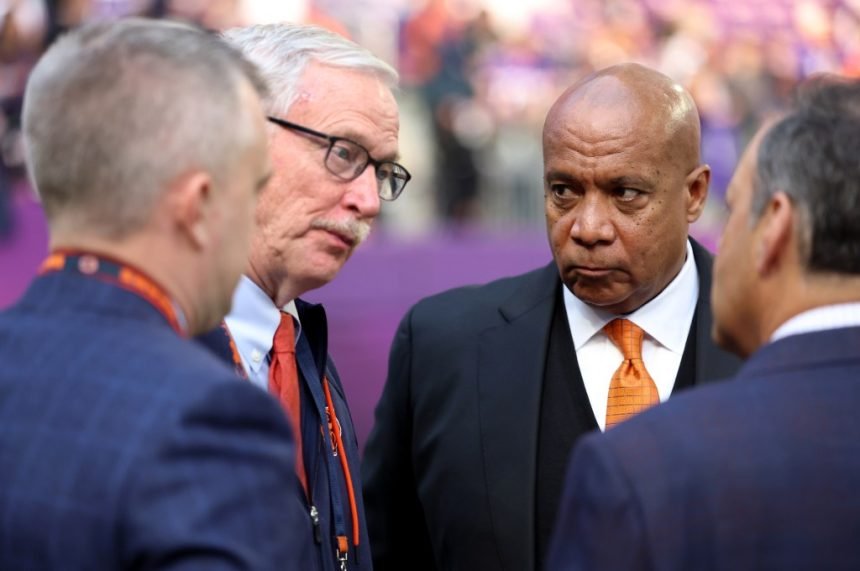
The Bears hired Warren, who had served as commissioner of the Big Ten Conference for three years, to replace Phillips as president and CEO. Before joining the Big Ten, Warren spent 15 years as an executive with the Minnesota Vikings, working his way up to chief operating officer.
With the Vikings, Warren was heavily involved in efforts to get a new stadium built in Minneapolis. The result was U.S. Bank Stadium, which opened in 2016. McCaskey cited those stadium dealings as “an asset” but not “something we specifically were looking for” in a CEO.
The Bears officially introduced Warren with a news conference on Jan. 17.
Feb. 15, 2023: Bears close on their purchase of Arlington Park
The Bears and Churchill Downs Inc. officially closed on the sale for $197 million, about a year and a half after entering into a purchase agreement. The Bears called it “an important next step” but cautioned that plenty of questions still needed to be answered.
Nine days earlier, state legislators in Springfield had proposed the first iteration of the so-called “megaprojects” bill.
May 30, 2023: Bears begin demolition of racecourse grandstand

Haggling over the value of the Arlington Heights property began shortly after the Bears officially bought the racetrack. Three local school districts that would be affected by the development proposed a valuation of $95 million, which for the Bears would’ve resulted in a $7.9 million annual property tax bill. The Bears countered with an offer to pay $4.3 million annually in property tax.
The Bears quickly moved to demolish the grandstand in an effort to get the property reclassified as vacant land.
Summer 2023: Numerous suburbs make their case for a Bears stadium
With the Bears haggling over property tax values in Arlington Heights, other suburban towns made public pitches to be the team’s new home.
In addition to Arlington Heights, Naperville, Waukegan, Rockford and Richton Park were among the towns stumping publicly for a Bears stadium.
Early 2024: A Chicago stadium is back on the table
After spending years exploring a move to Arlington Heights — and in the midst of a property tax dispute — the Bears changed their tune publicly for the first time. The Chicago lakefront was now an option again, with the team eyeing the parking lot area just south of Soldier Field.
At the NFL owners meetings in March, Warren called the Chicago lakefront the “ideal location” for a stadium.
“We did put serious energy — many, many meetings, many conversations, many discussions, many negotiations to get (the tax issue in Arlington Heights) resolved — but also during that time period, my focus was to make sure to evaluate what is the best location in the state of Illinois for the Chicago Bears’ future home,” Warren told the Tribune. “And as I started to study different areas and different sites, it became very, very clear that downtown Chicago, especially along the lakefront, was the ideal location.”
April 24, 2024: Bears propose new lakefront stadium

In a news conference at Soldier Field, the Bears pitched a new domed stadium, complete with a dazzling video introduction and renderings of a reimagined Museum Campus. Chicago Mayor Brandon Johnson, who unseated Lightfoot a year earlier, also spoke at the event and threw his support behind the plan.
The Bears proposed spending $2 billion of their money on the stadium, with $300 million from the NFL plus $900 million from the state using the existing hotel tax that funded the 2002 Soldier Field renovations. The infrastructure bill would cost as much as $1.5 billion on top of stadium construction.
Illinois Gov. J.B. Pritzker, who did not attend the news conference, said he was “skeptical” of the proposal.
The news conference came one day before the Bears selected quarterback Caleb Williams with the No. 1 pick in the NFL draft.
Summer-fall 2024: Lakefront stadium proposal goes nowhere
Despite a tepid response from state and local legislators after their Soldier Field news conference, the Bears remained steadfast that the Chicago lakefront was their priority.
Pritzker met with Warren and the Bears for the first time in mid-July. The governor’s office described the meeting as “cordial.” Pritzker’s position that a lakefront stadium plan was a “nonstarter” did not change after the meeting.
Later that summer, Pritzker said it would be “near impossible” to get a Bears stadium deal done when the legislature returned to session in the fall.
Nov. 12, 2024: Bears reconsider Michael Reese Hospital site
The Tribune and other news outlets reported that the Bears were reconsidering the former hospital site south of McCormick Place. Publicly, the Bears maintained they were focused on their stadium proposal at the Museum Campus.
Warren had previously said the 49-acre Michael Reese site was too narrow for a stadium.
Feb. 6, 2025: Virginia Halas McCaskey dies

The Bears principal owner and daughter of team founder George S. Halas died at age 102.
Chairman George McCaskey, Virginia’s son, said later that spring the family had no intentions of selling the team.
May 16, 2025: Focus returns to Arlington Heights
After a year of pitching a lakefront stadium with little progress, the Bears confirmed they had turned their attention back to Arlington Heights. The Bears likely would need “megaproject” legislation that would allow them to negotiate with local governments over property tax bills.
“Over the last few months, we have made significant progress with the leaders in Arlington Heights and look forward to continuing to work with state and local leaders on making a transformative economic development project for the region a reality,” the team said in a statement.
Warren continued to push for a megaprojects bill throughout the summer of 2025.
Aug. 12, 2025: Indiana takes first steps toward luring a team
With the prospects of a stadium deal moving slowly in Illinois, Indiana lawmakers moved in and established the Northwest Indiana Sports Commission, aimed at luring a pro sports team to northwest Indiana.
The 17-member commission would include mayors from East Chicago, Gary, Hammond, Michigan City, LaPorte, Portage and South Bend.
The new commission could study various plans and recommendations to attract one or more professional sports franchises to northwest Indiana and prepare a comprehensive master plan for building the facilities needed.
Dec. 17, 2025: Bears say they’re considering northwest Indiana

After months of little progress toward a megaprojects bill in Illinois, Warren released a letter to fans saying the Bears were considering northwest Indiana as the site for their new stadium.
“We still believe that Arlington Park is the most viable location in Cook County, but now we’re putting everything back on the table and exploring all options,” Warren wrote.
The Bears previously flirted with a move to Gary in 1995.
A statement from a spokesperson for Pritzker called the idea that the team would move to Indiana “a startling slap in the face” to Bears fans.
Indiana Gov. Mike Braun welcomed the announcement.
“The Chicago Bears recognize Indiana’s pro-business climate, and I am ready to work with them to build a new stadium in Northwest Indiana,” Braun said in a statement.
At the time, Hammond Mayor Thomas McDermott Jr. said he had not spoken with the Bears but would “bend over backwards to do anything I can to help the Bears come here.”
February 2026: Northwest Indiana towns — and even Iowa — make their pitches
Several towns in “The Region” moved quickly to draft proposals to be the site of the future Bears stadium. Gary, Hammond and Portage were among those making public pitches.
Perhaps poking fun at the yearslong saga, Iowa entered the fray. Not long after the Bears said they were considering northwest Indiana, a bill was introduced in the Iowa senate aimed at luring an NFL team to the state.
Meanwhile, in Indianapolis, the Indiana legislature moved quickly to pass a stadium bill aimed at luring the Bears over the border to Hammond. Braun signed the bill into law Feb. 26.
In a statement the Bears said: “Indiana has taken important steps over the last few months, and we are grateful for the leadership reflected by Governor Braun signing SB 27, establishing the framework for a stadium development in Northwest Indiana.”
May 31-June 1, 2026: Illinois legislature fails to finalize a stadium bill before its summer break

The Bears’ megaprojects bill fizzled on the second-to-last day of the session. On the final day, a new bill was introduced at 11 p.m. and both houses went into overtime.
The new measure would’ve allowed Cook County cities with more than 70,000 residents — most notably Arlington Heights and Chicago — to create their own stadium finance authorities.
In the wee hours of June 1, the Illinois legislature adjourned for the summer without voting on a resolution.
June 5, 2026: Bears say they’re moving forward in northwest Indiana
The Bears announced their board of directors voted to move forward with stadium plans in Hammond. They said the exact site was still to be determined.
The team carefully worded the language of its announcement to allow for a different outcome. At least two Illinois lawmakers said Warren gave them advance notice of the announcement, and Warren suggested talks about staying in Illinois would continue.