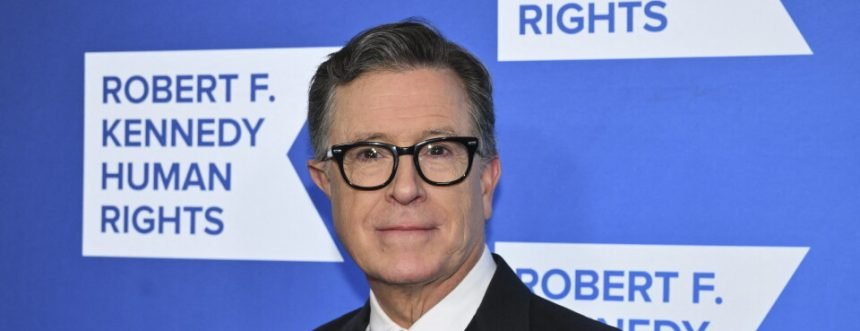
Stephen Colbert’s joke of having his band play “Charlie Brown” music in a mock effort to saddle CBS with copyright liability may not actually create any, but it incidentally evokes an area of the law with nebulous boundaries.
During the last episode of The Late Show, Colbert mentioned Lee Mendelson Film Productions—which owns copyrights to music from the Peanuts comic strip, film, and television franchise—filing a series of infringement lawsuits a day earlier.
“Anyone illegally using that music is going to have to pay through the nose,” he said—at which point his house band began playing the iconic tune “Linus and Lucy.”
“Oh no I hope this doesn’t cost CBS any money,” Colbert said sarcastically.
CBS all but certainly had a license to perform the work, and if not, there’s a strong argument in favor of the fair use exception to copyright liability.
But use of the music also touches on issues involving “synchronization rights”—a separate right to use music that appears in an audio-visual work.
The concept arose from a 1948 New York federal court case describing the form of copyright movie studios acquired in order to use music in their films. Theaters didn’t have to separately pay the performance rights organization for the right to use the songs on top of rights to play the movie because the movie producer already had paid for the right to incorporate the music into their work, the court said.
How exactly that right relates to taped television performances and rebroadcasts on TV and online isn’t well-tested.
John Simson, a professor of IP law at American University, said there’s a broad assumption that a sync license is required to do virtually anything with a taped performance.
“Publishers in the US have taken the position that it’s a sync even if you just show video of a performance,” said Simson, former executive director of sound recording rights clearinghouse SoundExchange. “I don’t really agree with that.”
“No one’s really gone to the mat on that” by taking a case far enough to set precedential boundaries for what kinds of re-uses of already-licensed works require a distinct sync license, he said.
Fair Use
Colbert’s exit from CBS became a national conversation after the Paramount Skydance Corp. entity chose not to renew The Late Show after his 11-year run.
CBS characterized the move as purely financial, while Colbert tied the decision to his criticisms of President Donald Trump as Paramount sought federal approval of its $8 billion merger with Skydance.
The segment in his May 21 finale tied that thread together with the Mendelson Films litigation, and fans cheered his seeming attempt to stick it to CBS as the clip went viral.
But while the lawsuit bait may be a good joke, it’s not likely to drag the network into a courtroom.
Fair use turns on four factors: nature of the use, nature of the original work, amount used, and impact on the original’s market.
The first and potentially most pivotal factor turns largely on whether the use of the work has a different purpose than the original.
“Fair use is the universal solvent, and I think that clearly would have been fair use. They were commenting on the lawsuit, they played a small bit of the music,” Robert Clarida of Reitler Kailas & Rosenblatt LLP said of the Colbert segment. “It’s certainly not a substitute for hearing the whole Peanuts soundtrack.”
“Colbert is very clever, and was making fun really of two things at once,” said David Leichtman of Leichtman Law PLLC. “There’s no basis for the Peanuts folks to come after him.”
Clarida said using “Linus and Lucy” in the two-pronged joke clearly transformed the purpose of the original 1963 composition.
Courts have routinely cleared limited use of protected works in news or news commentary segments that are designed to help tell the story, he said.
Covering Bases
“If they were really going to be sticking CBS with a high risk of legal liability, CBS could have just not aired the segment,” said Georgetown University IP law professor Kristelia García.
Even absent fair use, most large entertainment entities carry licenses from the two major performance rights organizations—ASCAP and BMI—that manage songwriter rights and collect royalties for millions of songs, attorneys said. CBS probably has licenses from even lesser PROs, García said, clearing its right to performances of virtually all commercial music compositions.
But the sync rights issue remains the wild card.
While a BMI license covers the live performance during the show as long as CBS pays the royalty—and as a compulsory license, with or without rights-owner approval—that doesn’t cover copying and displaying an audiovisual work with it.
“If you really wanted to be super aggressive, you could assert they needed to make a sync license to make a recording,” Clarida said.
García said CBS would indeed need—and probably secured—a sync license to cover the bit, because “it’s not as simple as having an ASCAP or BMI license.”
Performance rights from BMI only cover the performance of musical compositions, and there’s no compulsory license or organization selling blanket rights, so sync licenses must have rights-holder approval.
A right designed to avert double-payment can be interpreted to demand separate payments to perform a work and then post that performance online.
But García and Simson said the Copyright Act still hasn’t codified sync licenses, and rights-holders broadly accept platform solutions like YouTube’s content ID, where their work is identified wherever it appears and they can collect royalties.
Because of that and the entertainment industry’s inclination to settle or pay licenses in ambiguous situations, the legal assumption remains untested.
“It could be that CBS rolled the dice” and relied on a public performance license from BMI, García said. “But CBS doesn’t seem all that risk-loving to me.”