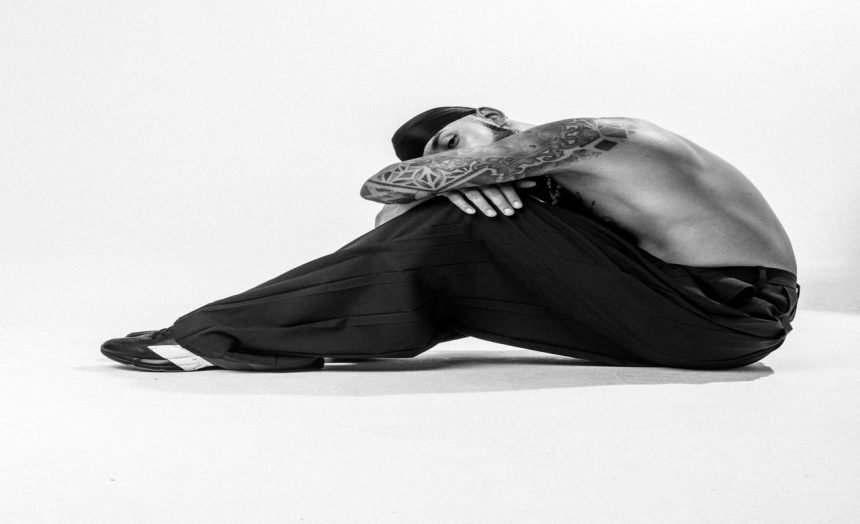
For years, Latin urban music built much of its identity around a familiar male archetype: self-assured, dominant, emotionally impenetrable, and defined by codes of success, power, and control. That narrative helped establish a global cultural phenomenon, but it also left little room for alternative ways of understanding masculinity. Enter NUP, a Colombian producer, songwriter, and creative force who has chosen to travel in the opposite direction.
While much of the industry continues to reproduce traditional models of manhood, NUP has placed sensitivity, aesthetics, and emotional vulnerability at the center of an artistic vision that extends far beyond music. His project blends sound, fashion, and personal storytelling from an intimate and reflective perspective—a rare combination within a creative ecosystem that has historically rewarded images of unshakable strength.
Although his name may still be more familiar to industry insiders than to the general public, his résumé speaks for itself. Over the past several years, he has contributed to creative projects involving some of the most influential figures in Latin music, including Shakira, Ricky Martin, J Balvin, Ryan Castro, Beéle, and Nicki Nicole. Yet the driving force behind his work appears deliberately detached from the pursuit of commercial hits. For NUP, the greater challenge is building an artistic identity capable of questioning how the contemporary Latino man is defined.
That vision was not born in multimillion-dollar recording studios or within the exclusive circles of high fashion. His story began far from the spotlight, among Colombia’s coffee-growing mountains, music rehearsals, and a rigorous artistic education. Before becoming a producer, Alejandro—his real name—spent nearly a decade studying trumpet performance in symphonic bands. Classical music occupied much of his childhood and adolescence, while rural life with his grandparents instilled values of discipline and perseverance that would later prove essential.
As Medellín emerged as one of the world’s leading hubs for urban music, however, he found himself facing a different reality. He watched other artists advance rapidly while he remained paralyzed by uncertainty and self-doubt. That feeling of being left behind eventually became a turning point. Rather than following the safest path, he walked away from opportunities many would have considered ideal and embarked on a solo journey to New York to study music production. What he encountered was far removed from the romanticized image often associated with success stories.
The city offered uncertainty before opportunity. During that period, he worked in restaurants, washed cars, and took on physically demanding jobs to survive. He moved between New Jersey and Manhattan, facing financial hardship while trying to remain close to his creative aspirations. Ironically, it was during one of the most difficult periods of his life that he began building the project that now defines his career. During a historic snowstorm, he found himself virtually isolated for weeks. Armed with limited resources, an aging computer, and a growing sense of determination, he transformed confinement into an improvised school of music production.
Those long days became an exercise in self-education. Through reading, experimentation, and countless nights creating beats, he began developing the creative language that would eventually lead him to collaborate with some of Latin music’s biggest stars. His return to Medellín marked the beginning of a new chapter. There, he gained a close-up view of an industry already operating on a global scale. One of the most influential figures in that process was Sky Rompiendo, whom NUP credits as a decisive influence on his professional development.
Rather than serving as a formal school, the experience became an ongoing laboratory of observation. While others sought the spotlight, he chose to listen, analyze, and absorb knowledge. He learned how songs are built, how international music dynamics function, and how the creative processes behind major artists unfold. Yet while music opened professional doors, fashion gradually became the space where he felt most free to express himself.
For NUP, clothing is not a superficial exercise tied to luxury or fleeting trends. Instead, it has become a tool for challenging deeply rooted assumptions about masculinity. Through aesthetics, he found a way to ask questions that music alone could not always articulate. His approach confronts a belief still present across much of Latin American culture: that sensitivity and strength are opposing concepts. In his view, a man can embrace elements traditionally labeled as feminine without sacrificing leadership, confidence, or character.
That perspective aligns with a broader cultural conversation unfolding among a new generation of artists, designers, and creators. The rigid boundaries that defined male identity for decades are beginning to dissolve, making room for more complex and diverse expressions of self. NUP understands that fashion can communicate emotions, contradictions, and personal journeys with an intensity comparable to music itself. That is why he resists defining himself solely as a producer, designer, or model. Instead, he moves fluidly between disciplines, using each as an extension of the others.
This fusion of sound, image, and personal reflection is precisely what distinguishes his work within an industry accustomed to placing its figures into clearly defined categories. Today, while continuing to participate in high-profile Latin music projects, he is also building a narrative that reaches beyond entertainment. His work poses an increasingly relevant question for contemporary culture: What does it mean to be a man in a generation that no longer accepts singular definitions or inherited models?
At least in NUP’s case, the answer appears to lie at the intersection of creativity, sensitivity, and authenticity—a space where vulnerability ceases to be a weakness and becomes a form of expression, and where identity is shaped not by imposed rules, but by the freedom to reinvent them.