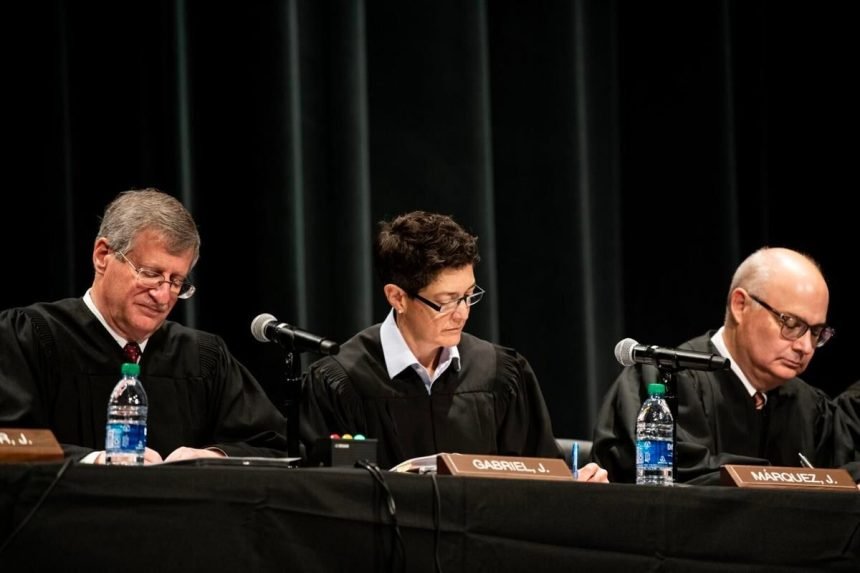
The Colorado Supreme Court blocked all attempts at redrawing congressional district boundaries for the 2028 election from reaching the ballot on Monday, concluding each of the proposed ballot measures violated the constitutional single-subject requirement.
The court considered five distinct but related ballot measures. Half of the proposals would have redrawn U.S. House of Representatives districts to give Democrats an overwhelming advantage, while the other half would have alternatively given Republicans a slightly larger advantage over the status quo. There was also a separate measure to alter the redistricting commission that drew the current boundaries.
The Supreme Court held that changing the state’s process for redistricting and approving new maps, either together or through separate interlocking initiatives, violated the Colorado Constitution.
“To conclude otherwise and to allow initiative proponents to proceed with interlocking measures like those at issue here would allow proponents to achieve indirectly what they could not achieve directly and would endorse an end run around the single subject requirement. This we cannot do,” wrote Justice Richard L. Gabriel in the June 29 opinion pertaining to the three interlocking ballot measures.
The proposed initiatives arose as part of an unprecedented national effort to redraw congressional districts for partisan advantage ahead of the 2026 and 2028 elections.
Last year, the Texas legislature, at the urging of President Donald Trump, redrew its House districts in advance of the next census to give Republicans the ability to win five more districts over the existing map. The move came as Democrats appeared, according to observers, likely to win a majority in this year’s elections for the U.S. House.
Then California voters approved a ballot measure in November to create a map with five additional seats favoring Democrats.
According to the National Conference of State Legislatures, 10 states have completed mid-decade redistricting to date, with more GOP-run states redrawing their districts. In some states, courts have rendered the ultimate decision.
For example, in Virginia, where voters narrowly approved a constitutional amendment that drew Democratic-leaning districts, the state Supreme Court’s majority struck down the change in May. In Utah, the state Supreme Court upheld a trial judge’s order to redraw boundaries to create one Democratic-leaning district.
Then, after the U.S. Supreme Court’s 6-3 decision in Louisiana v. Callais, multiple states in the South redrew their boundaries to eliminate districts with large populations of Black voters.
In Colorado, there were five measures proposed for the 2026 general election ballot that would alter district lines and the current 4-4 partisan split of the congressional delegation. Two of them were competing proposals that would comprehensively amend the state constitution to allow for mid-decade redistricting, circumvent the independent redistricting commission that approved the current boundaries, and adopt maps for the 2028 and 2030 elections — either favoring Democrats by 7-1 or favoring Republicans by 5-3.
The measures favoring Democrats were introduced first. In response, the map tilting toward Republicans was drawn, with Scott Gessler, a Republican former secretary of state, telling the Title Board they would only work to advance their map if one measure or a combination of initiatives favoring Democrats advances.
The other three proposals, backed by either Republicans or Democrats, would have accomplished the same goal in a multistep fashion. One initiative would have moved the language governing the redistricting commission out of the state constitution. The other two proposals would then implement new 2028 and 2030 maps, favoring either Democrats or Republicans. The parallel redistricting efforts would only take effect if voters approved the change to the commission on top of a new map.
In a pair of decisions addressing each method, the Supreme Court decided neither was permissible.
“We conclude that these are distinct and separate subjects. Temporarily allowing mid-decade redistricting is not merely the means to implement or effectuate the Initiatives’ central purpose of adopting a specific new congressional district map for the 2028 and 2030 election cycles,” wrote Chief Justice Monica M. Márquez in the decision addressing the two combined measures.
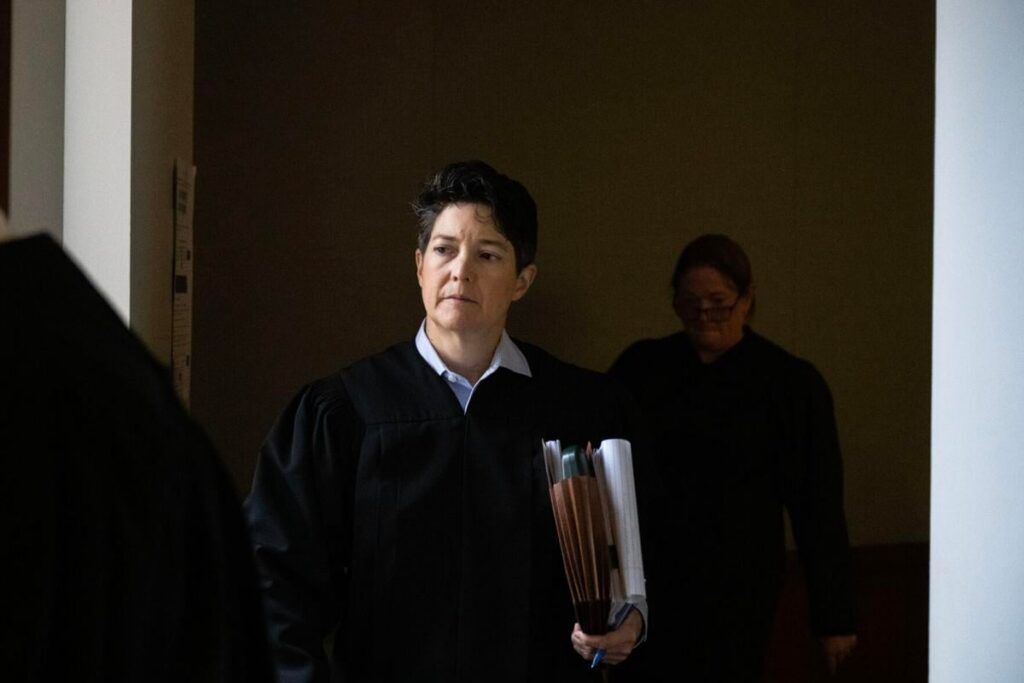
She added that authorizing mid-decade redistricting would be “a seismic shift,” and that some voters could prefer to redraw congressional district boundaries sooner or alter the redistricting commission’s power without supporting the specific maps envisioned.
“Conversely, other voters may support adopting one of the initiative’s specific maps to achieve partisan ends, but they might value the stability and continuity that comes with redistricting only once a decade,” wrote Márquez.
Gabriel, in the decision addressing the interlocking initiatives, wrote that breaking down the process into separate, but automatically connected, measures did not change the calculus.
“We conclude that the result is not different and that when a measure’s effectiveness is expressly contingent on the passage of a separate and independent measure, the measure contains multiple subjects, just as if the measures were combined into one,” he wrote.
Curtis Hubbard of Coloradans for a Level Playing Field, which advocated for the pro-Democratic measures, said the effort to counteract Trump’s national redistricting push has “been dealt a legal setback over a technicality.”
“The success of this partisan attempt to sideline Coloradans from responding to Donald Trump’s unprecedented mid-decade redistricting scheme is disappointing,” said Hubbard.
“Eight years ago, Colorado voters strongly supported an independent redistricting commission. Today, the court soundly rejected the Democratic efforts to manipulate the ballot process to overturn Colorado’s nonpartisan redistricting process,” said Gessler, who represented the proponents for the pro-GOP measures.
Gessler acknowledged that his clients’ proposals would have affected the redistricting process identically.