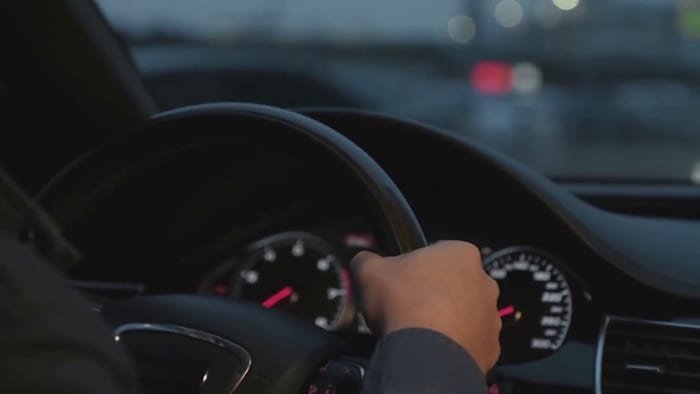
BLACKSBURG, Va. – A federal law may soon require automakers to build impaired driver detection technology into new vehicles — and researchers at Virginia Tech say the science is advancing, but a critical gap remains before it’s ready.
More than 12,000 people in the United States die each year as a result of impaired driving, according to the broadcast report. New biometric sensing systems — designed to monitor a driver’s respiration rate, heart rate, and eye movements for signs of impairment — are now being tested as part of a potential mandate targeting 2027 model-year vehicles and newer.
Miguel Perez, head of Virginia Tech’s Department of Biomedical Engineering, said the technology has made meaningful progress, but precision remains a challenge.
“There’s certainly a lot of advances that have been done,” Perez said. “The sensing is much better. Our ability to use the information from the sensors to detect impairment is better. But there’s still a gap between all that and then the ability to detect impairment with enough precision.”
How the technology works
The systems under development use multiple detection methods. Steven Benvenisti, a MADD ambassador and attorney with Davis, Saperstein & Saloman, said the approach is intentionally hands-off for the driver.
“The technology is entirely passive, which means that it operates without the driver even knowing, without the driver engaging in the technology in any way, and seamlessly ensures that there will be a normal driving experience except for those who are attempting to drive drunk,” Benvenisti said.
Automobile suppliers are currently developing breath-based, touch-based, and eye movement monitoring systems — all of which would factor into a determination of whether a driver is impaired, Benvenisti said.
Perez described the broader category of sensors being explored.
“There’s newer technologies that are being tested. And that goes more towards what I would call biometrics — bodily markers that can be tied to impairment in some way, shape or form,” he said.
Researchers urge caution on timeline
Despite the potential of the technology, both Perez and Dunn said the 2027 target for in-vehicle implementation was never realistic.
Perez said the original timeline for implementation in 2027 model-year vehicles may be too ambitious.
“The reality is that I don’t think we’re quite ready for that level of implementation,” he said.
Naomi Dunn, a research scientist at the Virginia Tech Transportation Institute, was more direct.
“That timeline to have these technologies installed in vehicles by 2027 was optimistic at best,” Dunn said. “Considering the technologies — what does exist is not at a point where it’s ready for deployment. So it’s not necessarily that it’s been stalled. There’s a huge amount of research activity that’s ongoing in the area to try and push these things forward. But it’s a matter of making sure that what comes out of this is actually done correctly.”
Dunn said accuracy and reliability are non-negotiable before any widespread rollout.
“A technology like this has the potential to save thousands of lives every year, but only if it’s done correctly,” she said. “And by correctly, I mean doing whatever we can to make it as accurate and as reliable as possible.”
She also flagged public trust as a major hurdle.
“Consumer acceptance and public trust in technologies — in any kind of technologies in vehicles — is paramount. But especially for something like this, where the technology is potentially making a judgment about whether or not you’re okay to drive,” Dunn said.
Broader safety implications
Perez said the goal of impaired driver monitoring goes beyond identifying a single driver — it’s about protecting everyone on the road.
“It’s more about an overall safety envelope and overall safety margin that looks not only at the driver, as an actor, but at everybody that is surrounding that vehicle and is part of the transportation ecosystem,” he said.
Benvenisti knows the cost of impaired driving firsthand. A drunk driver struck him during spring break when he was 21 years old, crushing his legs and leaving him in a coma. His parents were asked to consent to organ donation. Doctors told him he would never walk again. He recovered — and now he represents victims of drunk driving as an attorney and advocates against impaired driving as a MADD ambassador.
“My parents were asked to consent to my organ donation. And when I woke up, I realized everything that had been stolen because of a drunk driver,” Benvenisti said. “I made a pledge then that if there was a way for me to have a 100 percent full recovery, I’d spend the rest of my life doing everything I could to end drunk and impaired driving.”
He said the stakes of getting this legislation right are significant.
“We would probably save 10,000 people every single year if this technology was implemented in every single vehicle,” Benvenisti said. “The biggest responsibility and the biggest goal of this anti-drunk driving law is to protect the public and to save lives.”
A long road ahead
Even after the technology clears scientific and regulatory hurdles, Perez and Dunn said it will take considerable time before most vehicles on U.S. roads are equipped with impaired driver monitoring systems.
Copyright 2026 by WSLS 10 – All rights reserved.