Some Hamilton County school board members are questioning whether the district needs an educator diversity policy.
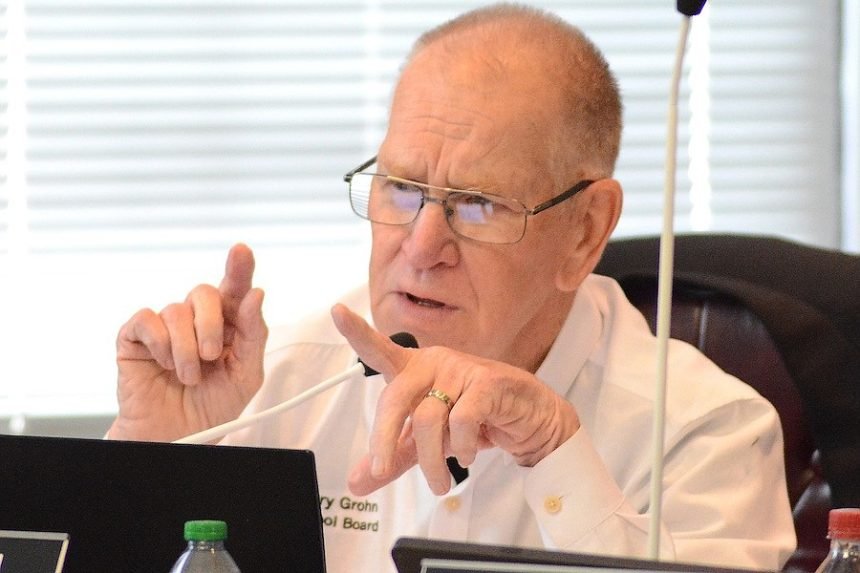
“If we’re truly honoring what is the moral, right thing to do and following federal law, we’re not supposed to discriminate on race, ethnicity, language, socioeconomic backgrounds, gender, sex, anything,” school board member Larry Grohn, R-East Ridge, said at Monday’s policy committee meeting. “I don’t think we need this policy. We’re going to be looking for the best candidate. When you introduce something like this, that says you’re going to put extra emphasis that automatically defers discrimination.”
He called it “a racist policy.”
In response, Superintendent Justin Robertson said anything Hamilton County Schools does will follow the state and federal law as applicable.
“What I think is important here is what we’re signaling to a district that’s made up of, 54% of its kids are either Black or Latino, and that is a very diverse district,” Robertson said. “Right now, our educator force is nowhere close to matching that demographic, and I think what the policy does is, it shows effort on the part of the board and the administration to hire and recruit without lowering the standard.
“I think it’s very important that we emphasize that point,” Robertson continued. “We’re not lowering the standard, but we’re saying that we are going to be intentional about trying to recruit teachers that reflect the demographics of our students.”
(READ MORE: Hamilton County school board approves five mental health providers)
During the 2023-24 school year, the most recent data published by the Tennessee Department of Education, 78.1% of Hamilton County teachers were white, 7.3% were Black and 2.8% were Hispanic. That year, 46% of students were white, 29% were Black and 21% were Hispanic.
The educator diversity policy dates to a 2019 Tennessee law that required school boards to set goals for educator diversity that took into consideration the diversity of the students it serves. It took effect with the start of the 2021-22 school year, before a Republican push to undo diversity, equity and inclusion programs took root in Tennessee and nationwide.
The law remained on the books until earlier this year, when Tennessee lawmakers passed the Dismantle DEI in Employment Act, which aimed to end initiatives in school districts, public universities and local governments that promote considering race, gender, national origin, age and other characteristics in hiring decisions. It also repealed the previous requirement for districts to have an educator diversity policy.
In July, the Hamilton County school board updated its educator diversity policy to reflect the change in state law. Under the updated policy, educator diversity refers to a teacher workforce that “reflects a broad range of backgrounds, experiences and perspectives, including but not limited to race, ethnicity, language, socioeconomic backgrounds and pathways into the profession.”
Black males make up roughly 12% to 13% of the student body, while the number of Black male teachers is less than 3%, Robertson said.
“There’s nothing that’s lowering the bar to say that we’re going to lower the bar to make sure we get more Black male teachers, but we do need to be cognizant of that,” he said. “Because what we know is that the teachers that impacted me were teachers that I could relate to and that I could know. And I’m not saying that we can’t relate to all kids, but there is something about seeing a teacher that looks like you in front of you.”
A number of research studies suggest students benefit from having a teacher of the same race or ethnicity.
Robertson noted that the policy also refers to socioeconomic background, which includes recruiting teachers who were first-generation college students so that they can set an example and mentor students.
One of the aspects of the policy that came under discussion Monday was that it states that one strategy to recruit and retain diverse educators is to work with educator preparation programs to identify any potential barriers to entry or completion for minority educators and to develop strategies to remove these barriers. Some board members questioned the language around removing barriers.
“I’m for supporting diversity, but I don’t believe in going overboard and a lot of extra expense and choosing candidates over other qualified candidates, more qualified,” said school board member Felice Hadden, R-Ooltewah.
She asked what strategies and expenses were going toward removing barriers.
Chief Talent Officer Zac Brown pointed to the district’s leadership development programs that allow current teachers and administrators to prepare to take on other roles. For instance, he said, when a Black man is admitted to one of the programs, sometimes people think an urban school is the best location for them, but the district recognizes that might not be the case.
Like it does for all candidates, he said, the district spends a lot of time ensuring it has the right person in the right place. It also ensures the district doesn’t have structures that mean it naturally moves people to different places because it believes that’s their best fit without talking to the educator.
Brown said he wrestles with the district having 3,500 teachers, but he struggles to maintain a workforce that’s 10% teachers of color.
“I have to say strategies are needed if we want to make sure we have a high quality and a diverse workforce,” he said. “But again, will of the board, policy or no policy, I will continue to do all I can to attract the best people for our kids here in Hamilton County. But again, please ask yourself, 10%, and it’s been like that for years.”
Contact education reporter Shannon Coan at scoan@timesfreepress.com or 423-757-6396.