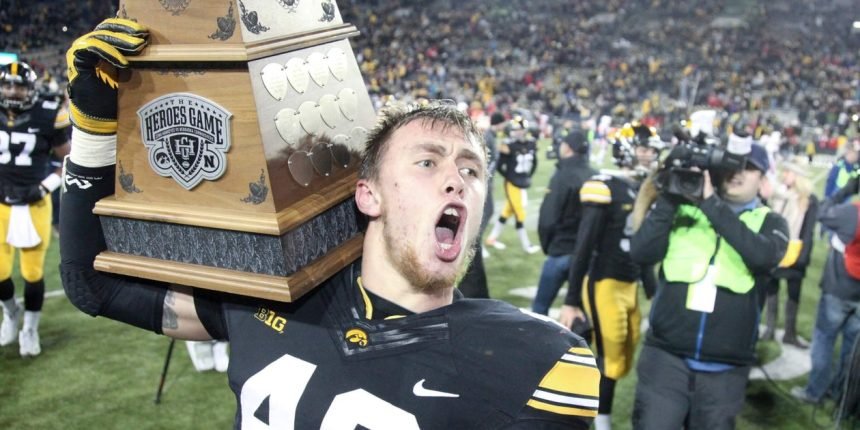
If the San Francisco 49ers ever need a reminder that “character” concerns can get overblown leading up to the NFL Draft, they need only glance at their 10-year wall.
In the run-up to the 2017 draft, team officials had to reconcile the unique skills they saw in a certain prospect with a few unfavorable reports coming from his college program. The player had a reputation as a frat guy, a social butterfly, a party animal. He was rowdy and irreverent. He was someone who marched to the beat of his own drummer.
That prospect: then-Iowa tight end George Kittle.
Yes, the same Kittle who’s been to seven Pro Bowls, who’s become a de facto team spokesman and whom the 49ers last month tapped to close the deal with free-agent wide receiver Mike Evans. The same Kittle who hosts 75 cohorts at Tight End University each summer and is entering his 10th season with the 49ers, a feat recognized with a place on their revered 10-year wall. The same Kittle who’s already built a strong argument for the Pro Football Hall of Fame.
In 2017, that George Kittle had an asterisk next to his name.
At the time, coach Kyle Shanahan and general manager John Lynch were looking closely at Iowa quarterback C.J. Beathard, whom they’d later draft in the third round. Lynch recalled Shanahan stopping the film and pointing out another player, No. 46.
“He was skinny back then,” Lynch said of Kittle. “He didn’t weigh a lot. But he was just closing down one side of the line of scrimmage and could really uncoil. And Kyle would say, ‘This is what it looks like. When you see a guy with this kind of forward lean.’ … He goes, ‘That’s really intriguing. That’s a skill.’”
The problem was that their scouts didn’t have No. 46 ranked very highly, which was at least partly because of the feedback coming out of Iowa. The Hawkeyes ran a notoriously tight ship, and Kittle … well, Kittle was more like Jack Sparrow.
“They called him a frat guy,” Lynch said. “They said he liked to party, to have a good time. And apparently at Iowa, that wasn’t a great thing.”
“They weren’t selling him,” said then-49ers quarterbacks coach Rich Scangarello, who went to Iowa to work out Beathard and Kittle before the draft. “They weren’t standing behind the guy. I think it takes just one person in the building to say something negative. Then all of a sudden, right or wrong, a narrative can form about an individual.”
Said LeVar Woods, who took over as Iowa’s tight ends coach before Kittle’s breakout junior season: “I think maybe there were some people in the building at the time that weren’t necessarily on George’s side. And I feel like maybe some of the NFL people didn’t talk to everybody involved with George, myself included.”
Woods, who now coaches at Michigan State, noted that Kittle arrived at Iowa with little fanfare. He was a 200-pound high school receiver with long arms and knobby knees, and no one knew where to put him. Was he a wide receiver? A tight end? At one point, the Hawkeyes tried him at outside linebacker, the position Woods was coaching when Kittle arrived. Woods didn’t like the fit.
“And I would say this to George’s face: I was not in support of that,” he said. “I’d only ever seen him go forward.”
Woods recalled Kittle making a splash as a redshirt freshman. He didn’t appear in games and didn’t travel with the team. So he put all of his energy — all of his creative energy — into his role on the scout team. Before the week of practice began, he’d go to the arts and crafts store, stock up on tape and markers, and fashion his helmet and uniform to look like Iowa’s opponent — all white with a red N when they played Nebraska, maize and blue for Michigan week and so on. Then he, Beathard and the other scout teamers would take it to the starters.
“They had a blast with it,” Woods said.
When Woods took over the tight ends in 2015, Kittle was third on the offseason depth chart. An injury to a senior elevated him to a starting role, and he took advantage, finishing with a team-best six receiving touchdowns. His final season, however, was a bit of a letdown. A foot injury limited Kittle to 22 catches and four touchdowns, which was another factor in his middling draft stock — he didn’t finish his college career with momentum.
Still, the 49ers found his blocking too impressive to ignore. And when he ran a 4.52-second 40-yard dash at the NFL Scouting Combine, they began to dig deeper.
They started with Beathard, someone they were certain had exemplary character. When they learned Beathard was not only close friends with Kittle but also his roommate, they started asking questions.
“There’s a wisdom about him,” Lynch said of Beathard. “He’s kind of country — a man of few words who said a lot when he did speak. And when we asked about George, it was, ‘Oh man, love the guy. I think we underutilized him in the pass game. I think he can be a threat in the pass game. And we just didn’t use him.’”
The 49ers also sent Scangarello to Iowa City. His chief objective was to watch Beathard throw, but his side mission — get more insight into Kittle — became increasingly important.
“I told C.J, ‘I’m coming down to work you out. George has to be there,’” Scangarello said.
There was one problem: The fun-loving tight end had just started his spring break. His last exam was on a Thursday, and the 49ers’ workout was scheduled for 10 a.m. Friday.
“And I gave him the most grueling workout,” Scangarello said. “I sent him on so many routes. … He was so hungover. And halfway through the drill, he went over to the garbage can and puked. And then he came right back to me and goes, ‘Let’s do more!’ He just had this attitude. Like, ‘I can go all day.’ It was crazy. It was everything you want in a player (as far as) that killer instinct. It was one of the most impressive workouts I’ve ever seen.”
Kittle has a slightly different recollection. He agrees the workout went well — “I had two one-handed catches; I was playing absolutely out of my mind,” he said — and doesn’t deny that he celebrated his last exam in style.
“I vividly remember that night,” he said. “I have a photo of it on my phone, actually. It was a fantastic night — had a great time.”
But he said he initially wasn’t supposed to be part of the workout. He’d had sessions with two other NFL teams that week, and Beathard had other targets to help with his workout. It was only when two Iowa receivers bailed at the last minute that Beathard called Kittle — at 8 a.m. — and begged him to take part.
“I would not have gone out the night before if I’d known I had a workout,” Kittle said. “So I sat in the hot tub and the ice tub for about an hour, drank about 12 Gatorades and went and had the workout of my life.”
Finally, the 49ers hosted Kittle at team headquarters for one of their 30 pre-draft visits. The visits include face time with the head coach and general manager and a group outing to Topgolf, something the 49ers did this week for the upcoming draft. The team likes to use its allotment of 30 visits on prospects it really likes or those with character questions — a broad, vague term that could mean different things to different teams.
Kittle was a little of both, and the 49ers were glad they brought him in. One of the notes in Kittle’s draft dossier was that “being cool and funny is really important to him,” which Iowa might have viewed as a negative. San Francisco didn’t.
“It helped being around him,” Lynch said. “We thought he had tremendous energy. He was funny. But that wasn’t a bad thing. He was cool, kind of quirky. He wasn’t afraid to talk to the GM and the head coach like a lot of guys are on their 30 visits. George had a comfort about him that was kind of refreshing. We thought his 30 visit was very positive. And so it was an avalanche of momentum.”
After the visit, the 49ers gave Kittle a third-round draft grade.
“But we kept saying, ‘The way (Iowa) talked about him, we don’t think he’s going until the fifth,’” Lynch said. “So we were hanging on.”
San Francisco took Kittle at No. 146, the second pick in the fifth round and one spot after the Denver Broncos took Michigan tight end Jake Butt.
“We got him,” Lynch said. “It was well worth it.”
Woods noted that the same personality traits — the mischief, the mirth, the rowdiness — that ran counter to Iowa’s rigid culture are celebrated in Kittle today.
“It’s natural,” he said. “He’s not faking it. It’s who he is. People gravitate to genuine people. And George is very genuine. And he makes you love him. It’s hard not to like George Kittle. And to me, if you don’t like George Kittle, that says more about you than it does George Kittle.”
And, true to form, Kittle doesn’t hold a grudge. He noted that he got to play with his cousin, Henry Krieger-Coble, for four years at Iowa and developed lifelong friendships with Beathard and others. He’s taking five of them to WrestleMania this weekend.
“I didn’t really drink the Kool-Aid the way they wanted me to drink the Kool-Aid,” he said. “And it’s not just Iowa. It’s a lot of colleges. When you don’t drink the Kool-Aid the way they want you to, they try to make life a little harder on you to see if you’ll bail on it because they try to get people like that out of the system.”
He said the resilience he developed in Iowa City has served him well in the NFL.
“Could it have probably been a little bit easier? Sure,” Kittle said. “But that’s college. And I honestly wouldn’t trade it. Because the friendships I made back then and the experiences I had at the University of Iowa — I had a fantastic time. I bet you I had more fun than almost every NFL athlete in college.”