Each year, hundreds of newly retired government workers across New York garner a benefit that would be unheard-of in the private sector: pensions that exceed the salaries they received while still on the job.
This is possible only because most current retirees can include virtually unlimited amounts of overtime pay in the earnings used to calculate their pension payouts.
That rule has incentivized state and local employees, especially police officers and firefighters, to work as much overtime as possible at the end of their careers, a practice known as “pension spiking.”
Pension spiking drives up costs for taxpayers in two ways – first by adding to overtime pay for active employees, and then by boosting pension payouts when they retire.
Cost-cutting reforms adopted in 2009 and 2012 imposed restrictions on spiking for people hired after 2009. But for workers hired before then unlimited spiking has remained a legal option – and a common practice.
Now, Governor Hochul and the Legislature are debating whether to roll back the reforms of 17 years ago. Among other changes, this could retroactively open the door to pension spiking for a new generation of public employees – and pile higher costs onto taxpayers for generations to come.
To illustrate the stakes of this issue, the Empire Center analyzed pay patterns for a sample of employees in two agencies: the New York State Police and the Suffolk County Police Department.
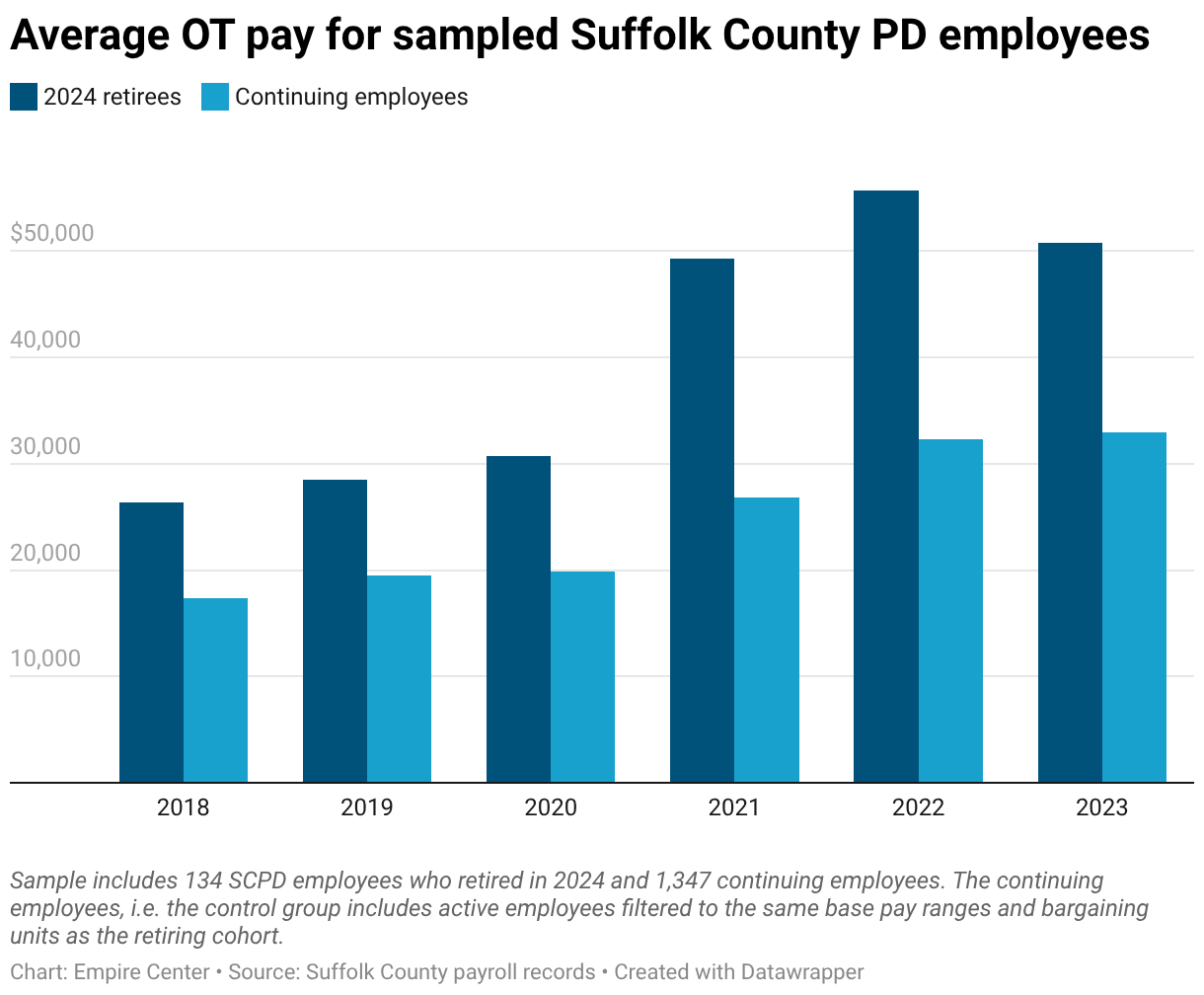
This analysis found that employees retiring in 2024 dramatically increased their overtime – by 78 percent at the state police and 73 percent at the Suffolk P.D. – during their last three years, the window that is the basis for calculating pension payouts.
During that period, the soon-to-be retirees averaged approximately 387 hours of overtime per year at the state police, and 497 hours in the Suffolk P.D. Those figures are the equivalent of 7.4 and 9.6 hours per week, respectively.
To be clear, pension spiking is not illegal or improper. The workers who are following the rules of, and responding to incentives created by, the state pension system. For taxpayers, however, the practice is expensive.
Overtime boosted the sampled officers’ final three years of pay by an average of 28 percent at the state police and 34 percent in the Suffolk P.D. That, in turn, increased their annual pension payouts by the same ratios, approximately adding an extra $20,000 annually for state police retirees in the sample and $39,000 for Suffolk retirees in the sample – amounts they are entitled to receive, with cost-of-living adjustments, for the duration of their retirements.
A quarter of the sampled workers – 17 percent of the state police retirees and 43 percent of the Suffolk retirees – boosted their pensions enough to exceed their final base salaries.
If these averages are extrapolated, they indicate that spiking increases costs for the overall Police and Fire Retirement System by tens of millions of dollars annually for each new class of retirees – and hundreds of millions over the course of their retirement years.
The reforms of 2009 and 2012, known as Tier 5 and Tier 6, did not fully ban spiking, but imposed a cap. For police and fire workers hired since then, overtime can account for no more than 15 percent of the earnings used to calculate pensions.
If that limit had applied to retirees in the analyzed sample from 2024, it would have reduced spiking by about 46 percent for the state police sample and 56 percent for the Suffolk County sample.
Eliminating that cap is one of many pension enhancements that state lawmakers are currently considering as part of negotiations over the state budget. These proposals – which public employee unions have dubbed “Fix Tier 6” – would potentially apply to all pension funds for government workers and include other costly changes such as lowering minimum retirement ages and reducing employee contributions.
Although officials have not yet published a formal fiscal analysis of any of the proposals under discussion, this report makes clear that lifting the cap on pension spiking – one of many proposal on the table – would by itself add substantially to costs for taxpayers.
Background on the state pension system
Pension for employees of New York’s state government, and of county and municipal governments outside New York City, are provided through the New York State and Local Retirement System, or NYSLRS, which is administered by the state Comptroller’s Office.
NYSLRS, in turn, consists of the Police and Fire Retirement System, or PFRS, and the Employee Retirement System, or ERS, which covers employees other than uniformed police officers and firefighters. (Public school teachers and administrators are covered through the separate New York State Teachers’ Retirement System. New York City has five different public pension systems for its employees, including separate police and fire systems.)
While workers typically contribute from 3 percent to 6 percent of their pay to cover their future benefits, the bulk of the tab is paid by their employers – and ultimately taxpayers. Over the past decade, the state and local governments have paid $50.6 billion into the state pension fund, compared to $5.5 billion from employees, according to the fund’s annual report.
A provision of the state Constitution declares that the pension benefits promised to new hires cannot be “diminished or impaired.” This has been interpreted to mean that any cost-cutting measures apply only to people hired after their enactment. Pension improvements, on the other hand, can and do apply retroactively.
Because of this restriction, the various pensions systems have multiple cohorts or “tiers” based on when employees were hired. This report focuses on employees in the PFRS, which has four relevant tiers. Most current retirees are in Tier 2, which covers people hired between July 1973 and June 2009. Tier 3 covers hires from July 2009 to January 2010; Tier 5 from January 2010 to March 2012, and Tier 6 from April 2012 to the present. (There is no Tier 4 in PFRS.)
State law also provides that state and local pension benefits are not subject to state income tax.
In general, pension benefits are calculated based on two factors: years of service (how many years the employee worked) and final average earnings (the average of the employee’s last three years of pay).
This analysis focuses on two agencies within PFRS: the New York State Police and the Suffolk County Police Department.
The two agencies use parallel formulas: Retirees are entitled to pensions equal to 2 percent of their final average earnings for their first 25 years of service, plus 1.67 percent for each additional year, up to a maximum of 70 percent.
For employees hired before January 8, 2010, who are in Tiers 2 and 3, there is no hard limit on how much overtime pay can be included in their final average earnings. The only restriction is that qualified earnings in each of those final years cannot exceed the average of the previous two years by more than 20 percent. Under this rule, soon-to-be retirees who plan ahead can ramp up enough overtime to more than double their base pay in seven years.
For employees hired after January 2010, in Tiers 5 and 6, overtime is capped at 15 percent of their final average earnings.
A 2011 Empire Center report estimated this cap, along with other reforms made as part of Tier 5 and 6, were saving taxpayers more than $1 billion annually.
Methodology of this report
For this analysis, the Empire Center drew on state payroll and pension data which it routinely compiles for its government transparency website, SeeThroughNY.net, along with local payroll data posted by Suffolk County.
The center identified 483 employees who retired in 2024 from the two agencies – the New York State Police (NYSP) and the Suffolk County Police Department (SCPD) – and matched them by name with payroll records from the previous six years, 2018 through 2023. It was able to reliably match 382 retirees, 340 of which drew overtime pay. This left a sample of 206 retirees from NYSP and 134 from SCPD.
The center also identified a control group of non-retiring employees (2,785 from NYSP, 1,347 from SCPD), who were drawn from the same collective bargaining units and salary ranges as the retiree sample.
Detailed findings
For each group, agency and bargaining unit, the analysis then compared how overtime utilization changed between the two three-year periods, 2018-20 and 2022-2024.
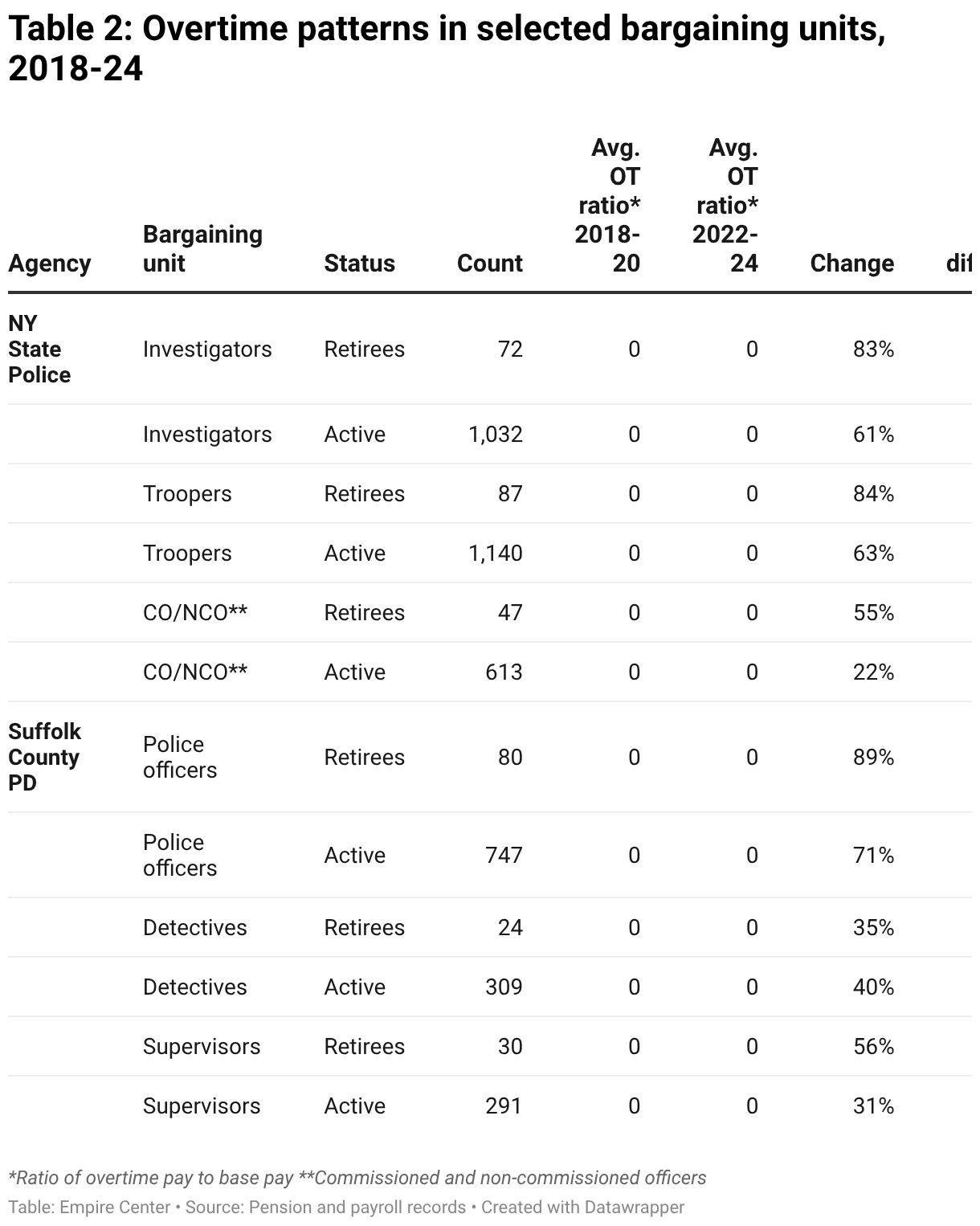
As seen in Table 1, both retirees and non-retirees were paid for higher amounts of overtime, on average, in the second three-year period. However, the increase for NYSP employees on the verge of retiring was 25 percentage points higher than the increase for employees who remained active. For SCPD retirees, the overtime rate was 19 points higher.
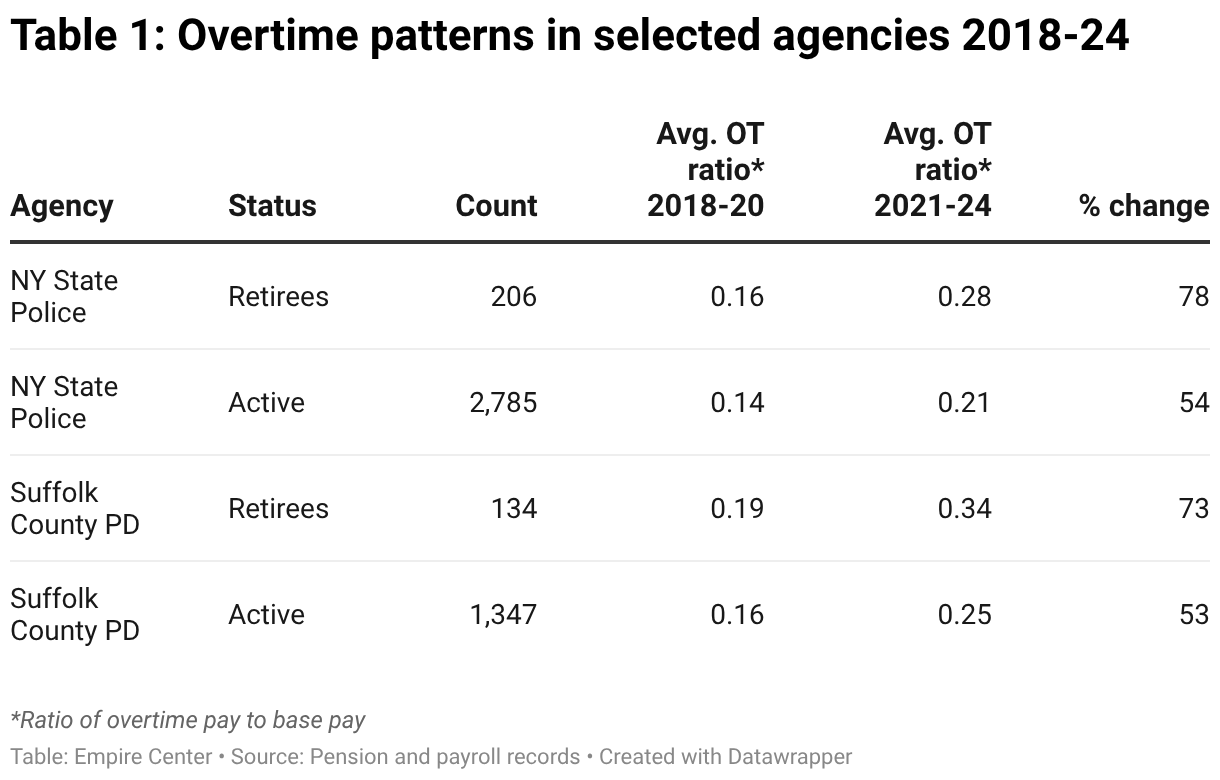
This general pattern held for almost every sub-group analyzed, with one exception: in the Suffolk County detectives’ bargaining unit, the rate of increase for retirees was five points smaller than for active employees (see Table 2).
The added overtime use, by itself, added to pension payouts and costs for taxpayers. If the 340 retirees had used the same amounts of overtime as their non-retiring colleagues, their combined annual pensions would have been $2.6 million smaller – and taxpayers would have save $47 million over the next 20 years.
Conclusion
The state’s pre-2012 government pension rules – which apply to most current retirees – create a powerful incentive for employees to work as much overtime as possible at the end of their careers, especially among law enforcement officers.
This analysis demonstrates that recent retirees responded to that incentive: They “spiked” their overtime by roughly three-quarter in their final three years, adding tens of thousands of dollars to their annual pensions.
Those findings, when extrapolated to the overall Police and Fire Retirement System, indicate that spiking costs tens of millions of dollars for each new cohort of retirees – and hundreds of millions over the duration of their pension-collecting years.
The 2010 and 2012 reform put limits on this practice but stopped well short of a complete ban. Workers hired since still get pension credit for a substantial amount of overtime – as much as 15 percent of their final average salary.
As part of their “Fix Tier 6” agenda, however, public employee unions are proposing to remove that limit and reopen the door to virtually unlimited spiking. By definition, the money spent on that change – as with all pension sweeteners – will flow to people who are no longer performing services for the public.
Before approving such changes, Governor Hochul and the Legislature should be honest about how much more of the taxpayers’ money they will be spending – and how little, if anything, taxpayers will receive in return.