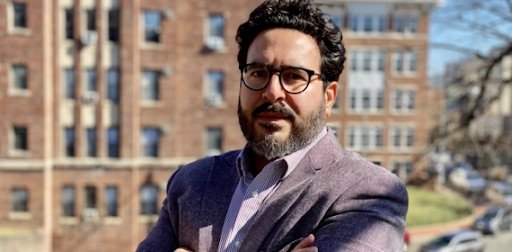
A Georgetown University history professor will serve as a 2026-27 residential fellow at the National Humanities Center (NHC), a nonprofit dedicated to advancing study in the humanities, the organization announced April 2.
Mike Amezcua will be one of 29 fellows relocating to Durham, N.C., in the coming academic year, chosen from more than 450 applicants. As a fellow, Amezcua will work on his book, which explores the financial effects Latino businesses and entrepreneurs have had on U.S. society.
Amezcua said the fellowship allows participants to focus on research of their choice while living in Research Triangle Park, one of the largest research centers in the country.
“It’s a residential fellowship in Research Triangle Park, North Carolina, where scholars from across the country come together for a year to focus entirely on their research and writing,” Amezcua wrote to The Hoya. “Fellows are relieved of teaching and administrative responsibilities, which is rare and genuinely valuable.”
Amezcua said the fellowship is well-recognized within his field, and he was not sure he would be chosen due to its competitive nature.
“The NHC is well known in my field, so it was on my radar for a long time,” Amezcua wrote. “The application involves a project proposal, writing samples and letters of recommendation. It’s competitive, and, honestly, I was thrilled when I got the news. It’s the kind of thing you apply for knowing it’s a long shot.”
Rafael Jovel (GRD ’27), one of Amezcua’s dissertation mentees, said Amezcua’s work and teaching has impacted his own research.
“Professor Amezcua is a great advisor,” Jovel told The Hoya. “I took his class in the fall on the history of racial capitalism, which blends deeply into the research he’s doing.”
Jovel said Amezcua has been hands-on in supporting his research and initiatives at Georgetown.
“Even outside of the class context, he’s been lovely,” Jovel said. “I applied for a grant at the Georgetown Americas Institute and he turned around a recommendation letter for me in a day. He’s very supportive in that way. He’s always having us, as advisees, go after things that we want, and he’s always making sure that we can get it done.”
Amezcua’s book explores the effect Latino businesses and entrepreneurs have had on American capitalism, as opposed to the impact of more well-known corporations, economists and magnates.
Amezcua said his research emphasizes the impact of smaller businesses and entrepreneurs on American capitalism, as well as Latino resistance to entrenched systems of biased finance.
“Most histories of American capitalism center on billionaire tycoons, celebrated economists or the rise and fall of corporations,” Amezcua wrote. “This book does something different. Drawing on archives from coast to coast and across the Americas, it recovers untold histories of Latino resistance to manipulated markets, efforts to democratize finance and the pursuit of economic power — from food stands to banks — by Mexican Americans, Puerto Ricans, Cuban Americans and others. It’s a story about how ordinary people built something extraordinary and why that history matters.”
Gabriel Eljaiek-Rodriguez, a former NHC fellow and now the organization’s scholarly programs research manager, said the NHC uniquely offers residential, humanity-focused fellowships.
“The Center is the only advanced studies center only focused on the humanities in the world,” Eljaiek-Rodriguez told The Hoya. “What we want is to offer a residential fellowship for projects and academics that are interested in working on advanced projects.”
“For the residential scholarships, we want scholars who have already published one or two books and who already have a particular trajectory and a particular place within their institutions,” Eljaiek-Rodriguez added.
Eljaiek-Rodriguez said the selection committee carefully considers the scholars who are chosen for the fellowship, including if the committee believes they will be able to complete their projects.
“We want to emphasize the fact that we select the scholars that we do because we not only believe in what they are proposing, but also because we believe in their trajectory,” Eljaiek-Rodriguez said. “We know that they have been working on a particular topic or a particular set of topics. We know that the scholars we invite are going to be able to finish the project that they have been working on.”
Amezcua said he believes the experience at the center and in the company of other scholars will greatly impact his career.
“When you’re surrounded by people who are deeply invested in humanistic questions, it sharpens your own thinking,” Amezcua wrote. “I expect it to be one of the more formative years of my career.”