


Hispanic Business TVHispanic Business TV
  • Featured
  • Popular Cities
    • Atlanta
    • Boston
    • Chicago
    • Dallas
    • Denver
    • Houston
    • Las Vegas
    • Los Angeles
    • Miami
    • New York
    • Phoenix
    • Salt Lake City
    • San Antonio
  • Business
    • HBTV Toolbox
      • Social Media Management
  • Politics
  • HBTV Sports
    • MLB
    • MMA
    • NCAAF
    • NBA
    • NCAAM
    • NFL
    • NHL
  • Entertainment
  • Living
    • Culture
    • Latino Lifestyle
    • Education
    • Cannabis
Reading: Syringes, Mario and virtual reality: Technology’s evolution in 70 years of nursing
Share
Sign In
Notification Show More
Font ResizerAa
Font ResizerAa
Hispanic Business TVHispanic Business TV
Search
  • Featured
  • Popular Cities
    • Atlanta
    • Boston
    • Chicago
    • Dallas
    • Denver
    • Houston
    • Las Vegas
    • Los Angeles
    • Miami
    • New York
    • Phoenix
    • Salt Lake City
    • San Antonio
  • Business
    • HBTV Toolbox
  • Politics
  • HBTV Sports
    • MLB
    • MMA
    • NCAAF
    • NBA
    • NCAAM
    • NFL
    • NHL
  • Entertainment
  • Living
    • Culture
    • Latino Lifestyle
    • Education
    • Cannabis
Have an existing account? Sign In
Follow US
© 2024 hispanicbusinesstv All Rights Reserved.
Hispanic Business TV > Business > Tech > Syringes, Mario and virtual reality: Technology’s evolution in 70 years of nursing
Tech

Syringes, Mario and virtual reality: Technology’s evolution in 70 years of nursing

HBTV
Last updated: April 17, 2026 7:26 am
HBTV
Share
9 Min Read
SHARE


Contents
Computers shake things upBecoming experts in online educationFaculty snapshot: Pat Taylor’s ‘TV class’

Half a century ago, Boise State nursing faculty gathered around two shared computers during lunch breaks, tentatively learning to use a mouse. Today, they’re pioneering artificial intelligence and virtual reality in the classroom. 

From glass syringes to electronic medical records, “faculty had to keep current with technology,” said Pam Springer, faculty from 1989–2013 with a front row seat to the program’s mid-years of evolution. The tools of nursing education have transformed dramatically, but the program’s 70-year old commitment to relationships and accessible learning has never wavered.

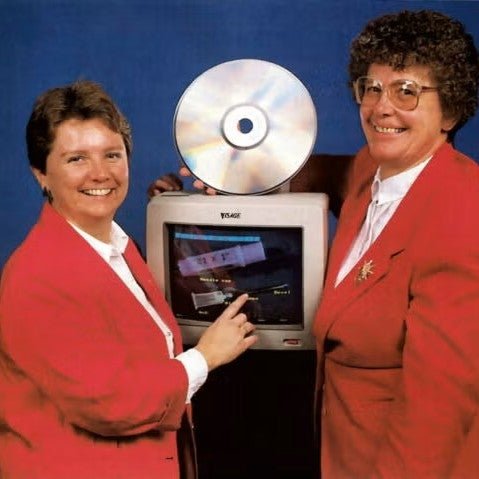
Former nursing faculty Nancy Otterness and Carol Fountain were featured in a 1990 issue of Boise State’s ‘Focus’ magazine for their innovative interactive video used to teach nursing students.

Computers shake things up

These days, computers and online classes don’t seem revolutionary. But when they first arrived, they were the biggest change faculty had experienced.

The school kept its first computers — all two of them — in the faculty lunch area. Instructors played  “Mario is Missing!” and “Snooper Troops” over their lunch breaks as a way to learn how to use a mouse and computer for the first time. 

“So to go from that to online teaching was pretty dramatic,” Springer said.

Black and white historical image of a nursing student using touch screen computer to learn. He reaches out toward the screen, which shows a patient in a hospital bed.
Nursing students used touch screen education technology in 1991. Courtesy of Albertsons Library archives.

Carol Fountain, a ‘64 alum and faculty from 1977–99, also remembers the faculty’s mixed feelings about it.

“We would start playing it during lunch hour and people went, ‘Computers? No, I’m not going to do anything like that,’” Fountain said. 

Except it didn’t take long for them to come around, she remembers. Pretty soon, those same instructors were saying, “Hey, I finished lunch. Can I play?”

Amy Spurlock, the current JoAnna “Jody” DeMeyer Endowed chair in nursing, also fondly remembers the arrival of internet access in 1997.

Pam Springer looks at a computer on a desk with her hand on a mouse. Speakers, a printer and phone are also on the desk.
Pam Springer, faculty from 1989–2013, held multiple leadership roles in the School of Nursing and College of Health Sciences before retiring. Pictured here in 2010, Springer experienced the middle years of the school’s technological advancements as faculty became proficient online educators.

“We had computers in our office, but we got modems so we could ‘surf the net,’” she said. “Pam Gehrke and I, we heard about this thing called Ask Jeeves. You could just type a question and then ask it, and you would get an answer. I have a clear memory of Pam and I in my office asking Jeeves things, and we just thought it was the coolest thing!”

Becoming experts in online education

Like most big changes, adapting to digital advancements was not easy. 

Ingrid Brudenell, faculty between 1981–2010, remembers the challenge of moving to an online learning management system. It felt sudden, she said, to transition away from using overhead projectors. “You had to get everything online, so you could share it,” Brudenell said. “Technology changed everything.”

Black and white historical photo of Pam Gehrke sitting in her office in front of her desk, which hold papers and a computer.
Pam Gehrke, pictured here in 1990, designed and taught the first online course in the College of Health Sciences. She retired in 2022.

Transitioning to online teaching was a next level challenge. But nursing faculty were early adopters, learning not just how to do it but how to do it well.

Pam Gehrke designed and taught the College of Health Sciences’ very first online class in 1998, and now, Boise State faculty are experts in online education. This is perhaps best seen through the Online RN-BS Completion program. 

Innovative for its time, the program launched in 2008 amid skepticism that it would be successful. But faculty are committed to delivering the highest quality online instruction and student support. Their dedication and proficiency shows: more than 3,200 nurses nationwide have earned their bachelor’s degrees through the program since it began.

Black and white historical image of Pat Taylor at the front of a lecture hall with a larger image of her projected on a screen on the wall behind her.
Pat Taylor in 1994 teaching a recorded class via Instructional Television For Students. Courtesy of Albertsons Library archives.

Faculty snapshot: Pat Taylor’s ‘TV class’

Pat Taylor, who taught from 1975-2007, considered her biggest success the “TV class,” she said.

Boise State started broadcasting KAID-TV, a PBS affiliate, on campus in 1973, and in 1986, Instructional Television For Students, or ITFS, began. Student handbooks from the era describe ITFS as “a low power microwave television broadcasting service that delivers live interactive instruction to off-campus sites in Boise, Nampa and Mountain Home. The ITFS facilities also videotape courses for use in remote locations.”

A black-and-white historical image of Pat Taylor standing at a table at the front of a lecture hall. She wears a lapel microphone and papers are stacked on a table beside her. Behind her, a large projected screen displays a close-up image of her face with handwritten text visible at the top of the screen.
Pat Taylor teaching in 1994. Courtesy of Albertsons Library archives.

Taylor taught her pathophysiology course in a recorded IFTS session for multiple decades, she estimates. Not only could people watch Taylor’s class live, but video tapes were mailed to neighboring areas so learners could watch them on their own schedule. It was the early days of asynchronous classes and remote learning!

“The hardest thing for me was always the people I knew at the hospital,” Taylor said. “They were watching me and I couldn’t see them. Oh, they were having a good time, too.”

“But it was so convenient for them,” she said, shrugging off any embarrassment she might have felt: learners’ access to education was more important.

As technology advanced, so did the tools that nurses used.

For Barbara Eno, who taught from 1957–1984, the most innovative tool during her nursing years was the plastic syringe. Instead of the sterile single-use tools used today, nurses used glass syringes that needed to be sterilized between uses.

Two students in blue scrubs stand by a patient's bedside and enter data into a laptop computer.
Nursing students started learning how to use EPIC, industry-standard software for electronic patient records, in 2023. Learning the software in school makes the onboarding process easier after they graduate and begin careers as new nurses.

Joann Springer recalls using glass syringes at St. Luke’s when “I had to bundle them up and send them down to the autoclave,” she said.

For other nurse faculty working before the 1980s, they remember only having to wear gloves during sterile procedures. “Before HIV, we never wore gloves to draw blood,” said Springer.

Charting online using electronic medical records and scanning in medications was also a technological challenge of the not-to-distant past.

Kelley Connor and Sarah Llewellyn sit in blue chairs and talk. Sarah holds a blue folder with the Boise State B on it.
Sarah Llewellyn and Kelley Connor have published research with other nursing faculty about using artificial intelligence in nursing education.

Current faculty — like Sarah Llewellyn and Kelley Connor — remember using paper charts, handwriting notes and faxing prescription orders to the pharmacy during their early parts of their careers in the late ’90s and early 2000s.

“A lot of people did quit at that time when things started becoming digital,” said Connor, faculty since 2006. “They’re like, ‘I’m not doing it.’”

But Boise State’s faculty have largely been ahead of the curve. As technology advances, faculty have embraced the possibility of artificial intelligence and virtual reality as educational tools.

A woman sits at a table wearing a virtual reality headset over her eyes and holds two remotes. A travel coffee mug is on the table next to her.
The School of Nursing acquired two VR headsets through a grant in 2025. The immersive education allows students to interacts with a virtual human, then switch places and rewatch their conversation. This enhances self-reflection and helps them learn skills like communication or de-escalation.

And while the Simulation Center uses high-fidelity manikins and audio-visual equipment for modern experiences, the scenarios remain rooted in real people’s stories. 

“Over the past 70 years, Boise State nursing has experienced tremendous change, and yet, many things have remained constant,” said Connor, divisional dean of the School of Nursing. “One thing that has never changed is the value we place on relationships. Whether it’s student-to-student, student-to-faculty, or nurse-to-patient, it’s the relationships we have that make a difference. These relationships have shaped our history and continue to guide our future.”




Source link

Sign Up For Daily Newsletter

Be keep up! Get the latest breaking news delivered straight to your inbox.

By signing up, you agree to our Terms of Use and acknowledge the data practices in our Privacy Policy. You may unsubscribe at any time.
Share This Article
Facebook Copy Link Print
Share
Previous Article States rush to redraw U.S. House districts ahead of the November midterm elections
Next Article Palmeiras sufre para vencer 2-1 a Sporting Cristal en Libertadores – The Morning Call
Leave a Comment Leave a Comment

Leave a Reply Cancel reply

Your email address will not be published. Required fields are marked *

Stay Connected

FacebookLike
XFollow
InstagramFollow
- Advertisement -
Ad imageAd image

Latest News

Greenberg Traurig Expands Global Hospitality Practice with Strategic Hires in Phoenix and Mexico
Phoenix
May 7, 2026
DOJ accuses UCLA medical school of race-based admissions discrimination
Education
May 7, 2026
Celebrate the 388th Anniversary of Hartford Public High School! Blue & White Night – May 14
Latino Lifestyle
May 7, 2026
Elon Musk eyes College Station-area site for $55B ‘Terafab’ chip plant
Houston
May 7, 2026

Advertise

  • Advertise With Us
  • Terms and Conditions
  • Privacy Policy
  • About Us
  • Contact

HispanicBusinessTV is your go-to source for the latest in Latino lifestyle, culture, and business news. Stay informed and inspired with our comprehensive coverage and in-depth stories.

Quick links

  • Advertise With Us
  • Terms and Conditions
  • Privacy Policy
  • About Us
  • Contact

Top Categories

  • Business
  • HBTV Sports
  • Entertainment
  • Culture

Sign Up for Our Newsletter

Subscribe to our newsletter to get our newest articles instantly!

© 2025 HispanicBusinessTV.com All Rights Reserved. A WooWho Network Digital Property.
Join Us!
Subscribe to our newsletter and never miss our latest news, podcasts etc..

Zero spam, Unsubscribe at any time.
Welcome Back!

Sign in to your account

Username or Email Address
Password

Lost your password?