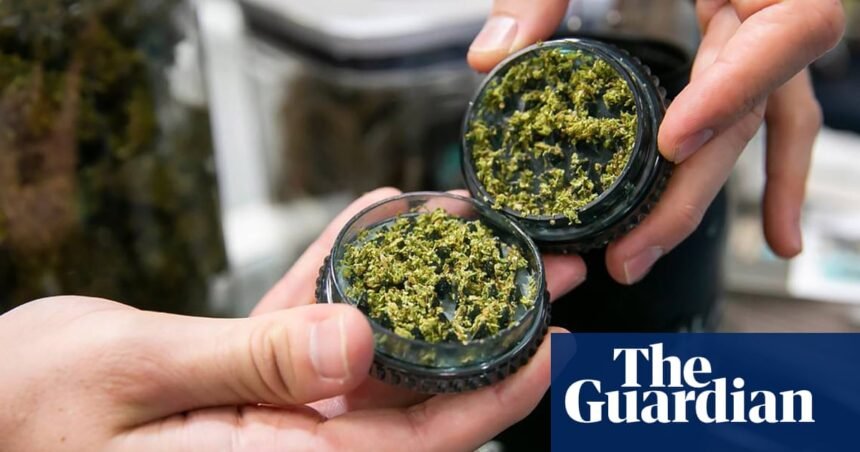
The Benzinga Cannabis Capital Conference, which took place in downtown Chicago last week, revealed an industry tensely awaiting legal legitimacy.
At first glance, it looked like any other business conference. Men, many in formal business suits, outnumbered women. The exhibition hall was completely devoid of skunk-y smells and a free T-shirt or tote bag was easier to come by than a joint.
Many attendees were accustomed to corporate culture before getting into cannabis, with backgrounds in the alcohol industry, the medical industry or law. Many CEOs of cannabis companies told the Guardian they’d never actually tried cannabis before working with it.
Between discussions about taxes and lobbying, panelists occasionally acknowledged the hundreds of thousands of people who have been incarcerated for taking part in the illegal cannabis industry, people who would never get to participate in a conference like this one.
Most conversations revolved around the difficulties of sustaining a business in a legal gray area.
“Our stock is a risky stock by definition of investment purposes, because our industry is new,” said Robert Beasley, CEO of Cansortium, Inc., a publicly traded cannabis company that operates in Florida, Pennsylvania and Texas.
Beasley said that “legislative events and political developments” affect Cansortium’s stock value “more than anything we do as a company”.
The uncertain timeline for various legal reforms makes it difficult for businesses to prepare for what’s next.
One of the biggest topics of discussion during the conference was rescheduling, which would shift cannabis’s legal status from a dangerous, forbidden narcotic to a medicine eligible for FDA approval. While this change wouldn’t do much for the legal status of recreational dispensaries or the products they sell, it could still dramatically affect their bottom line by allowing them to deduct business expenses.
Tax code 280E specifically forbids companies from deducting expenses for trafficking in illegal schedule I substances, including cannabis. This rule will no longer apply to cannabis if it’s rescheduled.
When the DEA announced in August that it wouldn’t hold a hearing on rescheduling until after the election, cannabis advocates worried that a second term for Trump would kill this initiative.
During a session titled Crafting the Next Chapter: Congressional Roles in Advancing Cannabis Reform, David Mangone, vice-president of lobbying firm The Liaison Group, suggested the industry could rest easy about the election since Trump had publicly supported Florida’s ballot measure to legalize cannabis.
In another session titled Consolidation Trends in the Wake of Cannabis Rescheduling: Identifying Winners and Losers, panelists debated whether the IRS might go after businesses deducting expenses as though rescheduling had already happened.
AJ Jamil, who works with the financial services company Liveflow, said that it’s “sad that it’s so so necessary in this industry to look for those kind of loopholes, because otherwise you just can’t do business”, adding that cannabis companies try to avoid punishing taxes by keeping their “plant-touching” entities separate from other parts of the business that don’t interact with an illegal substance.
“But the problem is that the IRS knows about this loophole and they have come after people for this,” Jamil said.
Exhibitors also included businesses like gummy manufacturers and ATM suppliers.
Cannabis’s tricky legal status also means that, even for completely legal components of the industry, decisions can hinge on unusual factors.
Bryan Gerber – CEO of Hara Supply, which supplies pre-roll packaging and other smoking devices – says sometimes he’ll turn away prospective clients because they insist on paying him in cash.
“They get angry, actually, like, why won’t you take my cash? Because they’ve got so much cash sitting there, and they need to figure out what to do with it,” he said.
Many cannabis businesses have an excess of cash because their illegal status makes it difficult for them to access banking services.
Varying state policies also can create headaches for the industry.
Dang Nguyen, a designer for The Packaging Company, which makes cannabis containers, says sometimes he’ll have to design many versions of the same package to comply with different state regulations. Some require a warning label on 30% of the design, others forbid colorful packaging.
Regulation has even created new sectors of the industry. Brandy Young founded Certainty Labs after New York legalized recreational cannabis. Her lab provides legally required third-party testing for cannabis products, to ensure they are accurately labeled for potency and don’t include an excess of contaminants like pesticides or heavy metals.
But, she says, labs get criticism from the industry and consumers alike.
“Our regulators kind of position us in the marketplace to be like the police of the industry, and we’re not,” she said.
On the other hand, testing labs can also get a bad rap from consumers, especially since an LA Times exposé this summer revealed that cannabis products contained pesticides and heavy metals that didn’t show up in lab reports.
“We see a lot of unscrupulous behavior in lab testing, unfortunately, despite the fact that we’re supposed to be a source of truth,” Young said.
While cannabis businesses that are on the edge of survival hope that legalization efforts will bring them security, Gerber says, legal legitimacy might come with new challenges.
“I’m assuming if the federal government wanted to make it legal, they’re only going to do that if they’re making money, right?” he said, inferring that it means even more taxes.