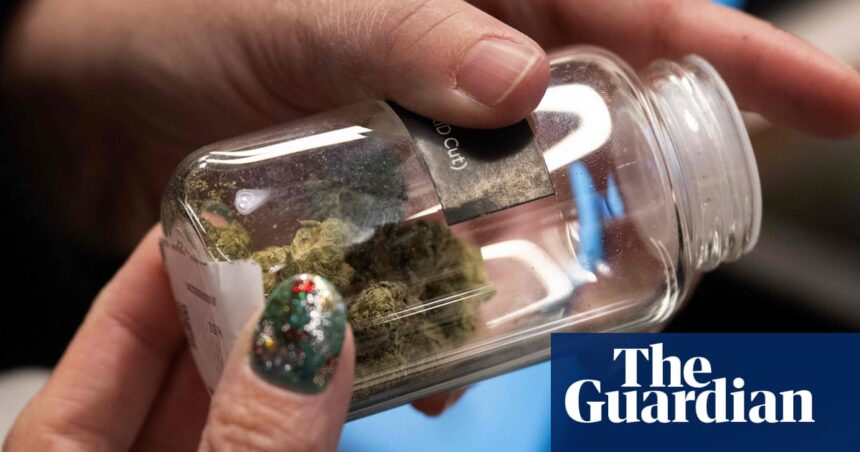
Recent rules proposed by the Drug Enforcement Administration aim to reclassify cannabis as a schedule III drug, raising an important question for the nearly 15,000 dispensaries in the US: what does this mean?
Cannabis, particularly cannabis containing delta-9 THC, occupies a bizarre legal gray area. It’s illegal on the federal level, but legal for either medical or recreational use in 39 states. The DEA classifies it as a schedule I substance, meaning it’s on par with potentially deadly drugs like heroin, yet nearly 4 million Americans use it with a doctor’s approval. Recreational dispensaries can’t easily access federally regulated institutions, like banks, and yet they pay federal taxes.
That all might change soon.
The DEA proposed rules last month to reclassify cannabis from a schedule I to a schedule III substance. Once it’s rescheduled, cannabis will be on the same level as drugs like ketamine and Tylenol with codeine – which are legal but restricted. It’s the first concrete signal that the DEA is shifting its attitude towards cannabis and its users, who for decades have been a target of the “war on drugs”. Rescheduling cannabis could give it legitimacy as a medicine – but dispensary owners and others in the industry have mixed feelings.
“It’s arguably the most significant step forward in the legal cannabis industry’s journey towards federal legalization,” says Morgan Paxhia, who co-founded Poseidon, a hedge fund that focuses on cannabis investments.
Paxhia says the cannabis industry isn’t for the faint of heart, with extra costs and legal hurdles in every direction. It’s hard to get insurance for a dispensary, for example, because it’s a burgeoning industry in a legal gray zone. Dispensaries can’t access financial services like most bank loans or allow customers to use credit cards. The effective tax rate for dispensaries is high because they can’t take typical deductions.
“We expect some of those frictions will improve with the potential rescheduling,” says Paxhia.
But rescheduling won’t erase the cognitive dissonance between federal and state law. States where cannabis is legal for adult recreational use treat it more like alcohol. You just need to be over 21 and show an ID to buy it. Schedule III substances typically require a doctor’s prescription.
In fact, “rescheduling doesn’t do a lot,” according to Aaron Smith, executive director of the National Cannabis Industry Association.
The one concrete advantage for dispensaries would be a reduced tax burden. He says that Section 280E of the tax code dictates: “If you’re trafficking any schedule I or schedule II drug, then you cannot take business deductions.” If cannabis becomes a schedule III substance, “then that problem basically goes away for the industry”.
Some experts the Guardian spoke to, like Paxhia, were hopeful that rescheduling would ease barriers to other financial services. Others were skeptical.
Katharine Neill Harris, a drug policy fellow at Rice University, doubts rescheduling will lead more banks to open themselves to dispensaries. While a small number of credit unions already lend to dispensaries, the bigger banks aren’t likely to risk it.
“Bank of America, like Wells Fargo, I mean, they’re just not going to enthusiastically embrace this kind of gray area of law. That’s just not how they operate,” she says.
These financial barriers contribute to the industry’s much-criticized lack of diversity, says Harris, because it’s hard to get a foot in the door if “you don’t have enough money to fund a business on your own. You can raise money, but then that requires a network of other people who are wealthy. And so the industry itself has just sort of skewed more towards white owners and white men in particular.”
While rescheduling will reduce the tax burden for existing dispensaries, Harris says, it’s unlikely to level the playing field for those looking to get into the industry.
Paxhia notes the lack of access to financial services can be dangerous, as dispensary workers “are just sitting ducks, because there’s no credit card transactions” and they often have large sums of cash on location.
“People get shot and killed. It’s horrible,” he said.
While rescheduling alone might not fix this problem, the Safer Banking Act, which was introduced in Congress in 2023, would guarantee that financial institutions could serve cannabis dispensaries without legal repercussions.
It’s also possible that treating cannabis as a regulated medical drug could mean additional hurdles that state-legal dispensaries don’t currently face.
“I know that with most schedule III drugs, you usually would have to go through a pharmacy. A lot of our associates were like, ‘Hey, do we have to become pharmacists now?’ So that’s a concern,” says Dominique White, director of people and operations at Ivy Hall, an Illinois-based dispensary.
But, Smith says, “that’s a very unlikely situation.” He adds that the Biden administration “is under pressure to do something positive on cannabis”, and “if this somehow backfired, and now all of a sudden the FDA is going to require these businesses to obtain their approval to sell cannabis, well, that would be a huge political embarrassment. That said, it’s not impossible.”
Smith is advocating for a memorandum that would ensure the federal government doesn’t intervene with state-legal cannabis operations after rescheduling, similar to the Cole Memorandum issued in 2013.
Rescheduling cannabis might not fix all or most of the cannabis industry’s legal problems, but many with a stake in the industry hope that this is the first step towards descheduling, which would put cannabis legally on par with alcohol.
“We’ve got the majority of Americans who live in a state that has made cannabis legal for adults and so they’re treating it comparably to alcohol. Moving into schedule III does not align federal law with those laws, but it moves us in that direction,” said Smith.
White, who believes that cannabis is “truly medicine”, thinks it’s illogical that there are so many more hurdles for buying and selling cannabis than there are for alcohol, which she says is “so much more damaging to the body”.