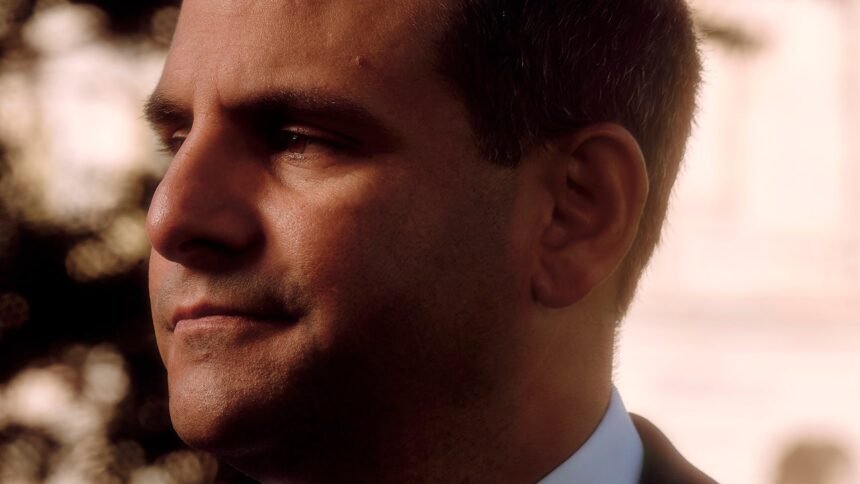
Carlos Trujillo’s career has not centered on mobilizing Latino voters, but that’s the task Donald Trump’s campaign has given him. Trujillo, a Cuban American senior adviser for the campaign on Latino issues, and one of Trump’s principal Latino surrogates, is working to consolidate, or even expand, the gains that Republicans have made with Latinos in recent years. Before President Joe Biden left the race, in July, his Latino support was sliding. A Times/Siena poll earlier this year even suggested that he could lose the Latino vote. Latinos are more excited about Kamala Harris, but she is still a little behind in the polls compared with where Biden was in 2020—and that was already lower than Latino support for Hillary Clinton in 2016, which was lower than it had been for Barack Obama in 2012.
The New Yorker Festival Presents “On the Trail”
Campaign reporters share stories from the front lines of a history-making Presidential race. Get tickets »
Meanwhile, Trump is running slightly ahead of where he was in 2020, despite the fact that, in recent months, the Harris campaign spent more than twenty times as much on Hispanic media and Trump’s ground game has paled in comparison. Trujillo and others close to the former President say that trusted community members rather than unknown campaign volunteers are helping them get out Trump’s message. They added that he has an edge on the policy issues that matter to Latinos (the economy, immigration, and safety), and that Latinos tend to be late-breaking anyway. Basically, they think Harris has been wasting her time and money.
Many of the Latinos the Trump campaign is focussing on—the ones whose support he needs—come, like Trujillo’s family, from working-class backgrounds, are religiously devout, and are first- and second-generation Latinos fearful of authoritarian governments like the ones they or their parents left behind. When I asked Trujillo, whom I met at the Republican National Convention last summer, about the irony that people who had fled dictatorships seemed ready to lend their support to a man who, by all indications, is a would-be dictator, he responded, “A dictator doesn’t leave office. A dictator persecutes their political opponents, their opponent’s supporters, and weaponizes institutions. Trump never did that. Democrats have.”
Trujillo’s family came to the U.S. in the mid-nineteen-sixties, a few years after Fidel Castro came to power. His maternal grandmother told him that she and his grandfather had to agree not to return to Cuba. He said, “They walked to the airport with the clothes they were wearing and that’s it. Not their wedding ring. Not a family portrait. Not a Bible. Everything was confiscated by the Communist Party.” Both sides of Trujillo’s family went from Cuba to Spain, but after a few months they arrived in the United States, where they became citizens. His mother’s family went to New York City, where they opened furniture and jewelry stores. His father’s side settled across the river in Union City, New Jersey, where they opened similar businesses. Trujillo’s parents met in New York. He was born there in 1983, and his family, including all four of his grandparents, moved to Florida just before his fifth birthday.
In Miami, Trujillo’s mother and father ran a small furniture store. As Trujillo remembers it, they worked all the time, including at night and on weekends, and they divorced within a few years. “They were just hardworking, middle-class Americans, and they were pretty apolitical,” he told me. “I think they were conservative in their fiscal and social views, but there was no news in their house, and they didn’t really talk about politics. They voted, although they never said for whom, and then moved on.” This was not the case for his maternal grandparents, who became steeped in the politics of the Cuban-exile community. Trujillo spent a lot of time at their home and recalled that they “would blast Radio Mambí,” a longtime staple for conservative Cuban listeners in Miami. “We woke up, we prayed, we put on Radio Mambí. That was the daily routine.” His grandparents barely spoke English, but they became “very proud Americans” and had an outsized influence on his political views, Trujillo said. The exile community “meant everything to me,” he added, and early on he decided to pursue a career in public service.
The Miami that Trujillo grew up in was a very particular place. He attended Belen Jesuit Preparatory School, an all-boys high school that had been founded in Havana, in 1854, by Isabel II of Spain. Castro was an alum, and he shut the school down shortly after he claimed power. In 1961, he confiscated the school’s property and expelled from Cuba its Jesuit faculty, who immediately reopened the school in Miami. Years later, when Trujillo was a student, some of his teachers had been Castro’s classmates. There were about a hundred and twenty students in his graduating class, he told me. He estimates that ninety-eight or ninety-nine per cent were Hispanic, and of those only a few were non-Cuban. He never saw himself as a minority, he said, largely because almost everyone around him was of Cuban descent.
Trujillo left Miami to attend a Jesuit college in Mobile, Alabama, before going on to study law at Florida State University. Upon graduation, he accepted a job as a prosecutor in the state attorney’s office, which he called “the best job I ever had.” He was working long hours and, he said, “doing a lot of good that directly impacted peoples’ lives.” But he saw that prosecutors largely implement and respond to the law, rather than shape it; so, in 2010, he decided to run for a seat in the state legislature representing a heavily Latino district in Miami. At the age of twenty-seven, Trujillo won with almost a hundred per cent of the vote. Marco Rubio was elected to the U.S. Senate that same year, and the two men, who came from the same community, got to know each other. Jeb Bush, by that point, had left Florida’s governorship and was working in finance, but he was still the biggest name in the state’s Republican Party, and he endorsed Trujillo in his successful 2012 reëlection campaign. In that year’s Presidential race, Trujillo was an early supporter of Herman Cain. Mitt Romney, he explained, “was just very conventional. It was just, ‘This is what Republicans should do—we’re for big business, we’re for Big Insurance, we’re for big corporations.’ And, you know, that just didn’t resonate with me.”
When the 2016 Presidential campaign kicked off, Trujillo was prepared to support Bush or Rubio. Trump, he said, “was a non-factor.” But things changed quickly as Trump, after a second-place finish in Iowa, steamrolled through the nomination contests in New Hampshire, South Carolina, Nevada, and, a few weeks later, Florida. (Trump won forty-six per cent of the vote there; Rubio came in second, with twenty-seven per cent; and Bush came in fifth, with two per cent.) Much of what Trump said resonated with Trujillo, including the candidate’s restrictive position on immigration. Trujillo had sponsored a bill to make it a felony for immigrants who had been deported to reënter the state of Florida, and he supported a bill sponsored by another Republican state legislator which would have allowed the governor to use the military to keep certain immigrants out of the state. (Neither bill became law, and Trujillo later distanced himself from a revised version of the bill that was more expansive than he intended it to be.) After stumping for Bush in New Hampshire in January of 2016, he reversed course and endorsed Trump following the South Carolina primary in late February, becoming the first Florida state legislator to do so. Trujillo told me that he and Bush haven’t spoken since 2016.
Trujillo explained his endorsement by telling reporters that he believed Trump’s message was “resonating with the majority of the American electorate.” He had also concluded that the Republican Party was at a crossroads and “could make one of two choices. We continue down this high-society, country-club, big-business path, or we reinvent ourselves as a party of the masses, the party of the American people. The first one who really struck that nerve was Trump. He started coming out on workers being left behind, on showing how globalization was good for some but very, very bad for many others.” But, despite Trujillo’s admiration for Trump, endorsing him was not an obvious decision. “The conventional wisdom,” Trujillo told me, “was that you can’t support Trump because it will end your career.” The upside was that Trujillo was given many more opportunities than he would have had in any other campaign. He raised money for Trump, voted for him as a Florida delegate at the Republican National Convention, and was appointed to Trump’s Hispanic Advisory Council. At an event he moderated, he presented Trump with a guayabera, the traditional shirt worn throughout Latin America, and said he hoped that Trump would wear it in Miami. Trujillo is still amazed by the access he had to Trump from a young age. “I didn’t have the money or the family or the power to be in that scenario,” he told me, “but I was kind of representative of the class he was going after.”