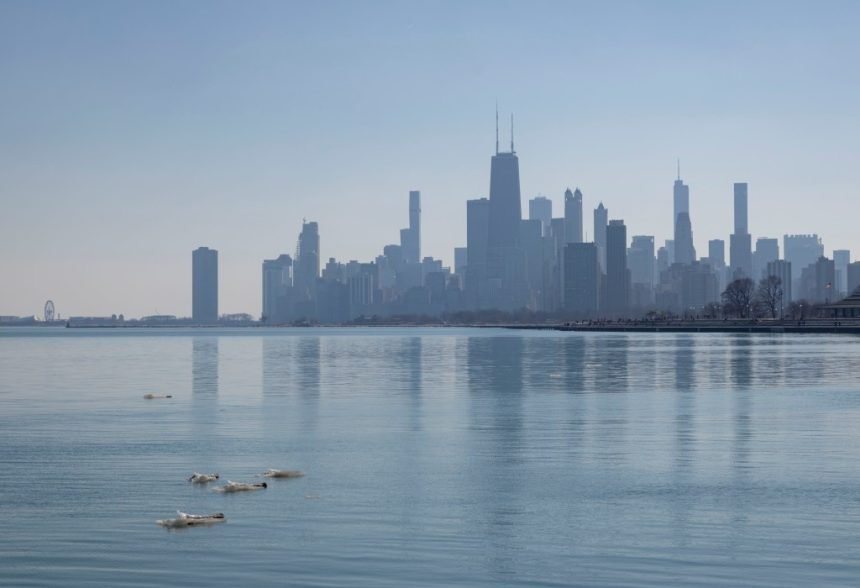
Alan Lev spent almost four decades building apartments exclusively in Chicago, until new requirements for affordable housing, unpredictable taxes and stagnant population drove him south.
For the past five years, the Belgravia Group chairman has invested mostly in Arizona, a state that’s seen inflows from places like Illinois and California. His company has already completed the construction of one condo building in Phoenix, with another complex already under way.
Lev isn’t the only developer who opted to go elsewhere. Construction of new homes has virtually dried up, with new apartments over the past 12 months amounting to just 0.8% of existing inventory. As a result, the average rent in Chicago jumped to $1,956 a month at the end of 2025. Costs surged 9.5% over the past three years, the biggest increase of any major city in the country, according to real estate data provider CoStar.
“We’re short on housing in Chicago, and we don’t need 30-unit apartment buildings as much as we need 300-unit apartment buildings,” Lev said in an interview. “There’s just not enough being built.”
The surge in costs reflects a major shift for Chicago, known as one of the last bastions of big-city affordability. Windy City rents surged on average 3.4% last year, with San Francisco being the only major US city to post a bigger increase — exactly 5.9%, according to CoStar.
And while the growth of the artificial intelligence industry and its high-paying roles is adding to an already hot market in San Francisco, the job market in Chicago is stagnant. Non-farm payrolls in the Chicago metro area increased just 0.3% in January from a year earlier, according to the US Bureau of Labor Statistics.
Local Regulations
Illinois Governor JB Pritzker, a Democrat who is running for a third term in November and is widely seen as a 2028 presidential candidate, is acutely aware of the problem. Mayor Brandon Johnson has also introduced an initiative to speed up permitting for construction.
“In many places, local regulations have made it too difficult and costly to build new housing,” Pritzker said at his budget address in February. “It all adds up to bureaucratic red tape that unnecessarily increases costs, delays construction, and frequently kills projects altogether.”
The number of apartment units that received a construction permit from the City of Chicago dropped by almost half since 2022. And the pipeline for 2026 is tight: one project with more than 300 units was delivered in January, with just one more of this scale expected before the end of the year, according to CoStar.
“There’s almost nothing starting,” said Mike Potter, an executive vice president of Chicago-based Riverside Investment & Development, which is working on a 199-unit apartment building near Union Station.“Same thing goes for the following year. So 2026 and 2027 are going to be very supply constrained.”
It used to take more than 100 days to obtain a construction permit prior to 2024, and while that’s come down, the process is still lengthy. Builders also say that the city’s affordable homes ordinance passed in 2021 under former Mayor Lori Lightftoot is simply too burdensome.
Property Taxes
To make matters worse, property taxes can be unpredictable. In the past 30 years, property owners in Cook County, which is home to Chicago and 134 other suburban municipalities, saw their bills increase by 182%. That’s double the rate of inflation, according to a study released by Cook County Treasurer Maria Pappas last month.
Capital has also dried up, especially for large projects that generate hundreds of new units. Between 2023 and 2025, only three multifamily loans were issued for more than $100 million for the entire metro area.
Insurance companies, traditional lenders to the industry, made no loans for Chicago apartment projects last year. Private capital, which includes specialty finance companies, mortgage REITs and other non-bank platforms, made no loans in the city in the past two years, according to data from real estate brokerage Newmark Group Inc.
“People outside of Chicago, investors, lenders, they’re the ones that are shying away,” said Lev, who is also a former president of the Home Builders Association of Greater Chicago. “It’s making capital harder to come by for projects in Chicago, and that’s constraining the supply. And by constraining the supply, we’re pushing the rents up.”
Pritzker has tried to tackle the problem, having recently introduced a plan that would change zoning laws to allow construction of multi-unit buildings in some residential lots instead of just single-family homes. It would also dedicate $250 million in investment to support construction of more starter homes and rental units across the state, among other measures.
Red Tape
Johnson, a progressive Democrat, has introduced the so-called “Cut The Red Tape” initiative, which has brought the first step of development approvals down to 79 days from 135 days previously.
To be sure, Chicagoans won’t be paying New York City prices anytime soon even if rents continue to rise. In March, the average rent in the Windy City was $2,009 a month, according to CoStar. While that’s close to the $2,177 a month cost in Los Angeles, it’s still much lower than New York’s monthly cost of $4,075 and San Francisco’s $3,262.
Some projects are still getting built with creative financing structures, public incentives or both. Related Midwest’s 400 Lake Shore, one of the few large-scale residential properties currently being built in the city, was funded through $500 million in tax-exempt bonds from the Illinois Housing Development Authority. The project will contain 20% affordable units and include a public park.
Older Buildings
Some older commercial buildings have also found incentives from the city for residential conversions. Riverside is one of five developers seeking to build housing within a cluster of old office buildings on LaSalle Street, once known the Wall Street of Chicago. It plans to turn a portion of 135 South LaSalle Street, Bank of America’s former Midwest headquarters, into 430 residences with a rooftop pool and fitness center.
Still, about 40% of Chicago is zoned for single family or two-flats, requiring developers to go through a 12 to 18 month process to gain permission to build anything larger, said Adrian Brizuela, the associate director of market analytics for CoStar. High interest rates are also forcing people to rent for longer.
“If you see rents that are going down, they’re in markets like Nashville and Austin where they built a ton of product,” said Curt Bailey, president of Related Midwest. “That’s really the only way to keep rents down.”